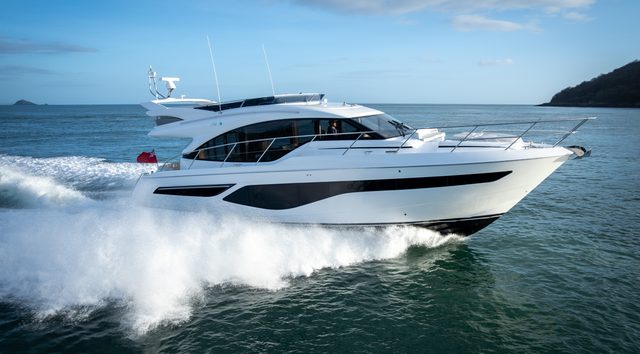
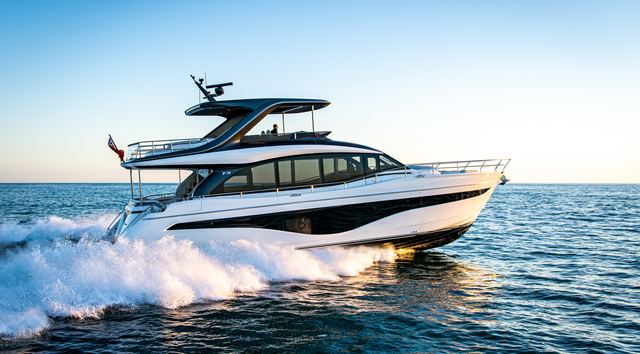
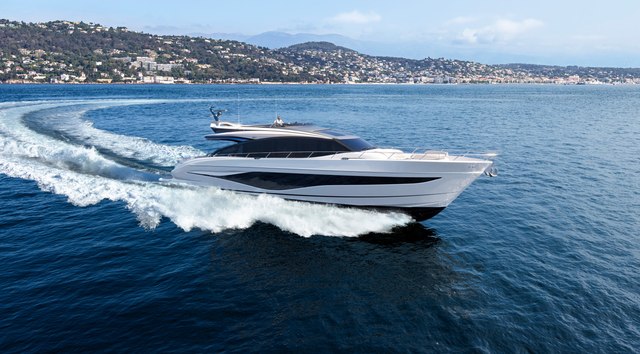
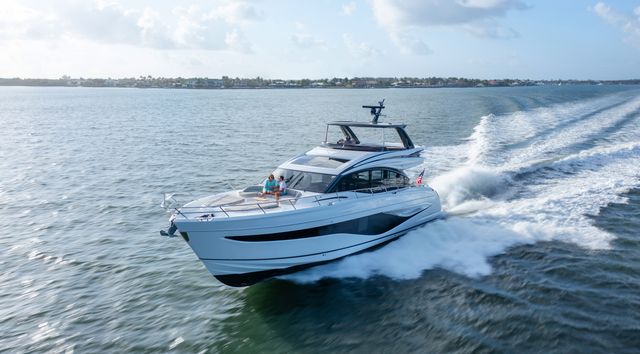
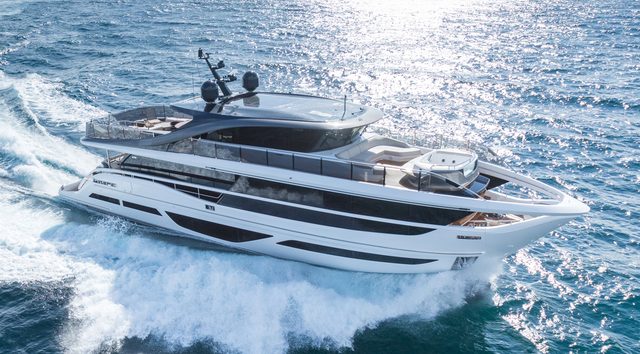
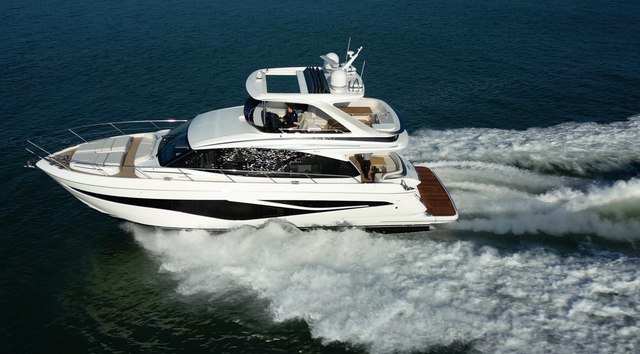
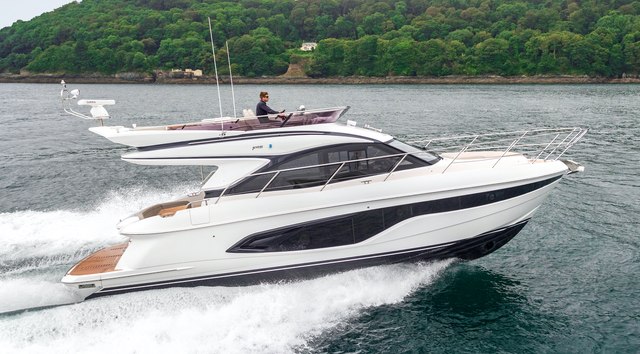
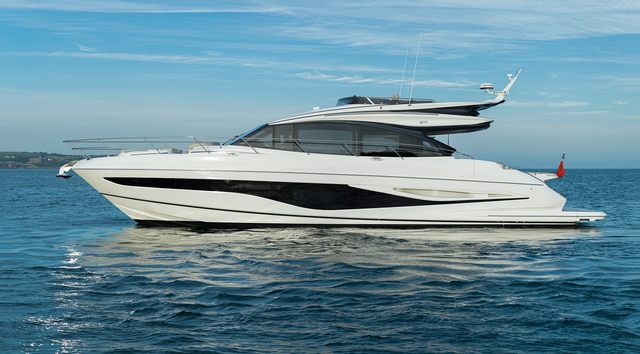
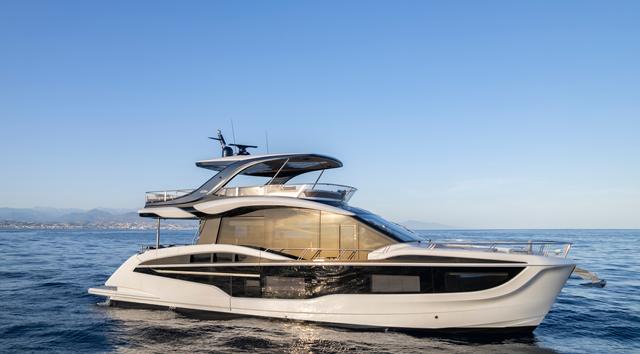
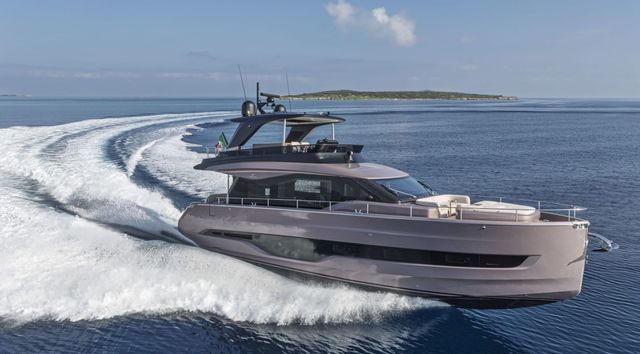
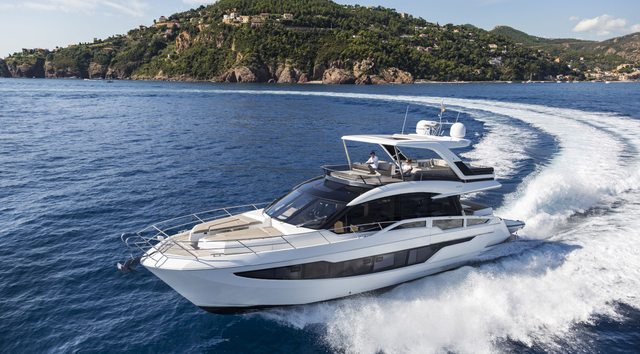
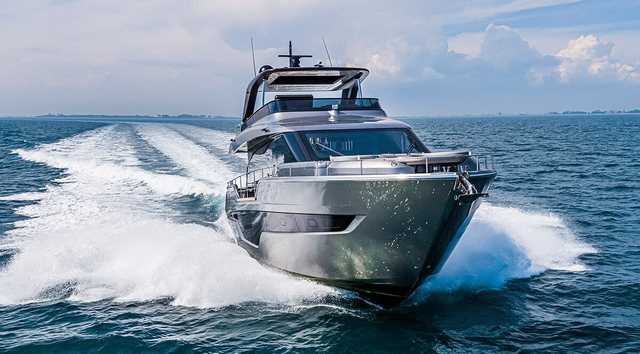
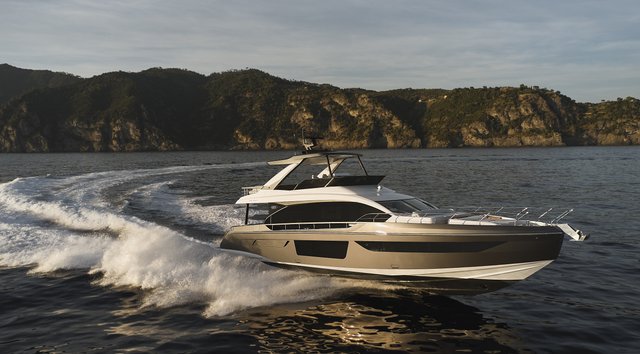
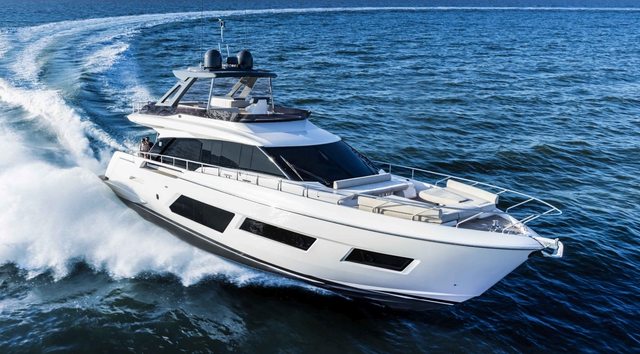
The Princess F65 takes the familiar F-Class formula and pushes it harder, with four guest cabins, a full-beam owner's suite, a large flybridge and proper crew accommodation all packed into 65ft. The layout is the big story, but the detail matters just as much - from the aft galley and practical deck spaces to the little bits of hardware and access that make the boat easier to live with.
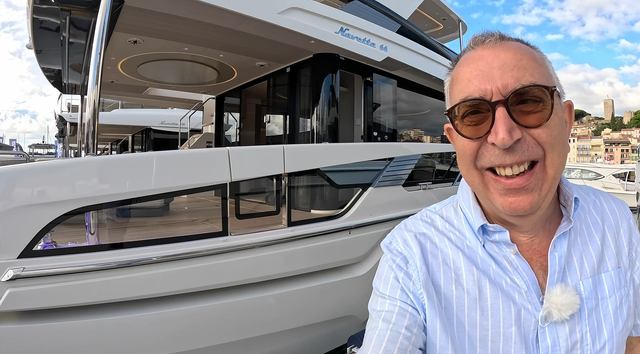
Video Tour
Princess F65 At A Glance
Why you'll love it
- Four guest cabins in a 65-footer
- Big flybridge with proper dining space
- Full-beam owner's cabin with aft bathroom
Things to know
- Tender rides on the hi-lo platform
- Fourth cabin is a compact bunk room
On Deck
The Princess F65 carries a lot of height, as you would expect from a 65ft flybridge yacht with four guest cabins, but the profile hides it well. The dark side glazing runs aft into colour-matched engine vents, while the window line drops towards the cockpit rather than ending in a hard square edge. Even the flybridge follows the same sweep, so the whole boat looks lower and cleaner than its internal volume might suggest.
A hi-lo bathing platform forms the main waterside area aft and carries the tender when under way. Close by is a stern docking station with engine controls, bow and stern thrusters and anchor winch control. For an owner who likes to handle the boat, that is a useful bit of kit because you can stand right aft and see what is happening during a berth. A nearby safety locker holds the engine and generator fuel shut-offs, manual bilge pump controls and the manual release for the engine room fire system.
The cockpit table is a good example of where Princess spends its time. The grain runs across the folding leaves, slim stainless sections line up when the table closes and a small gap beneath the top lets air circulate rather than trap damp underneath. Stainless cup holders and rails sit within the same unit. None of this changes how much space the cockpit has, but these are the bits owners tend to notice after a season aboard.
Sliding saloon doors sit alongside a lift-up aft window, so the cockpit opens straight onto the galley inside. That makes sense on a boat used for long lunches or evenings at anchor because drinks and food stay close to the outside seating rather than pass through the saloon each time. It also gives the aft end of the main deck a much more open feel when the weather plays ball.
Side Decks & Foredeck
The side decks have teak underfoot and substantial rails that run well aft, so there is something to hold before you have fully left the cockpit. Stern winches sit close to the mooring points and the stainless work around the deck feels thick and well judged rather than decorative. Princess has also taken care around the fairleads forward, where the stainless sections extend far enough to keep loaded lines off the gelcoat.
Up at the bow, the sunpad has a central footwell that makes a surprising difference. Rather than clamber across the cushions, you can put your feet down between them and step in or out normally. The backrests also work in either direction, so the same space can face forward as a pair of loungers or turn aft towards a small table. There is even a cool box tucked into the foredeck, while large lockers nearby take fenders and covers.
The anchor gear sits right forward with local controls, a chain locker, deck wash and a manual override for the windlass. These details are hardly glamorous, but they matter when you are the one at the bow dealing with a fouled line or a bit of kit that has stopped at the wrong moment.
Flybridge
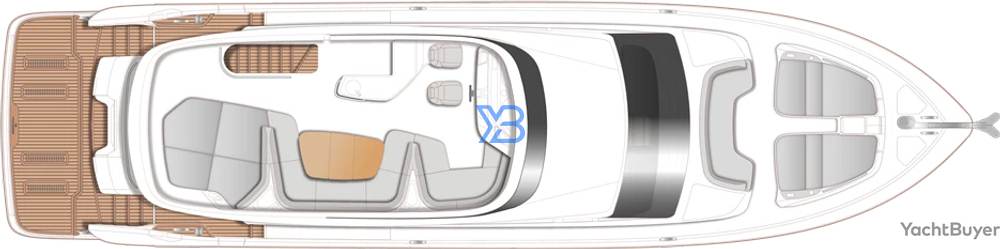
Steps from the cockpit lead to the flybridge, with storage beneath and low-level lights around the stair area. At the top, Princess has put the bar to one side in an L shape, so whoever is at the sink or fridge still faces the seating area rather than a bulkhead. There is storage below, an ice maker and a top-loading fridge.
The aft sunpad has another small but worthwhile idea. A walkway runs around its outer edge, so you can move from one side of the flybridge to the other without climbing across anyone stretched out on the cushions. An extended bimini comes aft from the hardtop, and the rear can take canopies if the owner wants a more enclosed upper deck.
The main flybridge dining table has a removable centre section. Leave it out and access around the seating is easier with a smaller table for drinks. Fit it and there is a much larger surface for meals. It is a simple piece of flexibility and one that makes more sense than trying to force one table layout to do every job.
Princess has also moved the navigator's seat slightly outboard at the upper helm. That sounds minor, but it means a passenger can get into it without climbing around the helmsman. Ahead are three multifunction displays, engine controls, bow and stern thrusters, trim controls, VHF and searchlight controls, with the fire suppression status visible here too. The helm seats use the same quilted finish as those downstairs, while a large seating area alongside gives passengers somewhere to sit without crowding the controls. An infill cushion can turn part of that seating into another sunpad.
What stands out on deck is not one huge trick but the number of small annoyances Princess has clearly tried to remove. The foredeck is easier to get on and off, the flybridge sunpad does not block the walkway, the navigator can reach the upper helm seat without climbing over anyone and the skipper has controls right aft for close-quarters work. On a boat this size, those things count.
Interior Accommodation
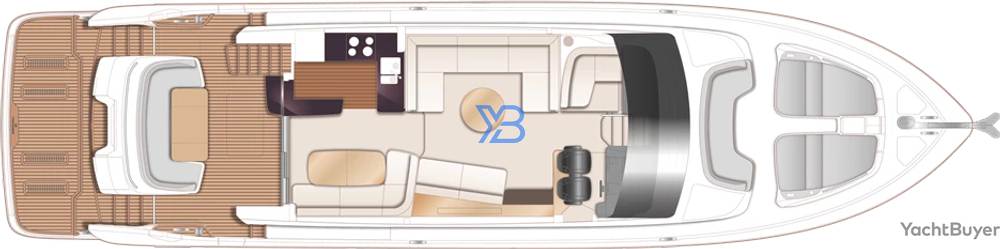
The galley sits right aft on the main deck, beside the cockpit rather than further forward in the saloon. Sliding doors open across the stern and the aft window lifts clear, so the galley can serve the cockpit without people carrying plates and drinks through the boat. It is a sensible layout on a yacht that will spend much of its time with people spread between the inside and outside spaces.
Equipment is much as you would expect at this size, with a large fridge over a separate freezer, four-ring electric hob, sink and dishwasher. Princess has also found space for bins, cutlery drawers and a good spread of general storage. Some drawers have a set job, including fitted crockery storage, while less-used items can go beneath the nearby seating. It means the things you reach for most stay close at hand rather than disappear under cushions.
Opposite the galley is a proper dinette with a table that folds out to give a much larger surface. The hinges sit flush within the top and the timber grain runs neatly across the folding sections. Large drawers fit beneath the seating, so this area earns its keep even when nobody is sat around the table.
That separate dining space allows the saloon further forward to work as a lounge. The seating is deep and comfortable rather than upright, with a large television that rises from the cabinetry when needed. Princess has also put a bar close by, with an ice maker, drinks fridge and storage for glasses. AV equipment sits lower down. It is all fairly conventional, but the layout works because each part of the main deck has a clear job.
The lower helm gets a pair of new Princess seats with quilted upholstery and shaped panels across the backs. Twin multifunction screens handle navigation and other data, with a separate engine display alongside, while the engine controls, steering and bow and stern thrusters sit close to hand. A side door gives direct access to the deck. There is even a weighted Princess badge in the steering wheel, so it stays the right way up as the wheel turns. Entirely unnecessary, perhaps, but very Princess.
Passenger space beside the helm has had some thought too. The seat is raised slightly for a better view ahead and there is a small table for a laptop or tablet. A drop-down side window sits alongside it, so with the helm door open there is a decent flow of air through the front of the saloon. The boat has full air conditioning, of course, but there are days when an open window does the job rather better.
The main electrical panel sits just aft of the helm. The 24V side covers battery systems, lighting and other domestic circuits, while the 240V panel deals with larger appliances such as the microwave, fridge, ice maker and dishwasher. Supply can come from shore power or the generator, with the changeover handled here. Tank levels and pump controls for the water systems are also close by. It is not a glamorous part of the interior, but on an owner-run boat it is exactly the sort of thing you want easy to get at.
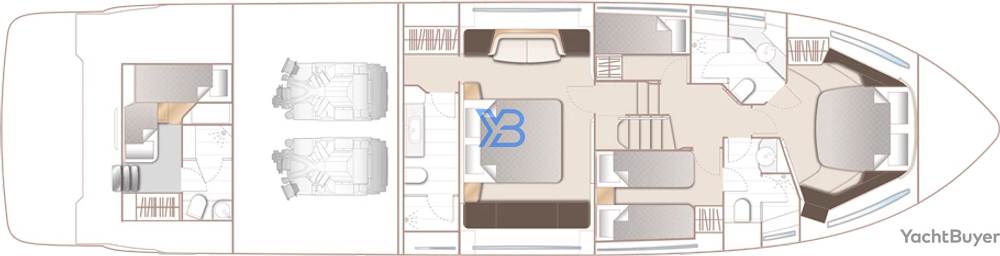
Curved timberwork follows the stairs down to the accommodation lobby, where the four-cabin layout starts to make itself clear. The guest cabins sit forward and amidships, while the full-beam owner's cabin lies aft. Before you reach it there is a useful laundry cupboard with a washer-dryer, and Princess has allowed enough room for separate domestic-size washing and drying machines if the owner prefers. A small locker alongside takes detergent and other laundry bits. Tiny detail, but a good one.
The F65 interior is quite traditional in the way it divides the main deck, and that works in its favour. The galley serves the stern, the dinette handles meals, the saloon is left as a lounge and the helm has its own passenger space. Nothing feels as though it has been asked to do three jobs at once, which helps a busy 65-footer feel easier to live with.
Owner's Cabin
The owner's cabin sits amidships and uses the full beam, with large hull windows on either side and Venetian blinds for privacy. The bed sits centrally with a large television opposite, while separate air-conditioning controls let the cabin run independently from the rest of the boat. Princess has worked the vents into the cabinetry rather than leaving them as obvious grilles, and the curved timber around the room gives the joinery a softer edge without becoming fussy.
Storage is one of the cabin's stronger points. Long runs of cupboards and drawers line the hull sides, with large wardrobes beside the entrance and further drawers beneath them. There is also a dressing area with a lift-up mirror and storage below, while a separate seat beneath the opposite window gives the owner somewhere to sit away from the bed. Low-level lighting is tucked beneath parts of the cabinetry, with another strip set into the timber around the cabin.
The bathroom runs right across the aft end of the owner's cabin. That gives it plenty of width, but the more useful point is what sits behind it. The bed is separated from the engine room by the bathroom and another bulkhead, so there are two layers between the sleeping area and the machinery space. At one end is a large rainfall shower with its own extractor fan, while the toilet and basin sit further across the room. Hull windows continue into the bathroom, again with blinds for privacy.
Guest Accommodation
The forward VIP cabin is a good size in its own right, with a central double berth and enough room around it to avoid the usual squeeze right up in the bow. A large hanging locker takes clothes, while a small dressing table has a lift-up mirror and drawer beneath. Storage runs around the upper sides of the cabin and there is AV equipment built into the cabinetry. An escape hatch sits overhead.
Princess has also left proper access behind the finish. Open a panel inside the wardrobe and the wiring and other systems behind the cabin are there to get at. That sort of thing is easy to ignore on a boat-show walk-through, but it matters once the boat has a few seasons behind it.
The VIP has its own bathroom with a separate shower, toilet, basin and storage. The same curved timberwork carries through here, so it feels like part of the cabin rather than a plain moulded compartment.
The third cabin sits further aft and has two single berths, but one moves electrically across to meet the other and form a double. That gives the owner a bit more choice when different guests come aboard, rather than fixing the room as a twin. There is a large wardrobe, AV equipment and a good-sized hull window.
Its bathroom also serves as the day heads. One door opens from the cabin and another from the lower lobby, so Princess has avoided giving over more of the lower deck to another separate bathroom. There is still a proper shower rather than a wet-room arrangement.
Opposite is the fourth cabin, and this is where the F65 earns its four-cabin claim. It is a bunk room rather than another full double cabin, so there is an obvious trade-off in space, but it still gets a decent wardrobe and storage around the bunks. A large hull window brings in plenty of light, with opening sections for ventilation and a Venetian blind when privacy is needed.
Crew Accommodation
The crew cabin is tucked right aft with its own entrance from the bathing platform, and it is far nicer than the name suggests. Princess calls it crew accommodation, but there is nothing stopping an owner from treating this as cabin five. Teenagers in particular would probably love it - their own little den, their own entrance and no need to trail through the main accommodation every time they come and go.
There are two proper berths in here, though Princess can fit just one if you would rather have the extra floor space. Headroom is surprisingly good for a cabin squeezed beneath the aft end of a 65-footer, and there is a decent wardrobe as well as more storage around the room. Open up the cabinetry and there are access panels to some of the engineering behind it, so this is not dead space that becomes a nuisance the first time something needs attention.
Best of all, it has its own bathroom with a toilet and a proper separate shower. That makes a big difference. Crew can stay quite independent from the guests, but an owner who runs the F65 himself has a genuinely useful extra cabin sitting back here. For a boat of this size, that is a lovely bit of flexibility.
Performance & Engine Room
Power comes from a pair of MAN V8 1200hp diesel engines, and the first F65 had already seen about 32 knots despite having only just gone into the water. A mid-20-knot cruise should be a comfortable place to sit, with the transcript putting range at around 270nm at that sort of pace. Slow the boat down to roughly 8-9 knots and that figure can rise to around three times as much, simply because you are no longer asking two big V8s to lift a 65-footer onto the plane.
That gives the F65 two quite different ways of travelling. There is enough speed for fast coastal work or a decent cross-Channel run, but you can also back right off and make the fuel last if there is no need to hurry. We would want a proper sea trial before saying much about ride or handling, though, because this tour took place at the boat show rather than out on the water.
Engine room access is from the aft end of the boat, and there is a separate lazarette close by for storage and engineering kit. Drop into the machinery space and the two MANs dominate the centre, with fuel tanks outboard, exhaust systems aft and a substantial generator low in the compartment. Air-conditioning equipment lives here too, while the silver-faced lining around the space provides the sound insulation.
The separate engineering space takes some of the less glamorous kit out of the engine room. Battery banks sit down here, along with more of the air-conditioning plant, while the deck drains come together at a common point before they discharge. It is the sort of area most owners will rarely show their guests, but anyone who looks after their own boat will be glad it exists.
Princess has also given some thought to what happens when something goes wrong. The engine room has automatic fire suppression, with a manual release back at the stern, while the fuel supply to the engines and generator can also be shut off from there. Electric bilge pumps are backed up by a manual system that can draw from the forward or aft bilges. Belt and braces, perhaps, but that is no bad thing in this part of the boat.
Uncover details about the Princess F65 or delve into the entire collection by exploring all Princess Yachts for sale. You might also want to browse all yachts for sale to uncover more options.
Pricing
Price as reviewed: $4,200,000 (€3,735,522 approx)
The first hull of the Princess F65 was priced at around $4.2 million when this review example was recorded, although final cost varies with specification, options and market.
UPDATE AUGUST 2026: YachtBuyer Market Watch currently records four pre-owned Princess F65 yachts for sale, with asking prices from €1.6 million to €3.9 million and an average asking price of €2.8 million. For the latest asking prices, recent listings and market data, see the live Princess F65 Prices.
Looking to own a Princess F65? Use YachtBuyer’s Market Watch to compare all new and used Princess F65 Yachts for sale worldwide. You can also order a new Princess F65, customized to your exact specifications, with options for engine choice and layout configuration. Alternatively, explore our global listings of new and used yachts for sale and find your perfect yacht today!
Rivals to Consider
The Princess S65 is the obvious place to start because beneath the skin it is remarkably close to the F65. The two share a 5.09m (16ft 9in) beam, 4,100-litre fuel capacity and almost identical displacement, but the S65 swaps the full flybridge for a much lower sportsbridge and adds a tender garage for a 3.3m RIB. Twin MAN V12-1400s take it to around 34-36 knots, against roughly 31-33 knots from the F65's V8-1200s. It still sleeps eight across four cabins and can have an en-suite crew cabin, so accommodation need not suffer much. The choice is quite clear: the F65 gives you a much larger upper deck and the more relaxed flybridge layout, while the S65 gives up some of that space for a lower profile, another few knots and somewhere to hide the tender.
The Schaefer 660 takes a rather different route. At 20.08m (66ft) long and 5.05m (16ft 7in) wide, it is almost a dead match for the Princess on footprint, yet its aft deck can become much larger once the cockpit sides fold down. Schaefer quotes 6.41m (21ft) across this area with the terraces open, while the hydraulic bathing platform can carry up to 800kg and lower into the water for a tender or PWC. Volvo Penta IPS1050 or IPS1200 drives also give it a very different mechanical set-up from the shaft-driven F65. Below, there are four cabins for eight guests, two crew berths and a private stairway into the full-beam owner's cabin. Fuel capacity is much smaller at 2,600 litres, but draft drops to 1.47m (4ft 10in). If the F65 appeals for its traditional flybridge layout and long-distance practicality, the Schaefer makes a stronger case for owners who spend more time at anchor and want the stern of the boat to become part of the day.
The Astondoa 66 Flybridge Mk2 is probably the closest straight flybridge alternative. It measures 20.12m (66ft) with a broad 5.30m (17ft 5in) beam, so it has a little more width to work with than the Princess. Four cabins sleep eight, with a separate two-berth crew cabin aft, while 1,000 litres of fresh water is useful for longer stays aboard. Standard twin Volvo Penta IPS1350s give around 30-31 knots, with MAN V8-1200s also available, and Astondoa quotes about 300nm of range. Up top, the hardtop has a retractable roof, while the flybridge gets its own outside galley and plenty of choice over the aft furniture. Forward, a Portuguese-bridge seating area adds another proper place to sit rather than just a sunpad. The F65 carries more fuel at 4,100 litres and has the stronger Princess detail work we saw throughout the tour, but the Astondoa counters with more beam, IPS as standard and a flybridge that offers better shelter without giving up its open-air feel.
Considering a new yacht? Explore Princess' entire current range to find the model that best suits your needs, and compare it with alternatives from competitors to ensure you make the perfect choice.
Specifications
- Builder Princess
- Range F Class
- Model F65
- Length Overall 20.3m
- Beam 5.09m
- Draft 1.63m
- Hull GRP
- Cabins 4
- Berths 5
- Crew 2
- Cruising Speed
- Max Speed
- Fuel Capacity 4,100 Litres
- Fresh Water Capacity 802 Litres
- Engine Model 2x MAN V8-1200
- Engine economic speed 11.9 knots
- Engine max range (speed type) 450 (nm)
Interested in a F65?
NEW Build
Find your local dealer for a personalised, no-cost consultation
or just request
Brochures & Pricing
Used & In Stock
Looking for a ready-to-go F65 or pre-owned options? Explore all inventory of the F65 available worldwide