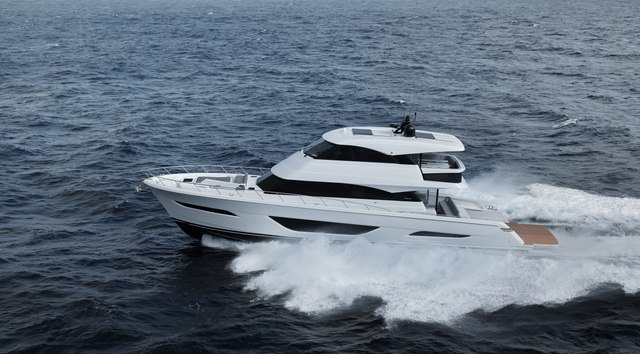
The Maritimo M50 has made its US debut at the Palm Beach International Boat Show, and is the entry point of Maritimo’s current M-Series.
It brings a format that is far more common in Australia and the US than it is in Europe, with a clear focus on owner operation and offshore use. So how does that approach work on a 15.88m (52.1ft) boat with a 5.22m (17.1ft) beam and no third cabin? In this review, we look at how the M50 uses its space, from the enclosed flybridge and helm through to the accommodation and engine room, and what that means in practice.
Maritimo M50 (Mk2) Key Facts
- LOA 15.7m
- Model Year 2025
- Cabins 2
- Crew 1
- Max Speed 30 knots
- Status In Production
- Generations 2
- Yacht Type Enclosed Flybridge
- Use Type Cruising
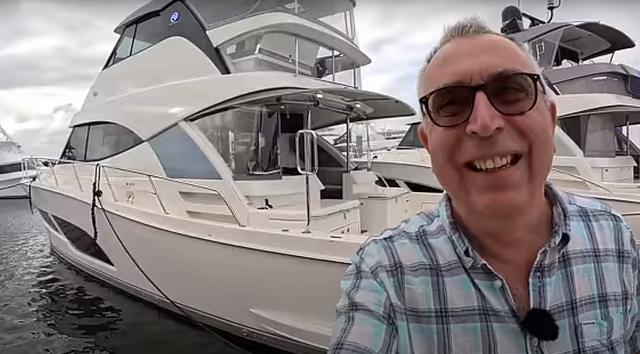
Review Video
The Maritimo M50 is designed in-house by Neil McCabe and Julian Villegas, with no external studio involved, so design, engineering and build stay closely tied together. That approach shows in the way the boat is laid out, with decisions driven by access, structure and long-term use, while Bill Barry-Cotter’s offshore background still shapes the focus on safety and reliability rather than styling.
It is set up as an owner-operated enclosed flybridge cruiser, and the move to two cabins gives you more space, better movement and larger bathrooms. That suits how most owners will use it, typically a couple on board with guests from time to time, while 50ft is treated as a size that remains manageable without crew .
In the current M-Series, it's just below the M55 Black Edition, M60 and M75, and carries a 5.22m (17.1ft) beam on a 15.88m (52.1ft) hull. That proportion gives it a broad footprint and a good sense of space throughout, and it is a big part of how the boat feels once you move around it. The Maritimo S50, developed alongside it, uses much of the same thinking around space and owner use, but shifts to a sedan layout with a lower profile and a more open main deck, so the M50 remains the more protected, raised-helm option within that pair.
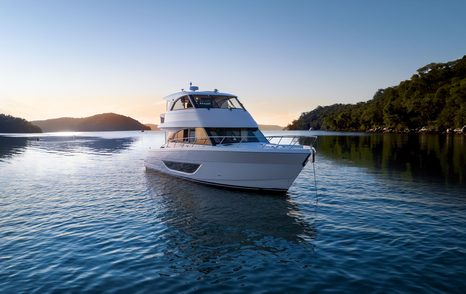
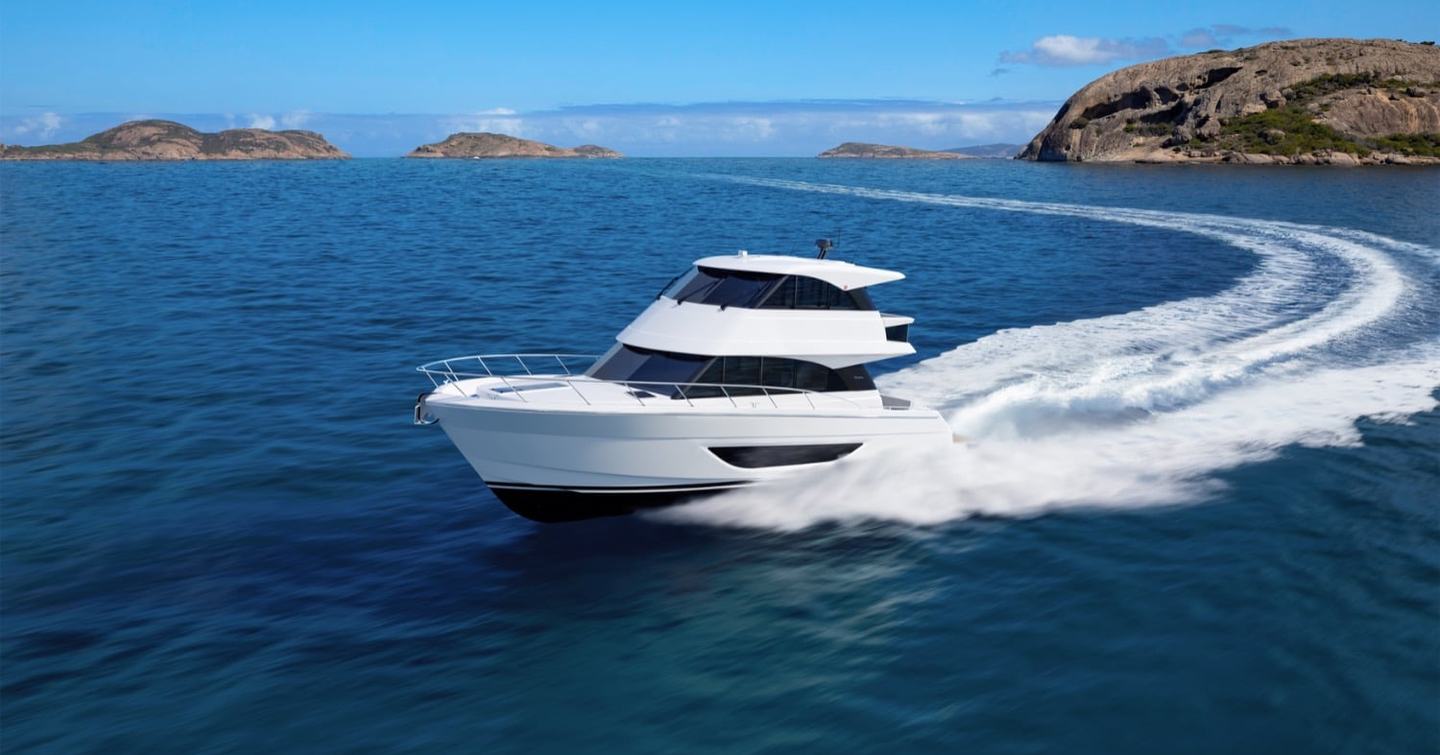
The hull uses a reverse chine that runs close to full length, which helps with lift and stability, while a softer chine radius and a defined keel keep the ride controlled as the boat comes back down . Much of that stability comes from how the volume is carried low in the hull, and the 1.39m (4.6ft) draft supports a steady offshore running attitude.
Fuel capacity is quoted between 3,500 and 3,800 litres, with test data recorded at 3,250 litres onboard . The tanks are kept low along the keel to maintain balance, and with a dry weight of around 26,500kg, the setup is aimed at keeping the boat settled and predictable in use.
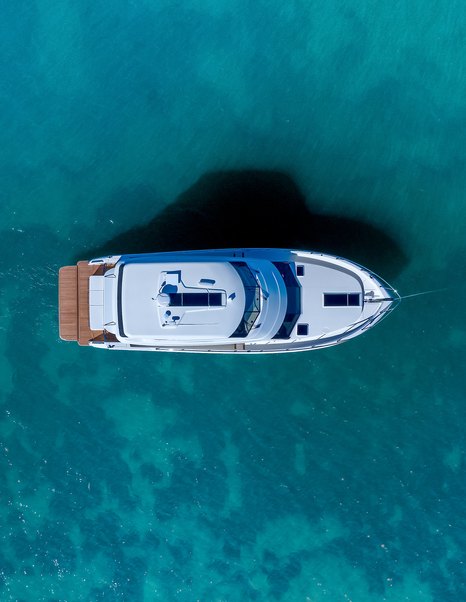
A bonded fibreglass hull liner forms part of the structure, which adds rigidity and opens up full-beam access below decks. That makes a difference in the engine room, where you can move around properly and reach service points from both sides, while the spaces are finished in gelcoat and the fuel tanks are built into the structure.
Straight shafts are used for simplicity and access, and Maritimo’s wider engineering approach includes dripless shaft seals with spares already in place and manual steering backup. There are also multiple sealed compartments with independent bilge systems, while 316-grade stainless steel fittings are built in-house as part of the core build.
The superstructure is kept relatively low with a reduced saloon window line, and the enclosed flybridge defines the profile. Wide walk-around side decks are built into the structure as well, so movement around the boat stays safe and straightforward.
At the stern, the swim platform lifts and folds to reduce overall length by around 750mm (2.5ft) when docked . It then opens the space back up at anchor, while the lazarette is accessed through separate hatches rather than a single lifting deck, which keeps things simpler to use and avoids unnecessary weight.
The interior follows the same build standard as larger Maritimo models, with a layout focused on storage and movement. Large side windows and overhead glazing bring in natural light, while the timber species, laminate schedule and glazing specification are not published, and a five-year structural warranty is confirmed.
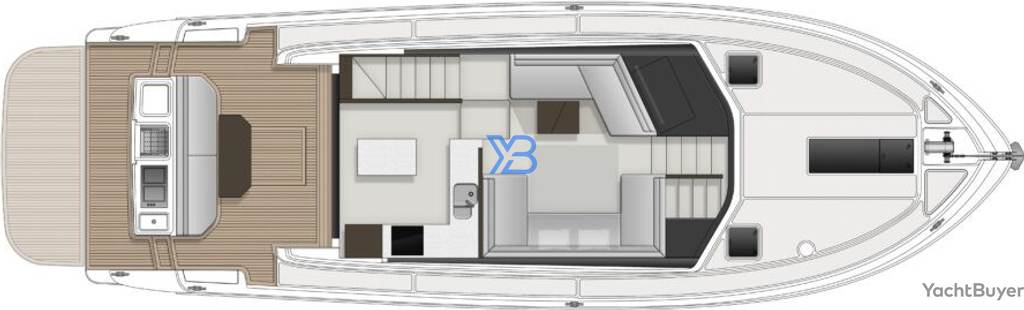
The absence of a lower helm shapes the whole main deck, as the space is given over fully to living and the layout is pushed further forward than usual. That gives you a clear, open floor area with no interruption, and it changes how the saloon works day to day, as everything centres on seating, dining and easy access through the space.
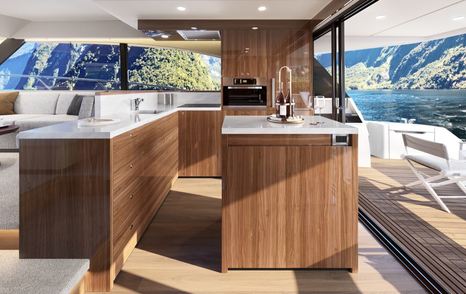
The galley is split across both sides with a small central island, so it avoids that narrow corridor feel and comes across more like a kitchen you’d have at home. The sink faces into the saloon as well, which means you stay part of what’s going on while using it, and that simple detail works well when you’ve got people on board. The aft galley position links straight into the cockpit, so there’s no barrier between inside and out, and that makes moving food and drinks around simple when you’re at anchor or alongside. It also means the cockpit and saloon work as one space rather than feeling separate.
Storage is one of the stronger points here, and it’s handled in a very practical way. There’s a large pantry that stands out straight away, while fridge and freezer space is split across both sides, including freezer drawers and an ice maker, and you’ve also got a microwave and induction hob, so it’s properly set up for longer stays rather than just short trips.
Some of the detailing is a bit less resolved, and one of the galley elements feels slightly out of place within the surrounding joinery. It works fine in use, but visually it doesn’t quite tie in with the rest of the finish.
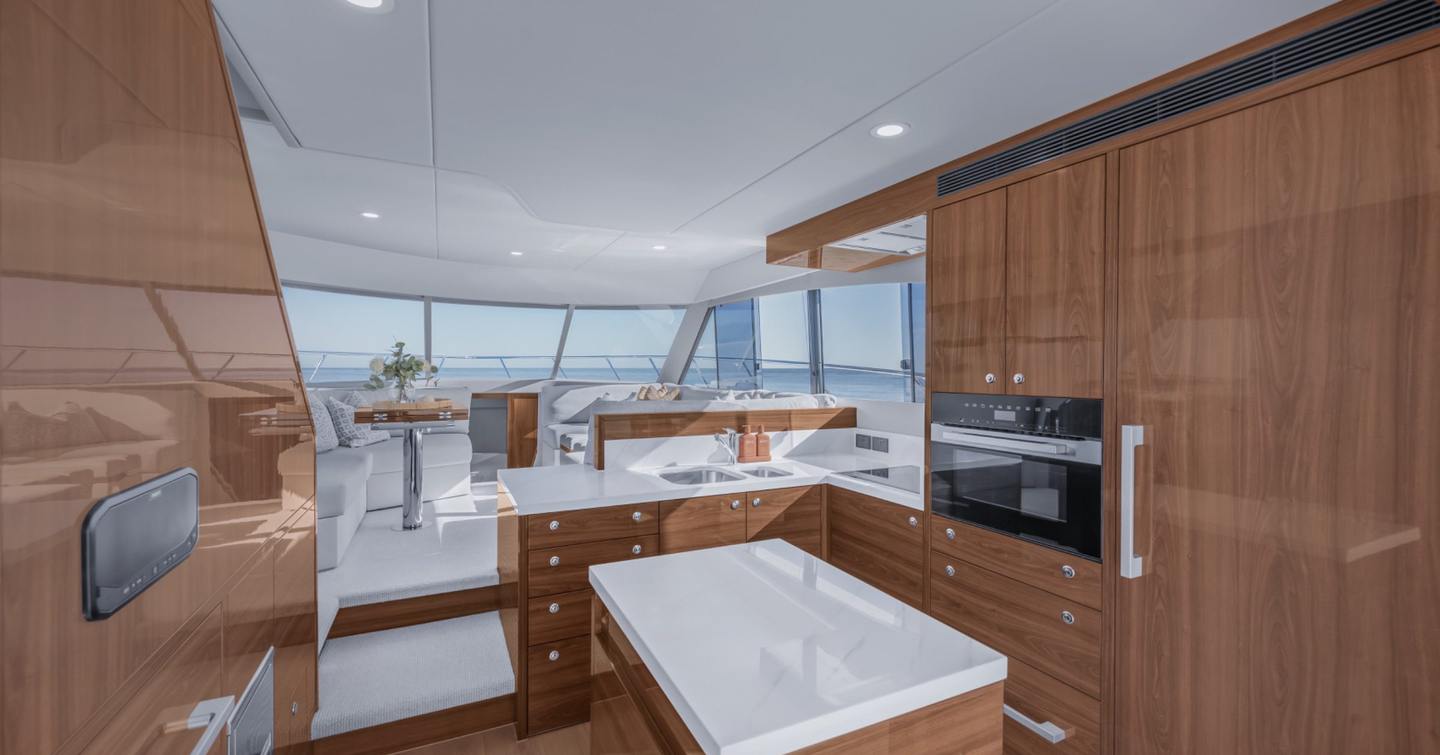
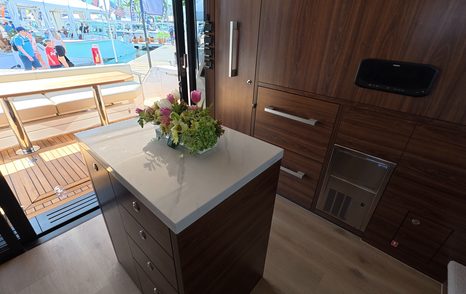
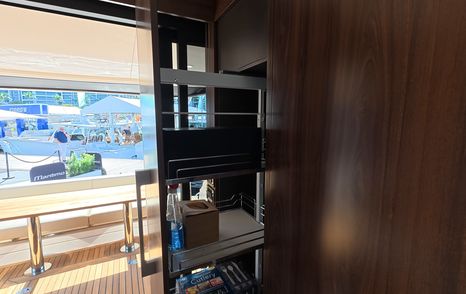
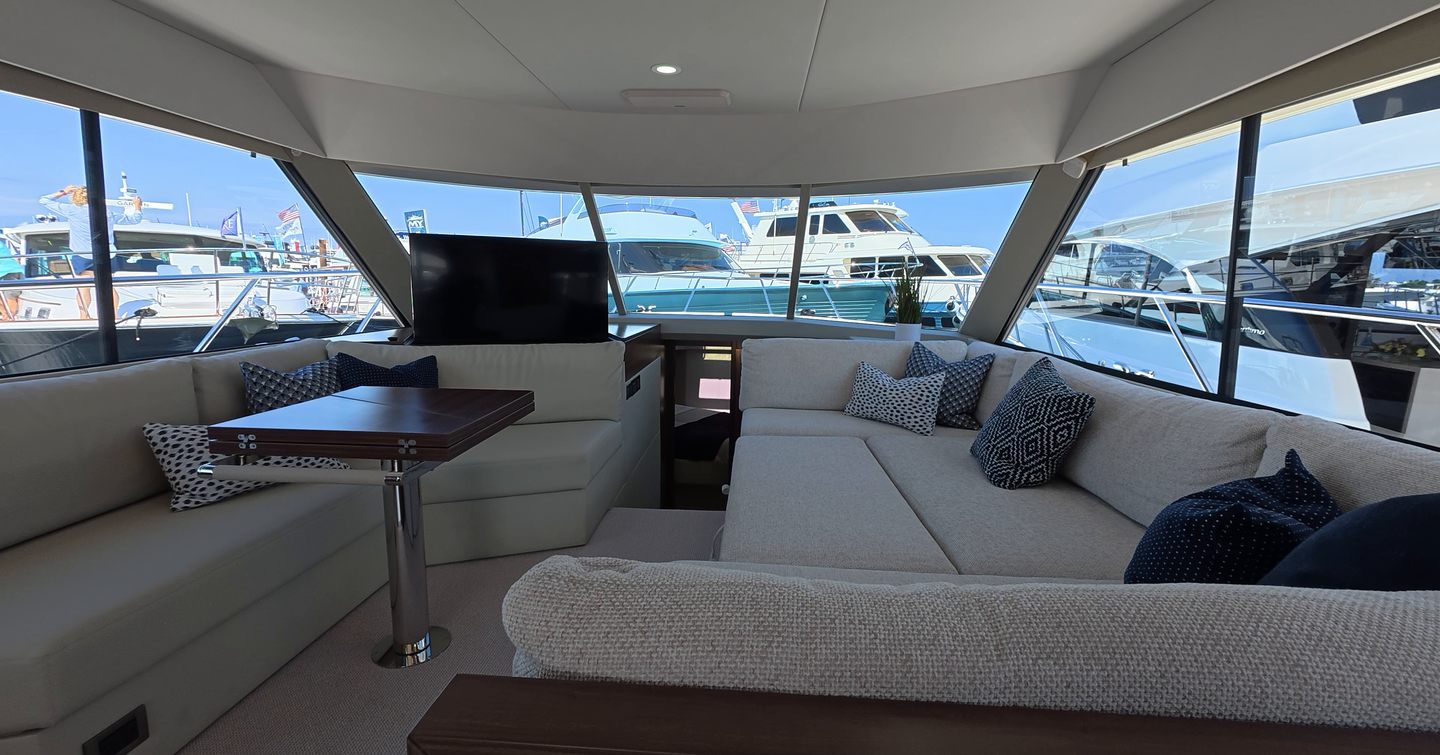
The seating area makes the most of the extra room, and it centres on a large sofa that can be set up as a day bed or switched back into a more typical seating layout. The table doubles in size when you need it, so it adapts depending on how you’re using the space, and that flexibility helps offset the two-cabin layout when you’ve got guests staying over.
Light plays a big part in here, with large side windows and sliding sections that you can open for airflow. The boat has full air-conditioning, but being able to get a cross breeze through the saloon makes a difference when you’re sitting at anchor.
A drop-down TV is built into the cabinetry and stays out of sight when it’s not needed, so it doesn’t clutter the space, and the key detail here is the expandable dining table that supports both everyday use and hosting.
Enclosed Flybridge
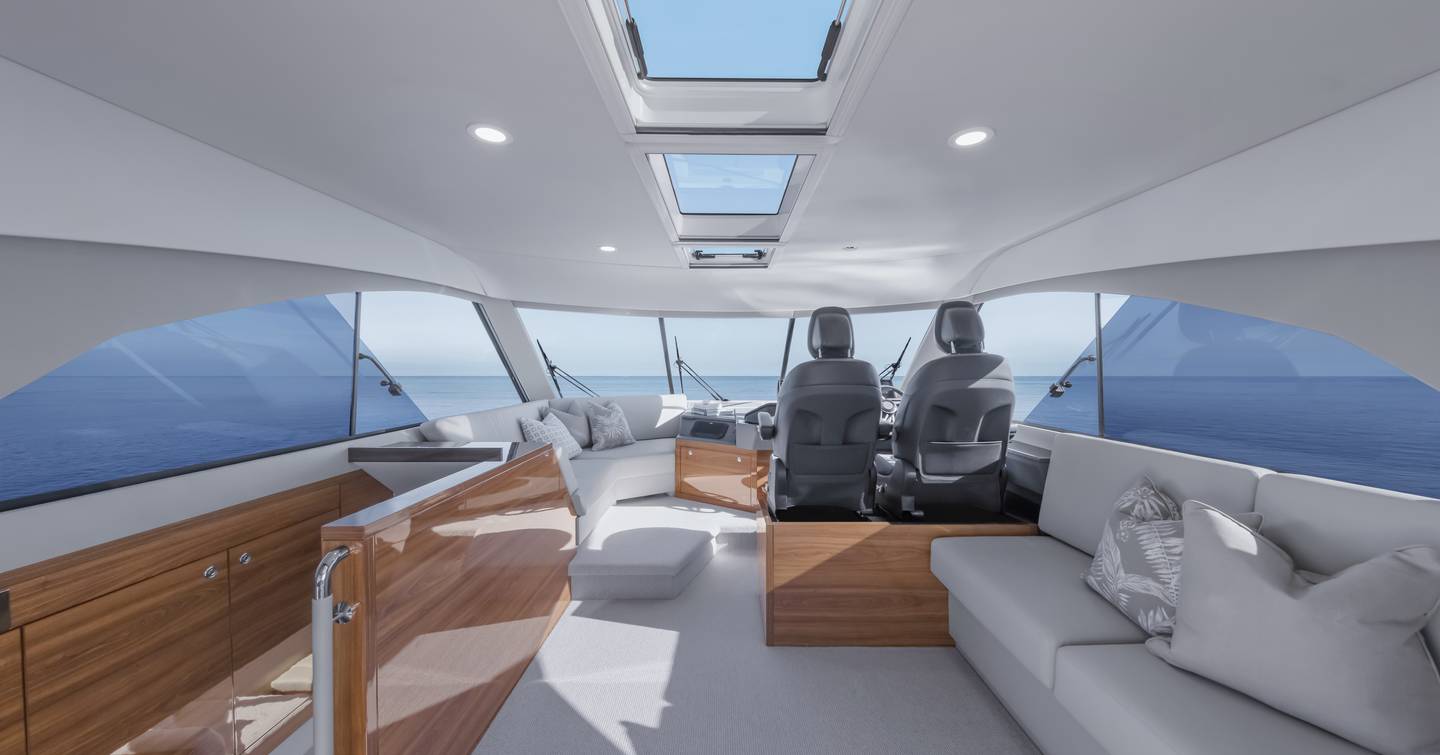
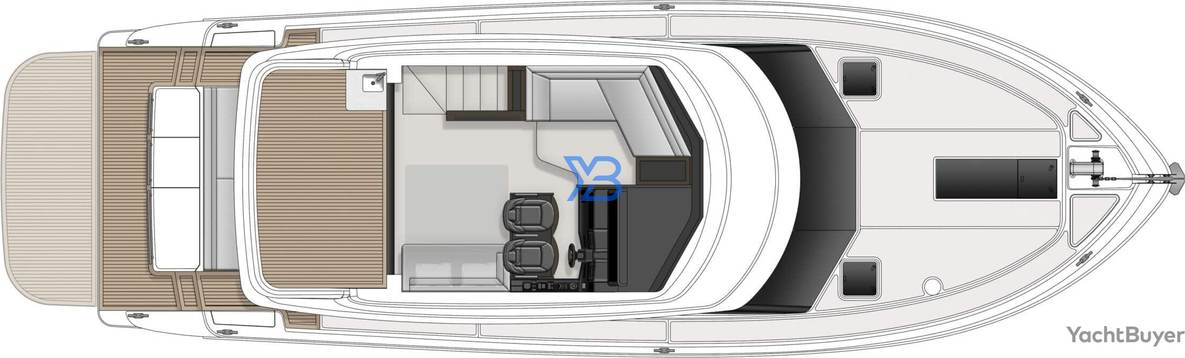
There’s a surprising amount of space up here. The helm sits forward where you’d expect, with seating alongside, and then you’ve got a decent amount of room behind it, so it doesn’t feel overly packed out with furniture. Next to the helm there’s a sofa, so people can sit up here while you’re running, and that works well enough for a couple of passengers. It’s not trying to be a full social deck, but it doesn’t need to be, and it keeps the focus on the driving position without isolating it completely.
You’ve also got a TV built in, and there’s enough space for this area to double up if needed, which ties back into the way the boat handles accommodation overall. It’s not the main purpose of the space, but it adds a bit of flexibility.
The glazing makes a big difference. It runs right around the space, and with opening sections and a skylight above, you can get plenty of air through it when you want to. So although it’s enclosed, it doesn’t feel shut off, and you’ve got the option to open it up rather than relying on air-con all the time.
Where this really comes into its own is in the conditions it lets you run in. Being fully enclosed and up high, you’re protected from the weather, and that changes how you use the boat, especially if you’re covering distance or dealing with rougher days. It’s a very easy place to sit and just get on with driving.
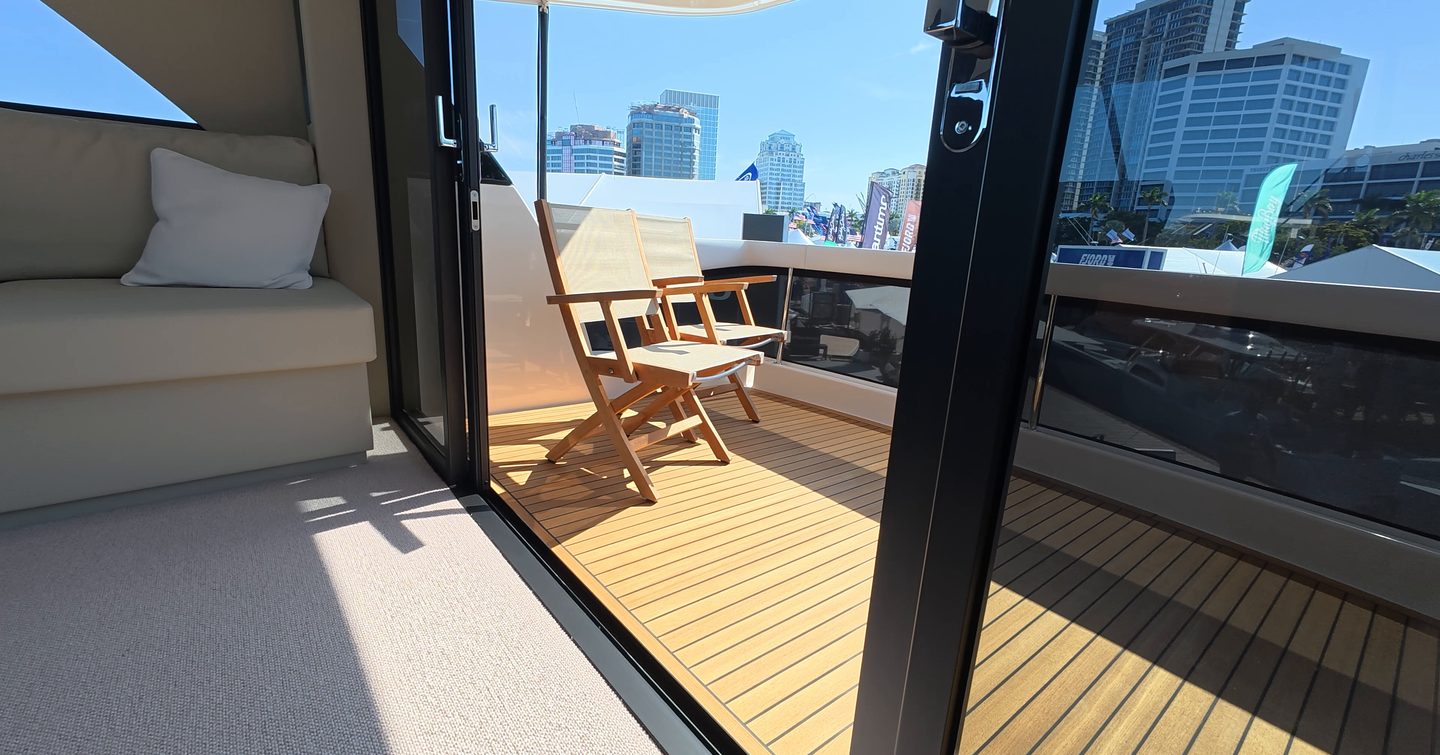
Right at the back, there’s a small open terrace. It’s pretty simple, just a bit of seating and not a huge amount else going on, but you do get a great view over the cockpit and platform, and it works well if you want to keep an eye on things without being in the middle of it.
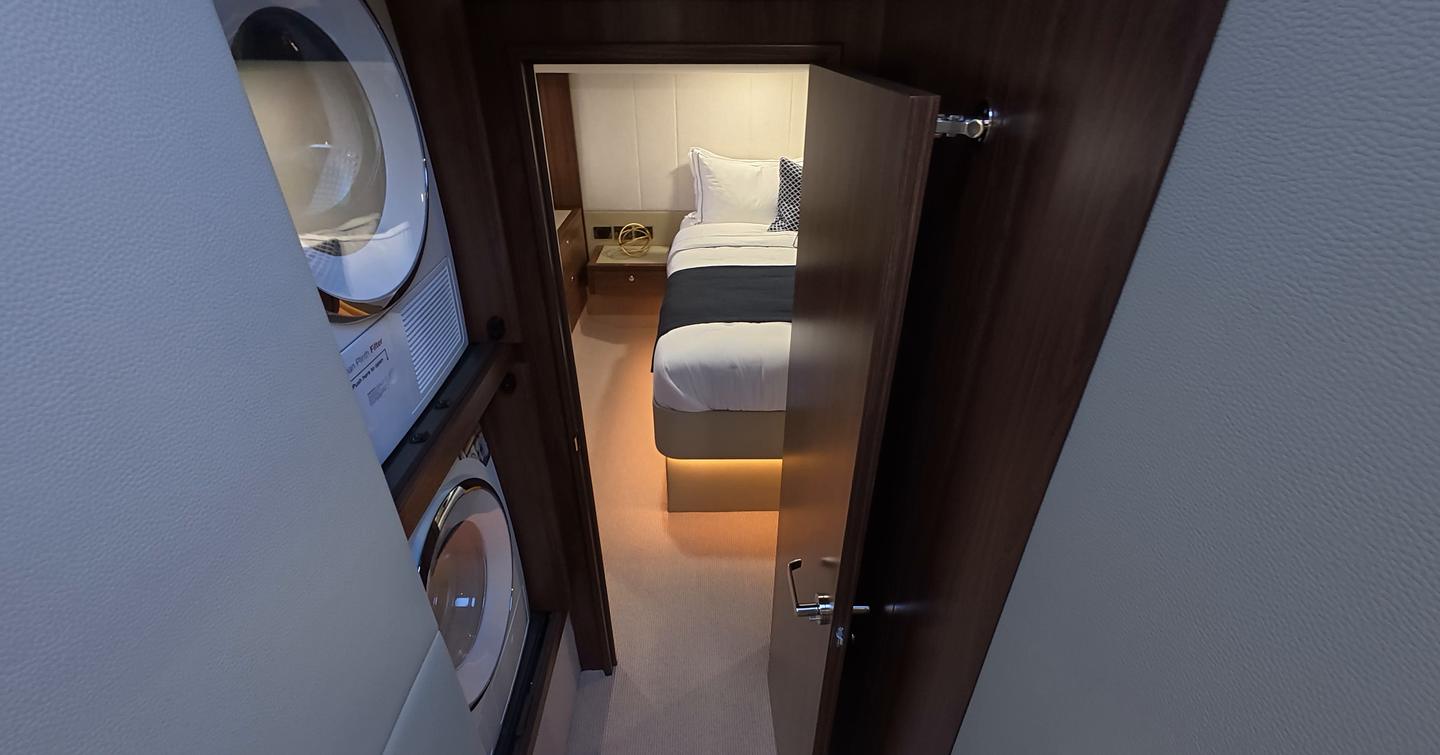
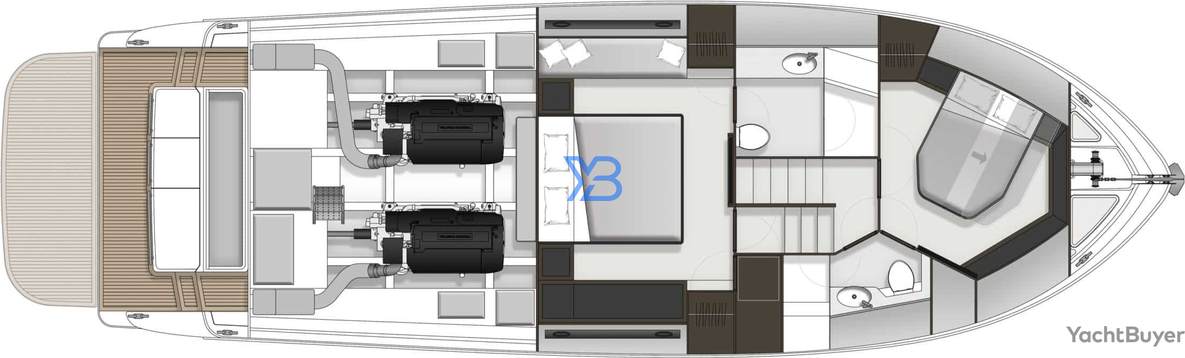
The lower deck is arranged as a two-cabin layout, which is a deliberate decision rather than a space-saving one. Instead of trying to fit in a third cabin, the focus shifts to giving each space more room to work properly. That ties back to the saloon, where the day bed adds an extra sleeping option when needed, so the boat can still accommodate more people without compromising the main cabins. It also keeps those cabins more private, as they are not being asked to do multiple jobs at once. There is also a split level between the cabins, with steps leading down into the owner’s space, and a washer-dryer positioned between the two areas.
Owner's Cabin
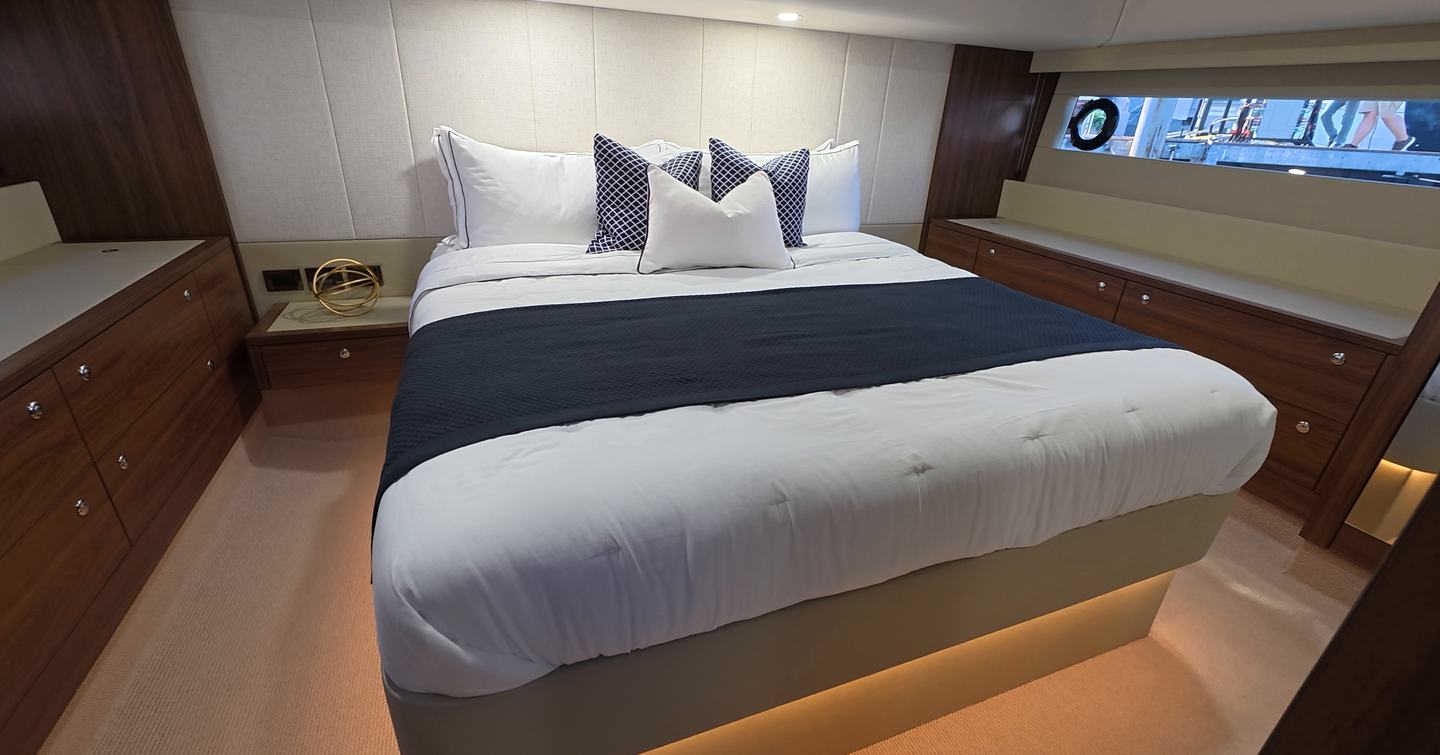
The owner’s cabin sits amidships and runs full beam, so it takes advantage of the widest part of the hull. That gives it a strong sense of width as soon as you step in, helped by a single-level floor that makes it easy to move around.
The bed is set centrally and raised slightly higher than you might expect, which makes it easier to get in and out of and gives it more of a domestic feel. Around it, storage is well handled, with hanging wardrobes on both sides, drawers built into the layout and space for a TV unit forward.
Natural light comes in through hull windows on either side, and opening portholes allow for ventilation when needed, so it works well both underway and at anchor. The finish is consistent with the rest of the boat, with a darker wood tone and clean joinery that keeps things simple and durable.
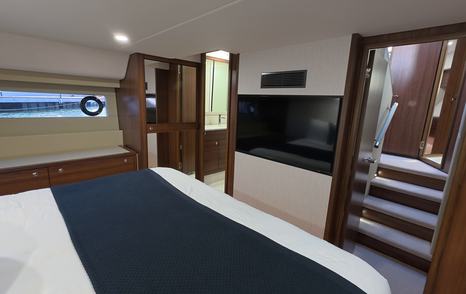
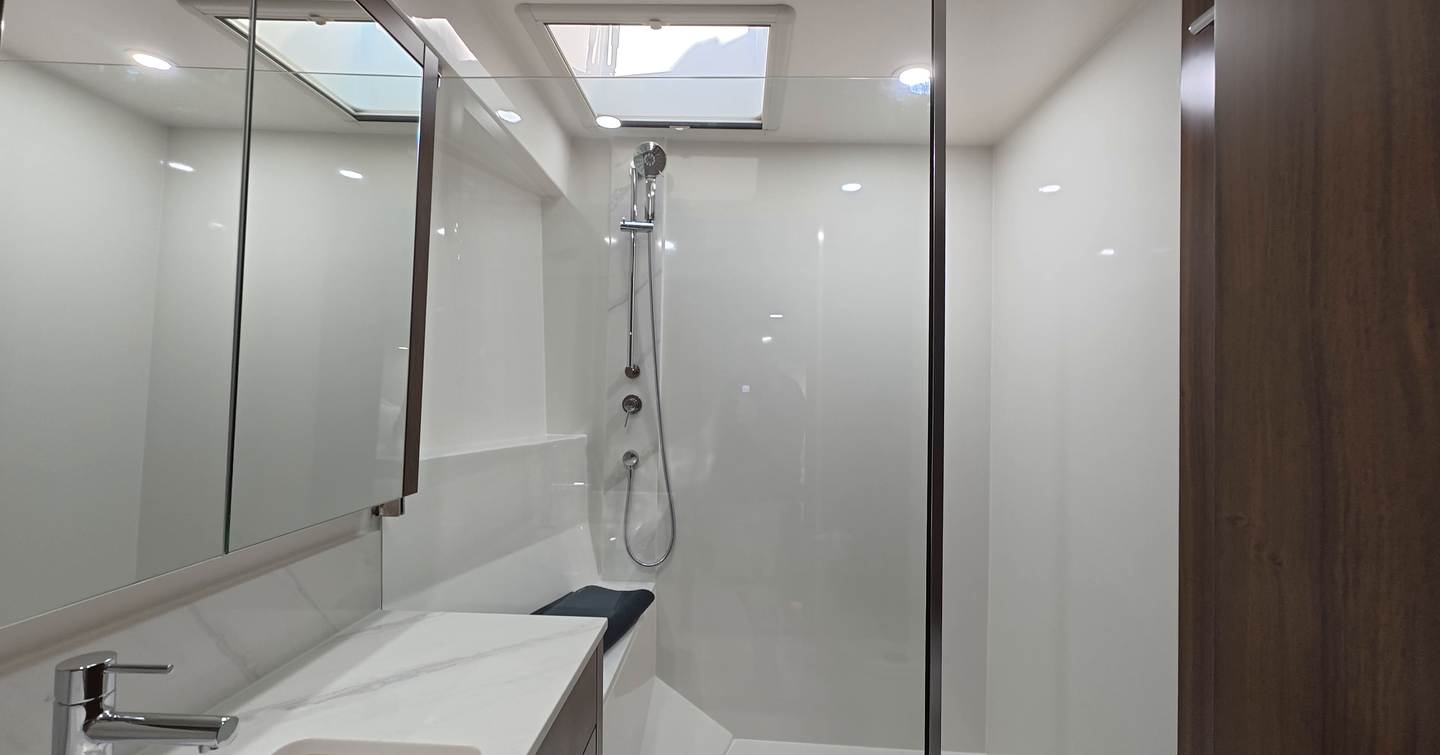
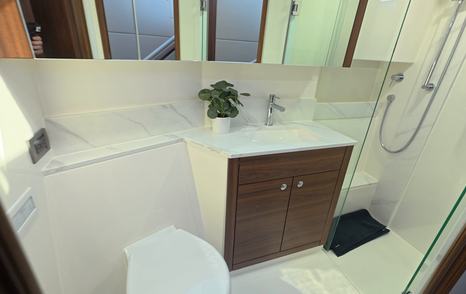
The ensuite sits forward of the cabin and is notably large for this size of boat, with full standing headroom and a separate shower area. A skylight above the shower brings in natural light, which makes the space feel more open and easier to use day to day.
Guest Cabin
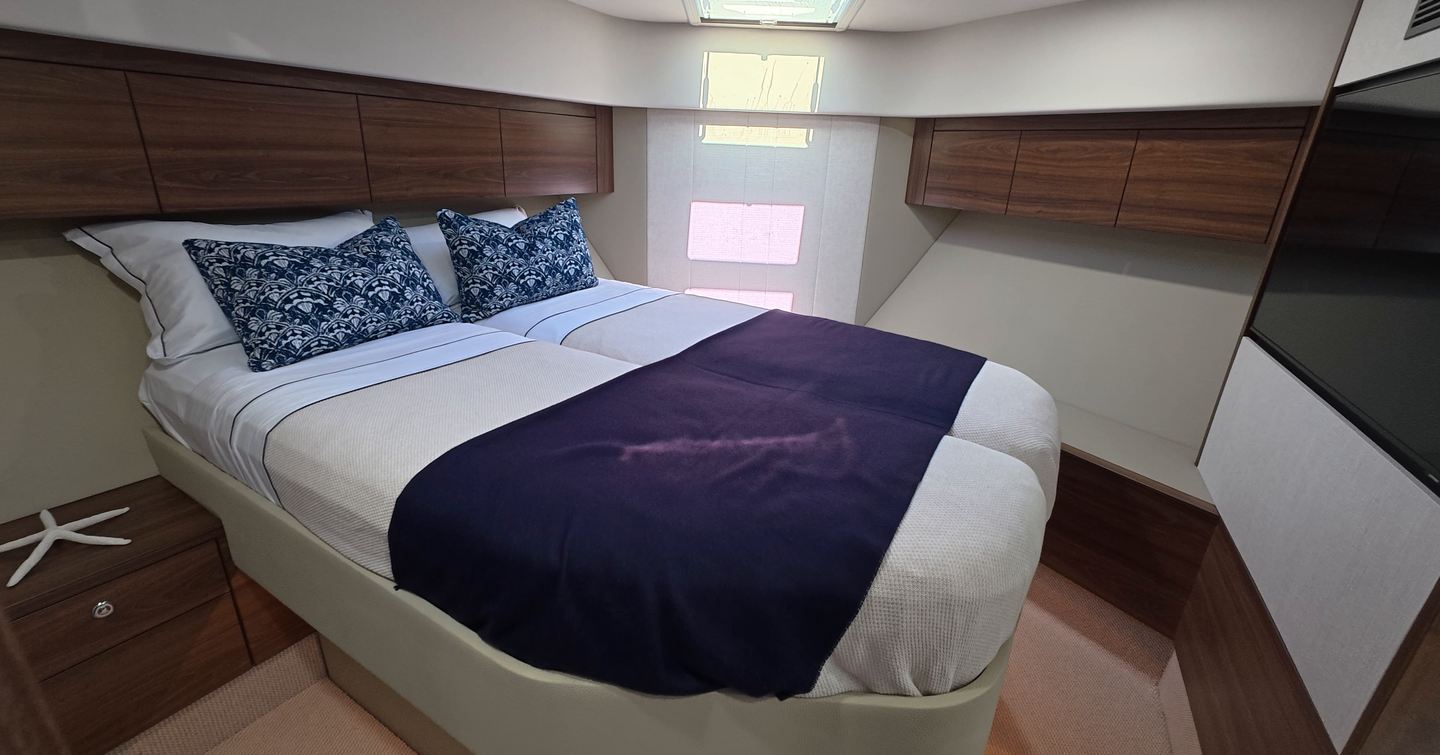
The guest cabin is located forward and uses the bow space efficiently, with a berth that can be set up as a double or split into twins. That flexibility makes it easier to adapt depending on who is on board, and it avoids locking the space into a single layout.
Headroom holds up well here, even towards the front of the cabin, so it remains comfortable to move around. Storage is built in with a hanging wardrobe and overhead units, which is enough for short to medium stays without needing to rely on other areas of the boat.
Light comes from a skylight above rather than hull windows, which works well in practice and ties directly to the glazing built into the foredeck above. It brings in a good level of daylight and keeps the space usable during the day.
The bathroom for this cabin sits just aft and doubles as the day head, and like the owner’s ensuite, it offers full standing headroom and a proper shower space. That layout keeps things simple and works well for both guests and general use on board.
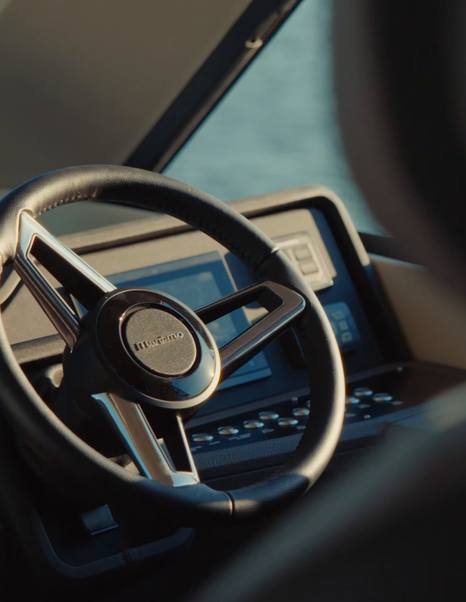
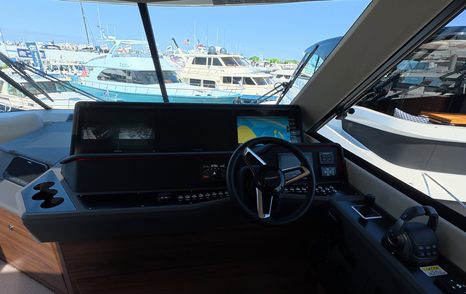
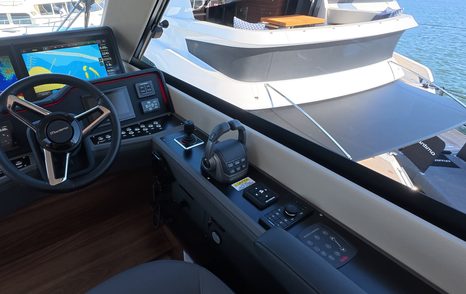
The helm is located on the enclosed flybridge and is the only driving position on the boat. The position itself is set high, which gives clear sightlines forward and down both sides of the boat, and that makes a difference when manoeuvring as well as when running offshore. You can see what’s happening around you without needing to lean or adjust your position much, and that visibility feeds directly into control.
The helm console is arranged around three large screens, with a clean layout that keeps key information directly ahead, and there is a remote control unit that lets you operate the displays without leaning forward. That setup works well over time, as you can sit back in the seat and still manage navigation and systems without constantly reaching.
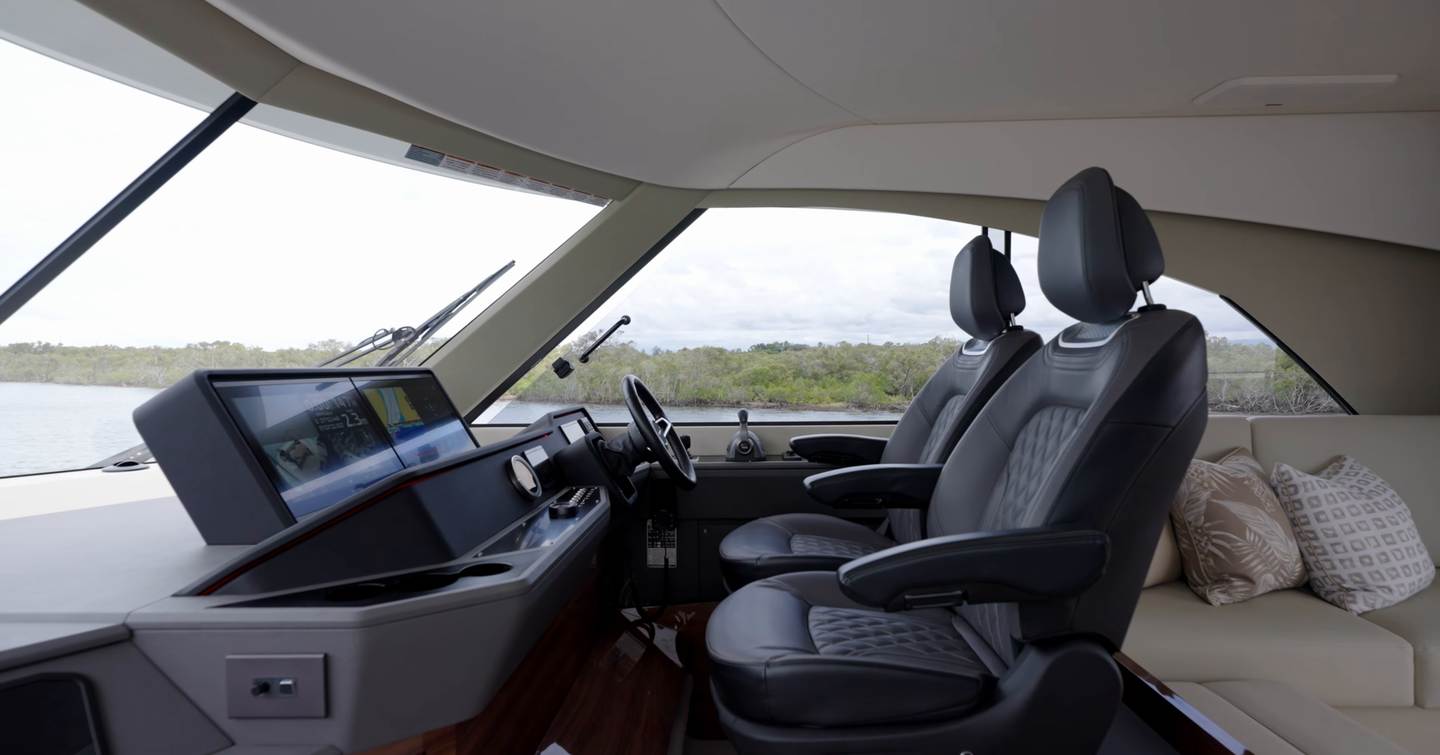
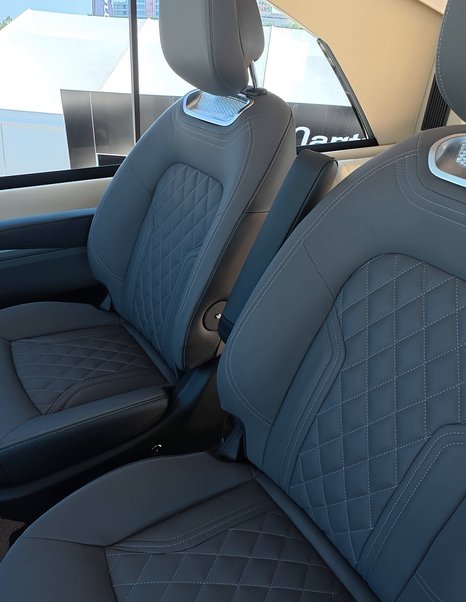
The seating is a standout part of the space, with large, heavily padded helm chairs that are electrically adjustable and built for long periods underway. They offer proper support and feel closer to a car seat than a typical boat chair, which makes a difference when covering distance.
The enclosed flybridge creates a controlled driving environment, with full protection from the weather and climate control built in. That changes how the boat can be used, particularly in mixed conditions, as you are not exposed while underway and can stay comfortable over longer runs.
There is plenty of glazing around the helm, along with opening sections and a skylight above, so you still get natural light and airflow when conditions allow. It avoids the space feeling closed in, and you can bring in fresh air when needed without relying entirely on air-conditioning.
A small seating area sits alongside the helm, so others can stay nearby while underway, and that keeps the space usable beyond just the person driving. It is not a large social area, but it works for short periods and adds to the flexibility of the space, ending with those twin adjustable helm seats at the centre of it.
The aft end is set up as a working and living space right by the water, and that intent comes through straight away in how everything is grouped together. Cooking, storage and access to the sea all sit in one place, so when the boat is at anchor this becomes the main area people gravitate towards.
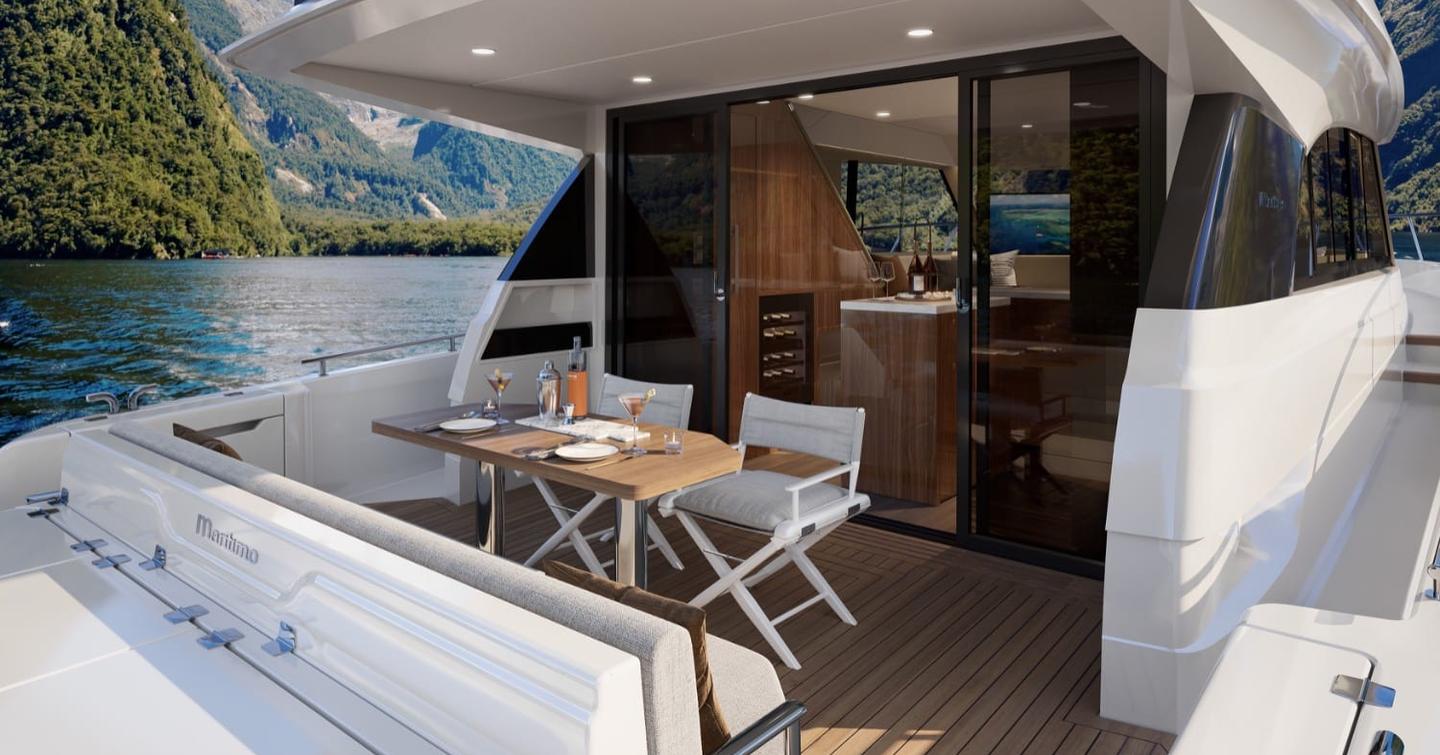
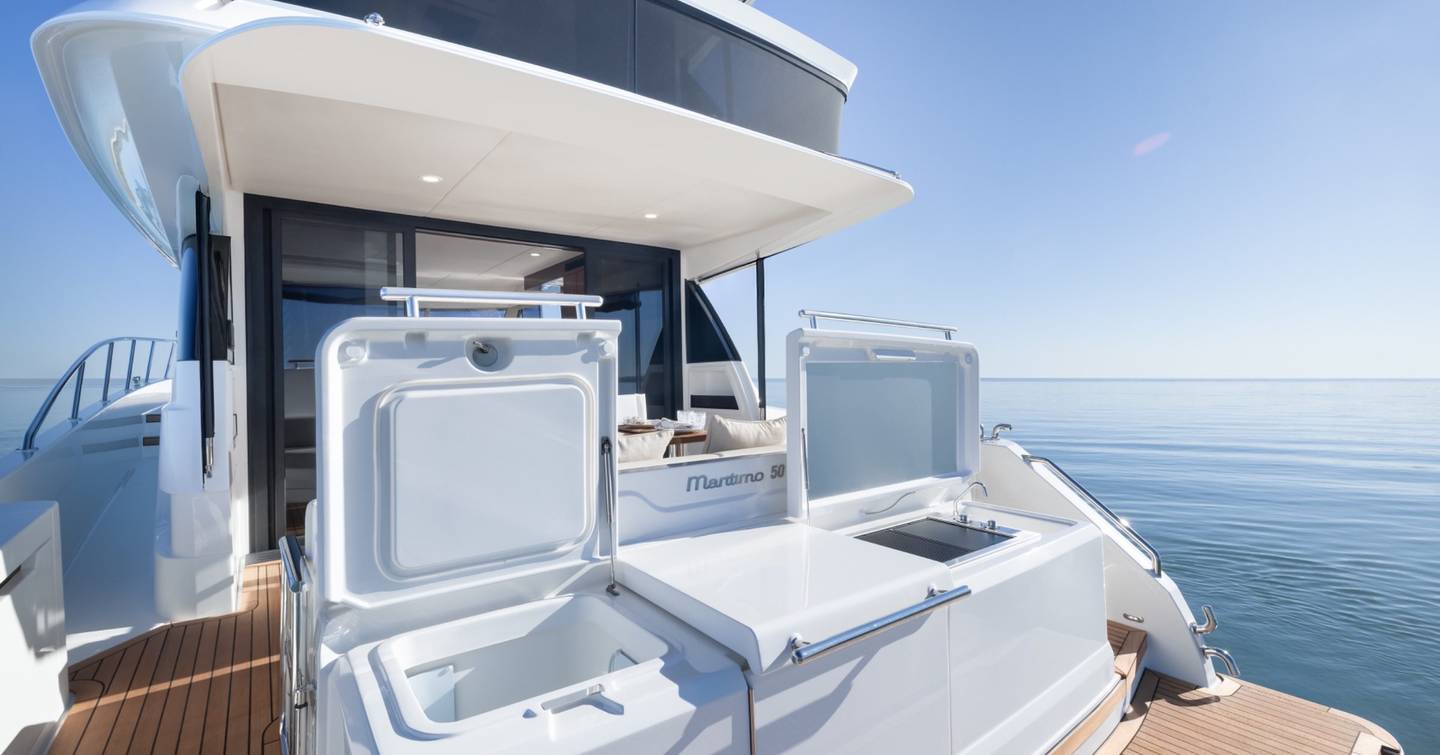
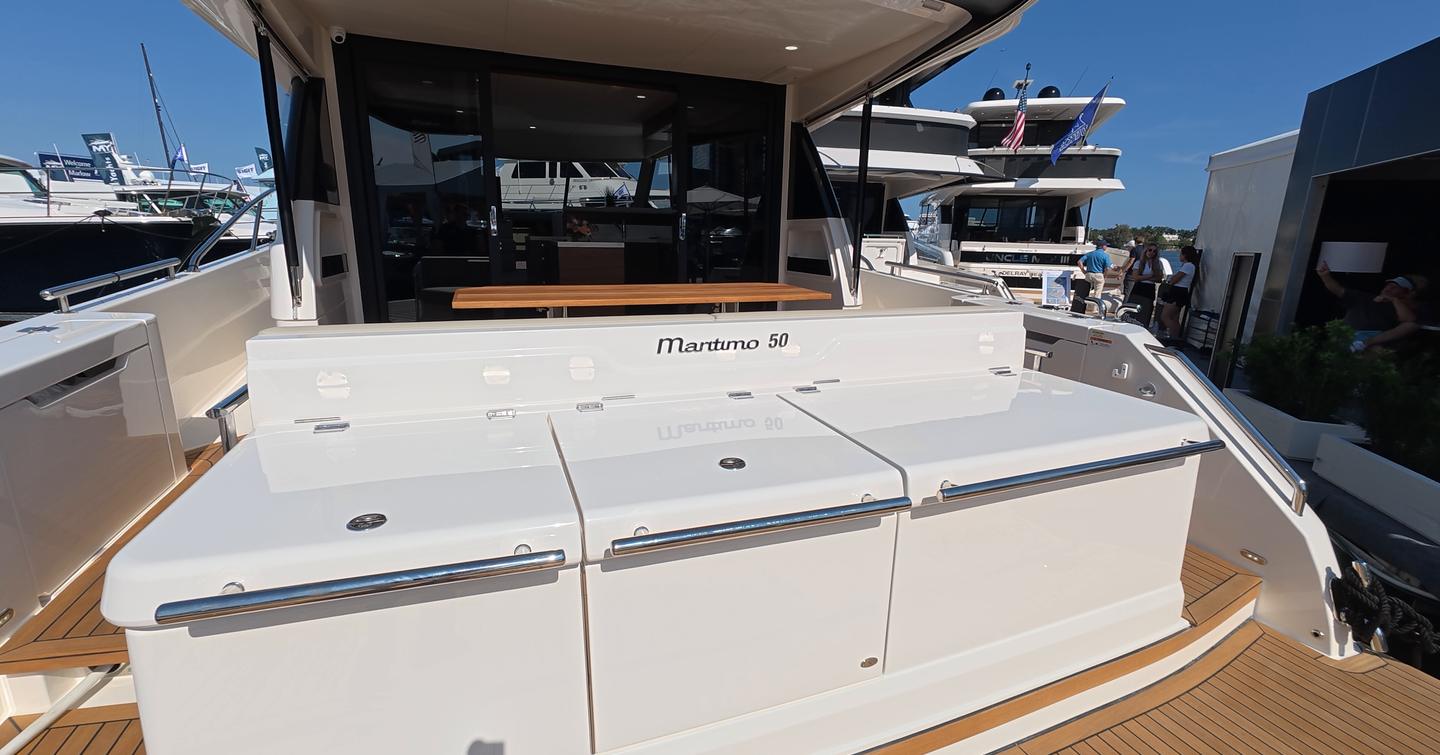
Across the transom, there is a built-in utility module with a fridge, twin grills and a sink, all positioned at the back of the cockpit so they are easy to use without moving far from the platform. That layout works well in practice, as you can cook, prepare drinks and stay connected to anyone in the water or sitting just aft, and it avoids the need to keep moving in and out of the saloon.
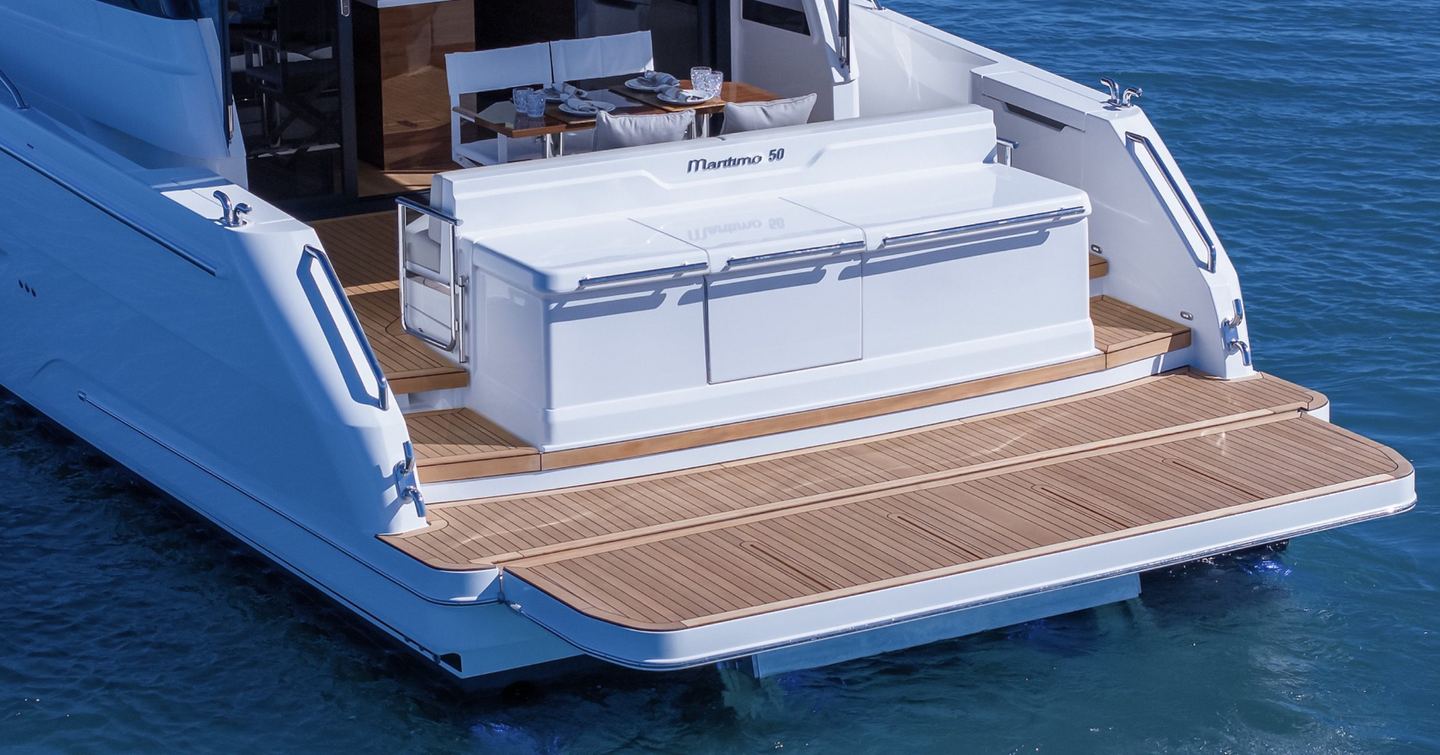
Access to the lazarette is built into this same module, with a hatch and ladder leading down into a large storage space that is kept separate from the engine room. It is easy to get into and properly usable once you are there, so it feels like a space that will actually be used rather than one that is awkward to reach.
The hydraulic bathing platform sits just aft of this and drops down into the water, so it can be used for launching a tender or as a place to sit at water level. It extends the usable space when you are anchored, and with the cooking setup just above it, the whole area works as a single zone focused on being close to the water.
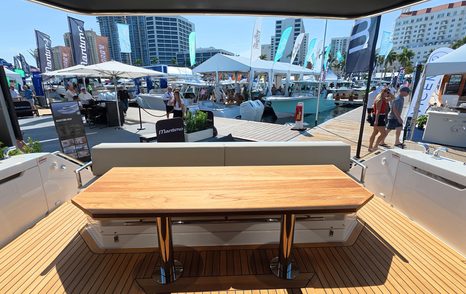
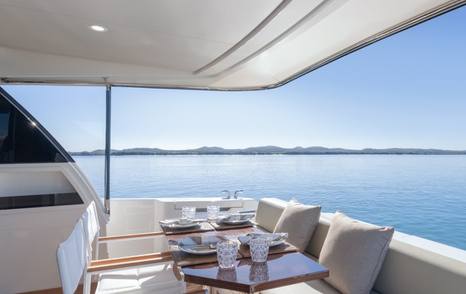
Stepping up into the cockpit, there is a fixed bench with space to add loose seating, and the extended roof gives a good amount of shade across the dining area. That protection makes it a comfortable place to sit for longer periods, and the position just forward of the platform keeps it connected to the action at the back of the boat.
Rope lockers are covered so lines and gear can be stowed out of sight, a deck shower sits close to the platform for rinsing off, and cleats are positioned to make tying off a tender straightforward, while the stereo system is integrated neatly into the structure rather than added on. Build quality comes through in the physical details, with solid-feeling mouldings and heavy stainless steel hardware that gives a sense of durability.
Side Decks & Foredeck
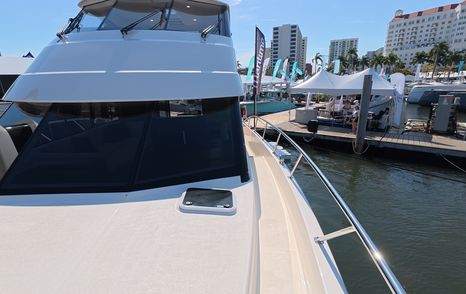
The side decks, which are wide enough to walk along comfortably without turning sideways. That makes a difference straight away, as you are not picking your way forward, and it gives a sense that the boat is set up for regular use rather than occasional trips forward.
The layout is symmetrical, with clear access down both sides, and the height of the bulwarks adds a level of security when moving along them. It is a simple setup, but it works, and it is the kind of detail that becomes more important the more time you spend on board, especially when conditions are less settled.
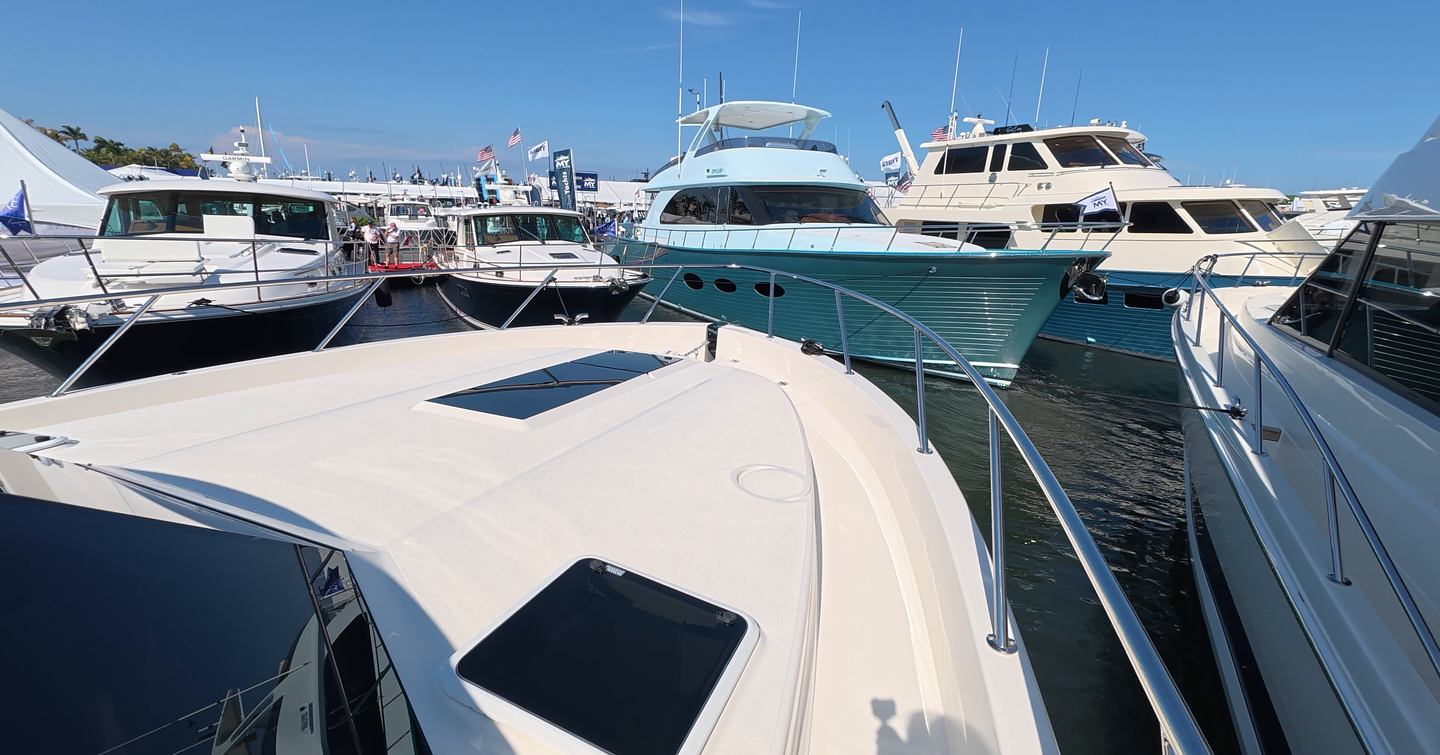
As you move forward, the foredeck keeps things clean and uncluttered, with a low-profile shape that can be used for sunbathing by adding loose cushions. The surface is very bright in its standard finish, which reflects light well but can feel exposed in strong sun, and that is one of the few areas where it comes across more as a blank canvas than a fully resolved lounging space.
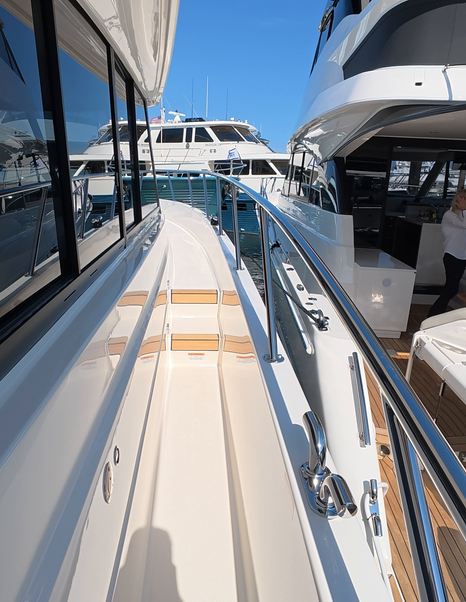
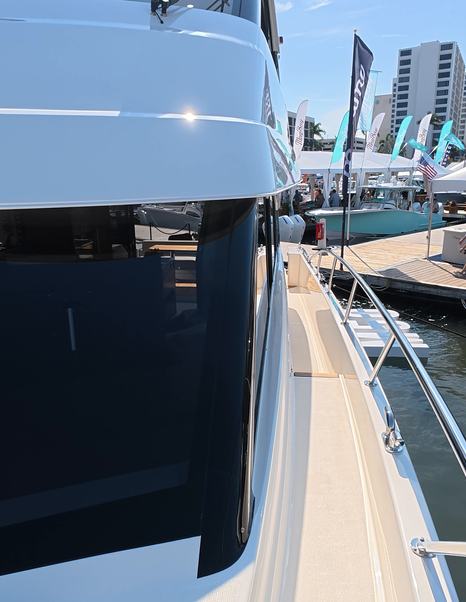
There is a gentle step up onto the coachroof, so moving between levels is easy, and the glazing set into this section brings natural light down into the forward cabin below.
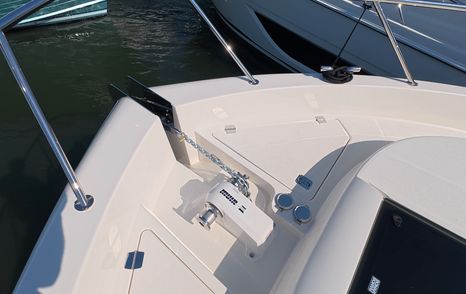
Right forward, the anchor is set into a recessed well, which keeps mud, water and debris contained in one place rather than spreading across the deck. It is a small detail, but it shows a clear focus on keeping the boat tidy and easy to manage after anchoring.
Anchor lockers sit either side of this well and provide good storage for lines and gear, and their size matches the overall practical tone of the deck layout.
Engine Room
Access to the engine room is through a hatch in the cockpit, and you don’t need to move the table to get into it, so it’s quick and easy to drop down. There’s a proper ladder in place as well, and once you’re down there, the surfaces are soft underfoot, which sounds like a small thing but makes a difference if you’re moving around.
The big thing here is the space. There’s a lot of room around the engines, and you can walk down both sides without having to squeeze through, which you just don’t see that often at this size. It immediately feels like an area you can actually use rather than just look at.
You’ve got twin Volvo Penta D13-800s on straight shafts, and the way they’re installed makes life easy. You can get to filters, dipsticks and all the usual service points without reaching blindly, and you’ve got clear access down into the bilge as well, so routine checks are straightforward.
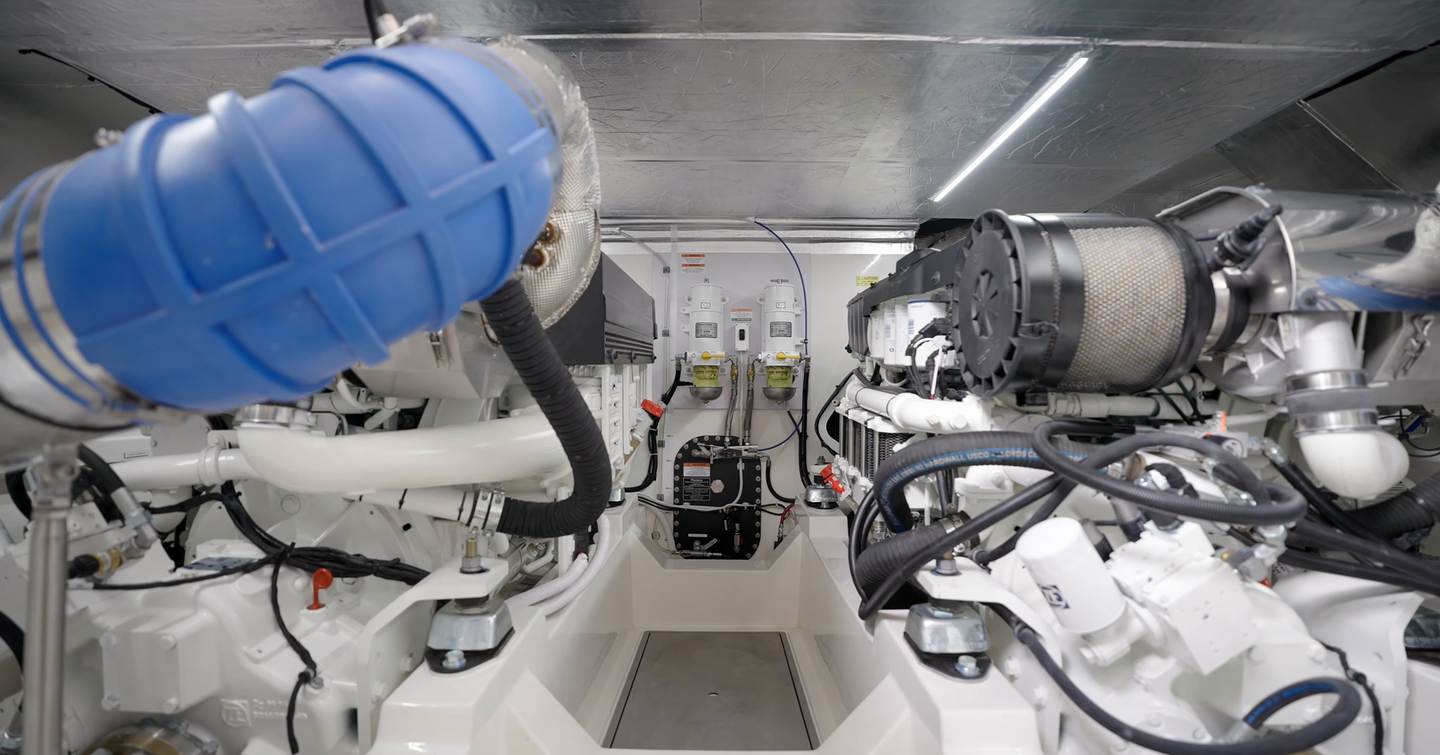
Everything is laid out in a very clean, logical way. Pipe runs are tidy, systems are easy to follow, and nothing feels buried or awkward to get to, which makes a big difference if you’re trying to keep on top of things yourself.
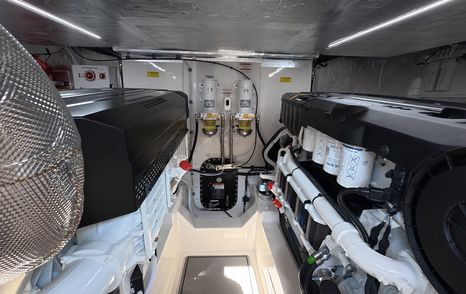
Fuel filtration is handled through Racor filters with clear bowls, so you can see what’s going on with the fuel straight away. Again, it’s a simple detail, but it’s the sort of thing that makes ownership easier over time.
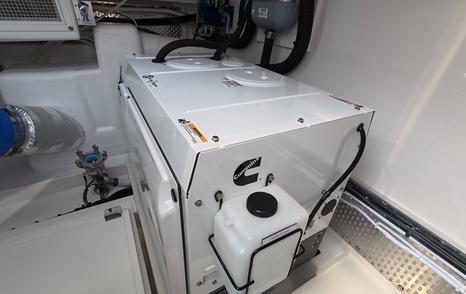
There’s still space further aft as well, even with the lazarette behind, and you’ve got good access around the generator, so servicing it doesn’t turn into a struggle. It all adds up to an engine room that feels properly thought through.
Performance sits where you’d expect for this kind of setup, with around 22 knots at a cruise, close to 29 knots at the top end and a range in the region of 350nm. It’s set up to cover distance comfortably, and the way the engines and systems are arranged backs that up.
The base price for an M50 in the US is $2,500,000 ex tax. That puts it at the higher end of the price spectrum. Still, there are two things to consider: Maritimo's tend to come with a healthy standard specification, and the build quality and engineering are absolutely top-notch.
You'll pay more, but it's much closer to a turn-key spec as standard, and it's built to last. For example, air conditioning, a generator, a bow thruster and a stern thruster with remote hold all come as standard.
There are some key options that a boat like this needs to maintain comfort on board, however. It's a tall, high-sided boat, so the trim system and stabilisers are a must-have to maintain comfort at anchor.
Our Verdict
The M50 feels like a very deliberate piece of thinking, and you can see that most clearly in the areas that are easy to overlook, particularly the engine room and the way the boat is laid out around access and movement. It is straightforward to understand, easy to get around and, importantly, easy to look after, which is exactly what you want from something that is aimed at owner use.
The two-cabin layout is the point that will divide opinion. If you want three cabins in this size range, this is not the boat for you. But what it does instead is give that space back to the owner, with larger cabins, better storage and a layout that feels less compromised when you are spending time on board.
Reasons to Buy
- Excellent engine room access
- Enclosed flybridge
- Easy owner operation
- Offshore prowess
Things to Consider
- Only two cabins
- Foredeck lacks seating
- Ungainly styling
Rivals to Consider
The Riviera 50 Sports Motor Yacht is closest in concept, with a similar enclosed flybridge layout and a broader family-cruising brief, but it takes a different approach in how that space is used. At around 17.01m to 17.02m (55.8ft) LOA, with a 4.95m to 4.96m (16.2ft) beam and 1.45m (4.8ft) draft (there are two different generations, differently sized), it runs Volvo Penta IPS950 drives as standard, with some offering shaft-drive MAN i6-800 alternatives, and carries around 3,300 litres of fuel. It keeps a three-cabin, six-berth layout with two bathrooms, which will appeal to buyers needing maximum accommodation, while its design leans more toward multi-purpose family use with a sports cockpit and mezzanine seating. Against that, the Maritimo M50’s 5.22m (17.1ft) beam, shaft-drive setup and stronger focus on machinery access and long-range use give it a different focus, particularly for owner-operators prioritising ease of maintenance and offshore capability over cabin count.
The Maritimo M55 Black Edition is the natural step up within the same range, and it keeps the same core DNA while adding scale. At 17.31m (56.8ft) LOA, with a 5.22m (17.1ft) beam and 1.47m (4.8ft) draft, it carries 4,550 litres of fuel and typically runs twin Volvo D13-800 engines on shafts, with performance figures not publicly specified. It introduces a third cabin within a six-berth layout and expands the overall volume, while retaining the enclosed flybridge, internal staircase and aft galley arrangement. The key difference is straightforward, as the M55 offers more range and an extra cabin, while the M50 delivers much of the same layout and beam within a shorter 15.88m (52.1ft) platform, which keeps ownership and handling more manageable.
The Viking 50ST comes from a different direction, with a strong focus on offshore sportfishing rather than cruising, and that shows in both layout and hardware. It measures 15.75m (51.7ft) LOA, extending to 17.02m (55.8ft) with the bow pulpit, with a 5.21m (17.1ft) beam and 1.45m (4.8ft) draft, and carries 3,785 litres of fuel as standard, rising to 4,542 litres optionally. Power comes from high-output inboards such as MAN V8 1200 MHP engines, with alternative options including Scania 1150 units, although official speed and range figures are not published. The layout includes two staterooms with flexible configurations and a fishing-led cockpit, supported by features such as a tuna tower and enclosed command deck. It is a more specialised platform, and while it can be used for cruising, the Maritimo M50’s layout, protection and engineering access give it a clearer focus on long-distance owner operation, while the Viking’s strengths sit firmly in its fishing capability and elevated sightlines from the tower.
Considering a new boat? Explore Maritimo's entire current range to find the model that best suits your needs, and compare it with alternatives from competitors to ensure you make the perfect choice.
Specifications
- Builder Maritimo
- Range M Series
- Model M50
- Length Overall 15.7m
- Beam 5.22m
- Draft 1.39m
- Hull GRP
- Cabins 2
- Berths 6
- Crew 1
- Yacht Type (Primary) Enclosed Flybridge
- Use Type (Primary) Cruising
- Cruising Speed
- Max Speed
- Fuel Capacity 3,700 Litres
- Fresh Water Capacity 750 Litres
- Engine Model 2x Volvo Penta D13-800
Maritimo M50 Layout
-
Flybridge
-
![Flybridge Maritimo M50]()
The only helm station is within the enclosed bridge
-
Main Deck
-
![Main Deck Maritimo M50]()
No lower helm means lots of space on the main deck
-
Lower Deck
-
![Lower Deck Maritimo M50]()
Just two cabins and two bathrooms, but they're very generous
Interested in a M50?
NEW Build
Find your local dealer for a personalised, no-cost consultation
or just request
Brochures & Pricing
Used & In Stock
Looking for a ready-to-go M50 or pre-owned options? Explore all inventory of the M50 available worldwide