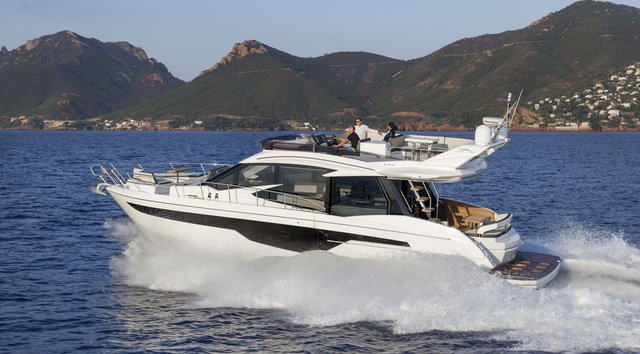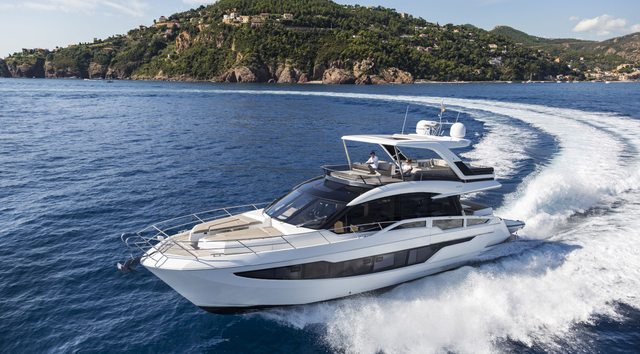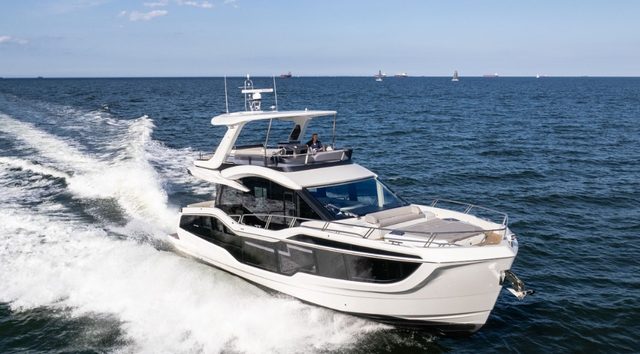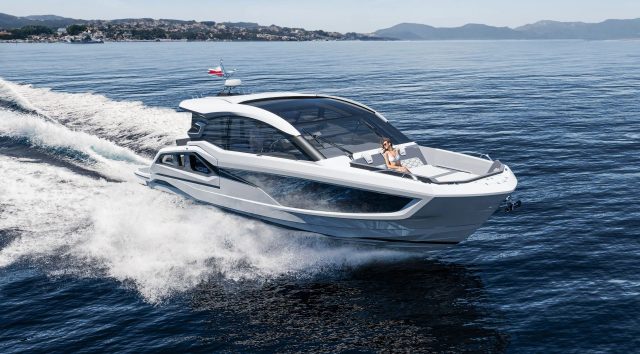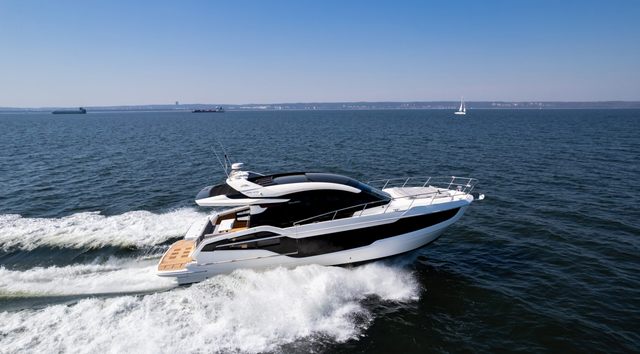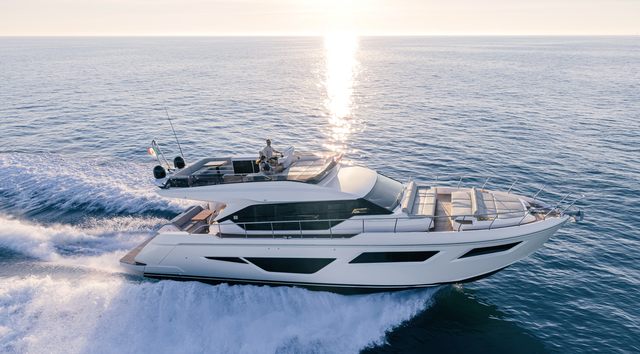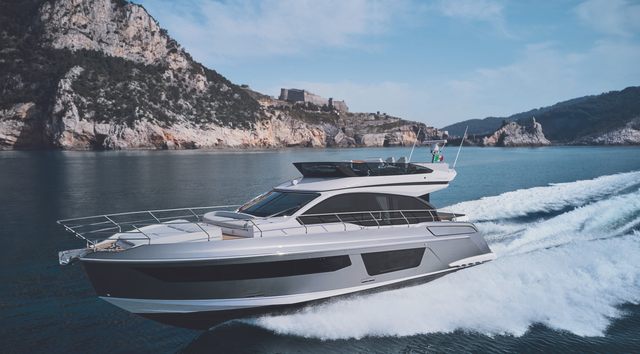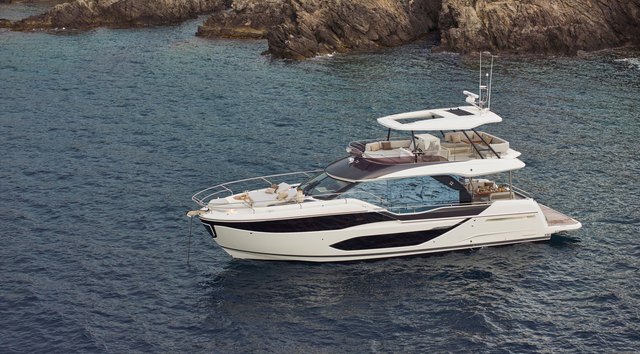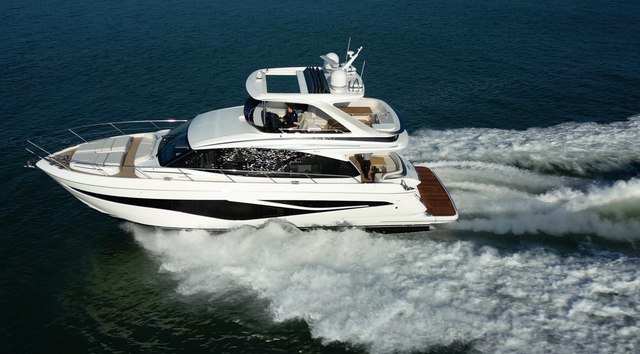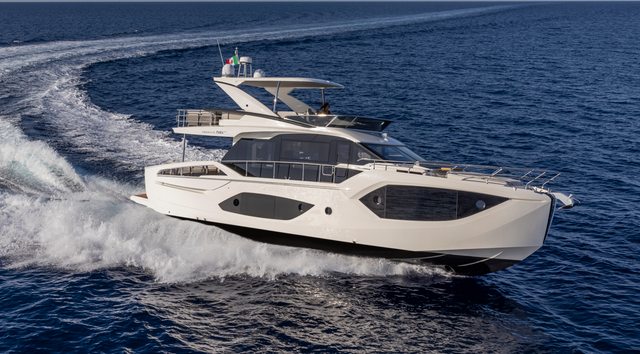
The 520 Fly arrives with a job to do. It replaces the well-regarded Galeon 500 Fly, and with Galeon now seen as one of the arch innovators in this sector, there is an expectation that this boat will move things on rather than simply refine what already worked.
This is not a clean-sheet design as it carries over the hull from the 500 FLY, so the fundamentals of performance and handling stay the same, and the changes focus on how the space is used above deck. Galeon has aimed to improve day-to-day living with wider social areas, more flexible layouts, and a stronger link between cockpit and interior, while keeping clear distance from the larger Galeon 560 Fly.
Review Video
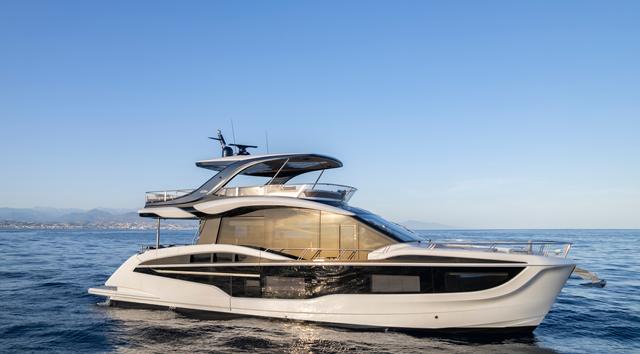
The exterior design of the 520 Fly, as it has been for some time, is by Tony Castro, and that continuity shows in the profile with long glazing panels and a shape that reads clearly as a Galeon. Inside, there is a change. The interior comes from Insitu & Partners, bringing a warmer tone with gloss finishes, brass accents, and softer colours in the amber palette.
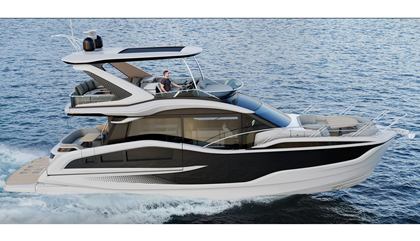
At 17.2m (56ft) overall with a beam of 4.61m (15ft), the 520 Fly sits squarely in the 50-55ft flybridge class, and that beam extends to around 6.7m (22ft) when the balconies are deployed. Draft is 0.92m (3ft) and light displacement is about 26.2 tonnes, so the numbers fall in line with the sector.
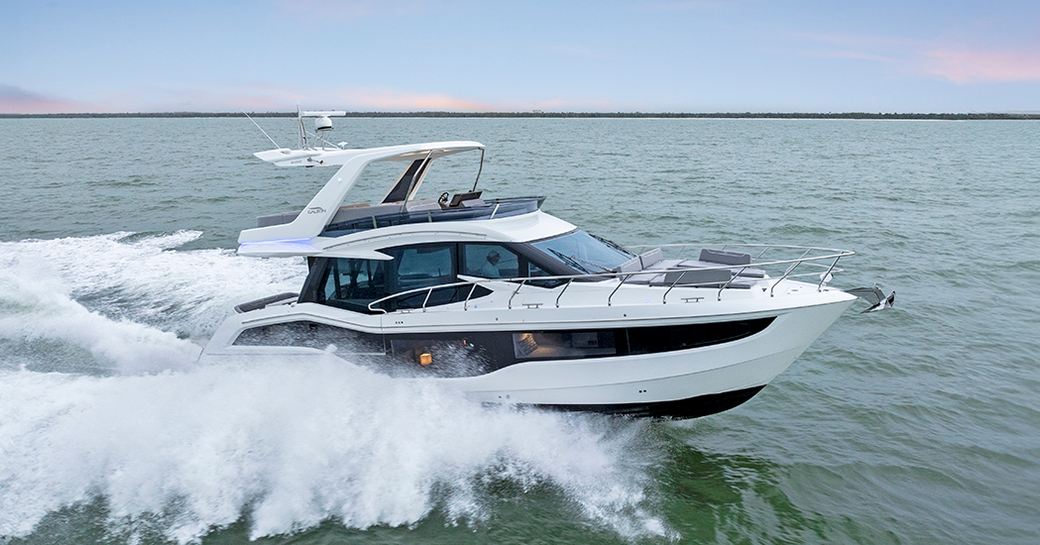
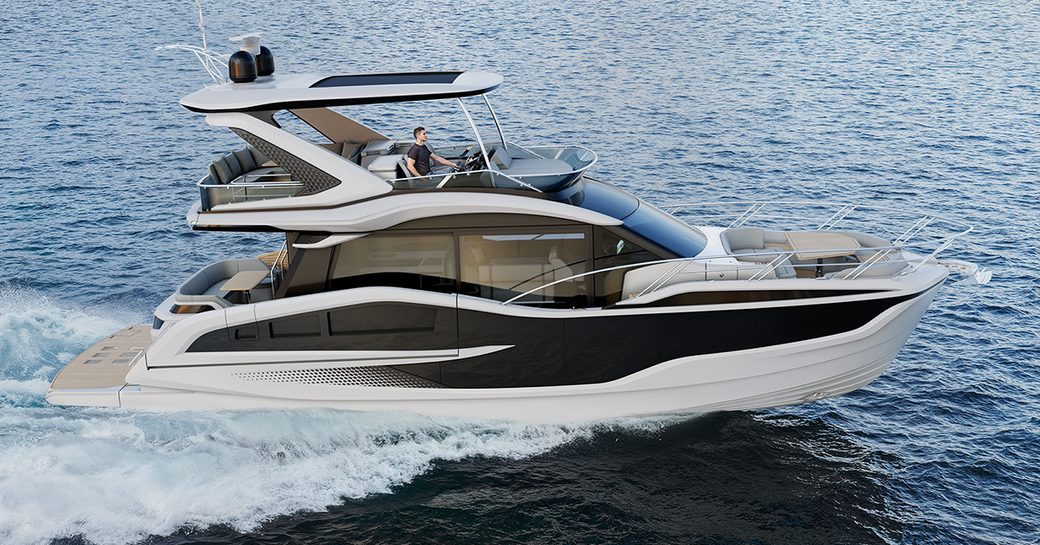
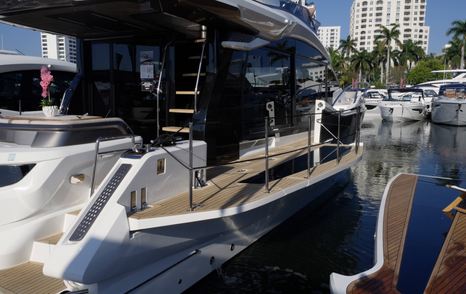
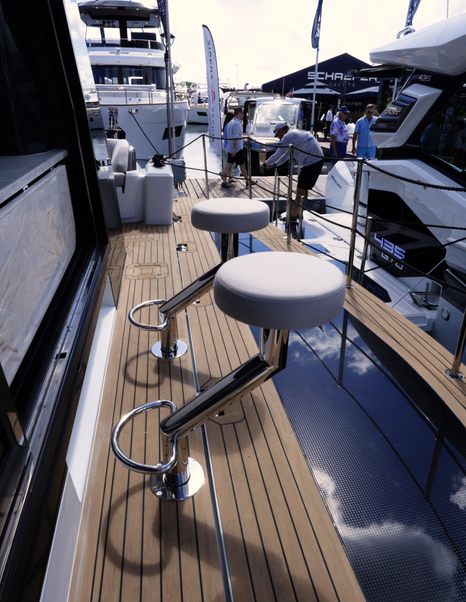
Those balconies remain the defining feature, and they have been developed nicely. The drop-down wings are larger, they operate more smoothly, and they now include glazing in the soles so you can see the water below.
Construction remains consistent with Galeon’s usual approach. The hull, deck, and superstructure are GRP, built using hand lay-up and vacuum infusion, and the interior joinery is produced in-house. The difference here is the level of structural demand. Drop-down balconies, large glazing sections, and hydraulic systems all add complexity, and they place more load into key areas of the boat.
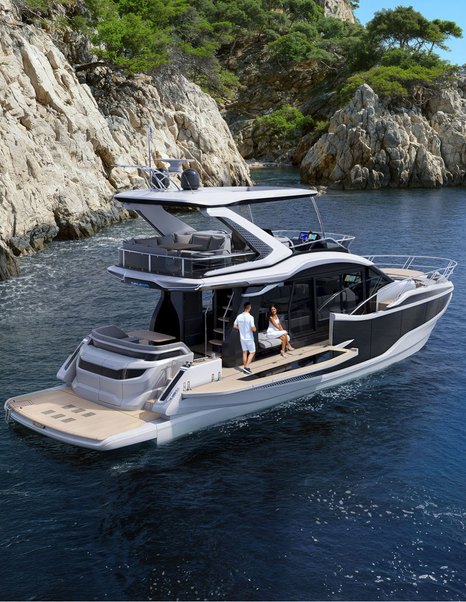
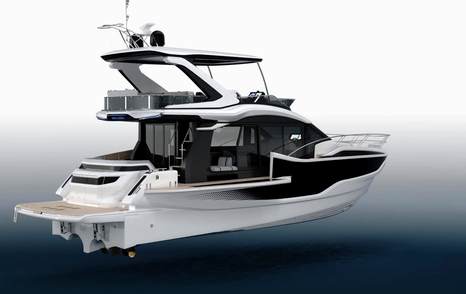
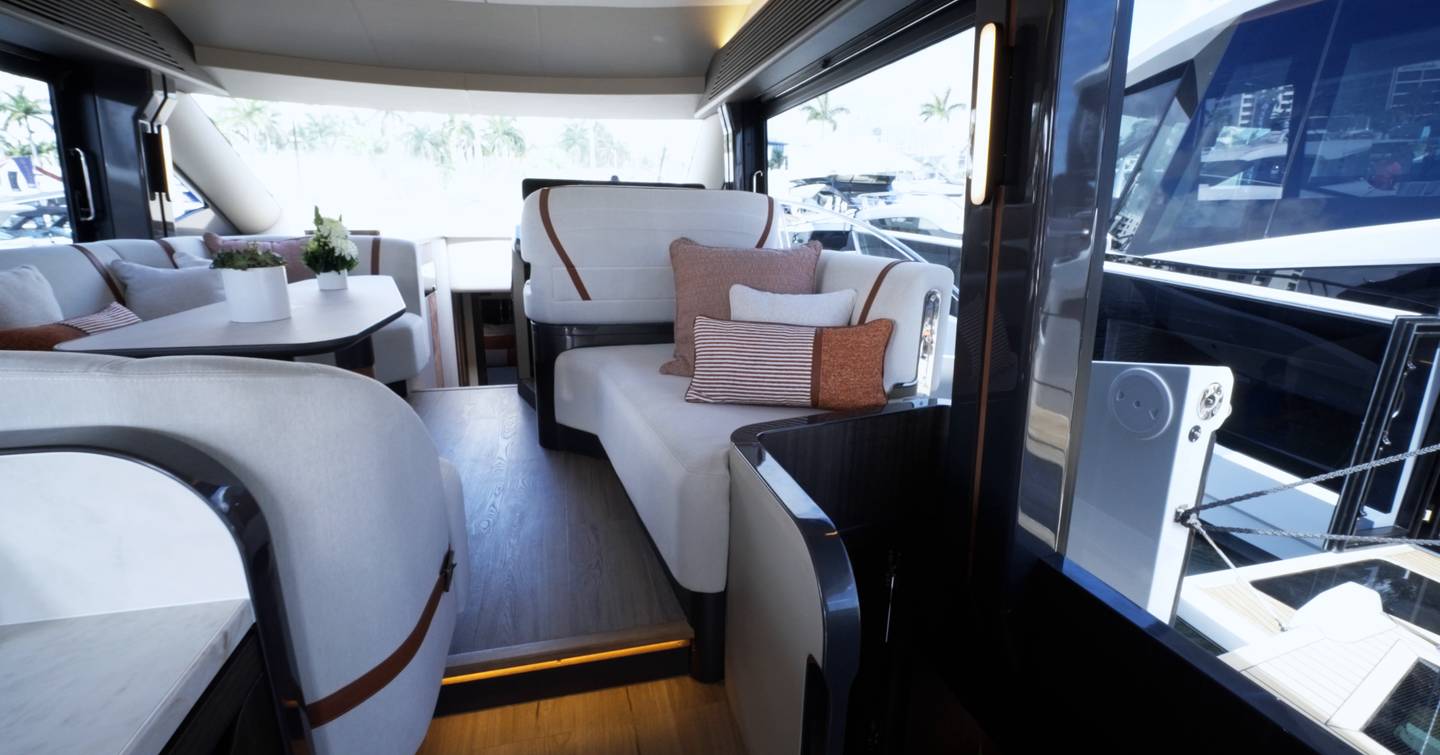
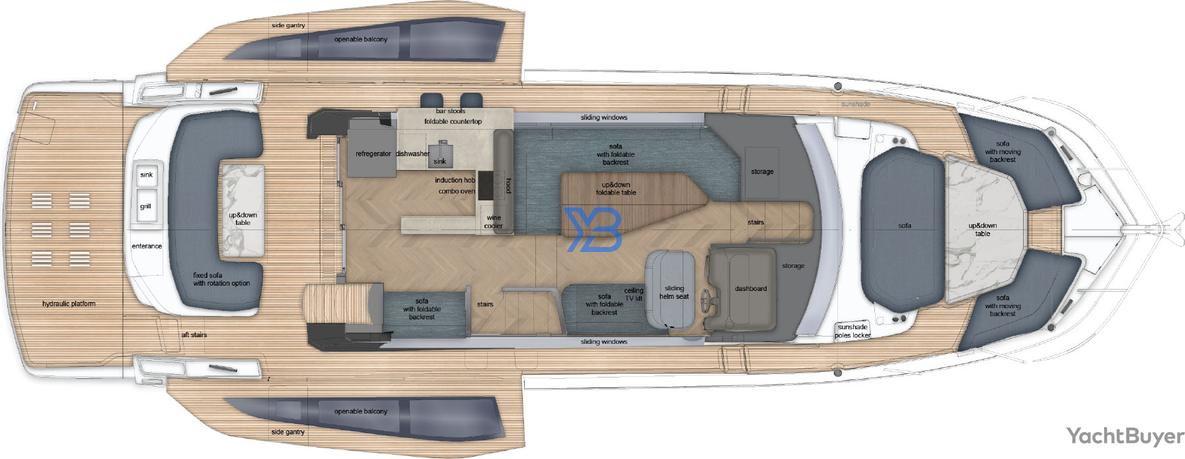
The cockpit, saloon, and galley sit on one level, so this entire deck links as a single space, and once the balconies are down, the change in width is genuinely impressive. There are no steps to break it up, and you can move from the aft seating through to the forward lounge without interruption.
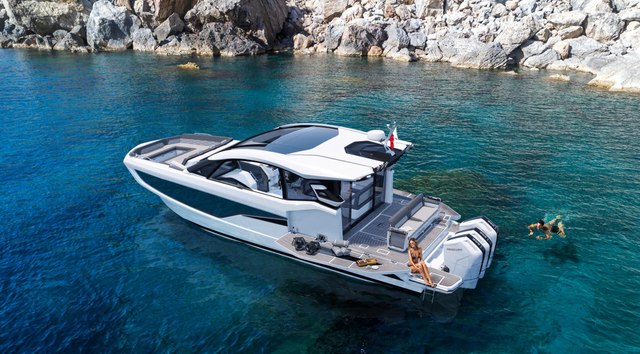
At the aft end, the sliding glass doors open wide, and with Beach Mode deployed, the sides fold out to extend the deck beyond the hull. That brings the water closer to eye level and gives this part of the boat a broader feel than you expect at 17.2m. It also lets air move freely through the space, so on a warm day, you can keep everything open without relying on the air-con.
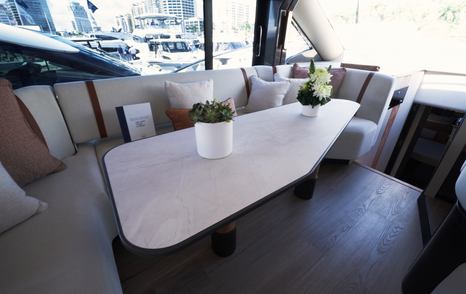
The main sofa sits to one side, leaving a clear walkway through the middle, and it is arranged so you stay connected to the cockpit and the view rather than facing inward. Where the two-way backrests are fitted, you can turn the seating to face outboard or aft, which sounds like a small detail, but improves how people use the space once the balconies are down. It's not just about adding the balconies; it's how they work with the rest of the space.
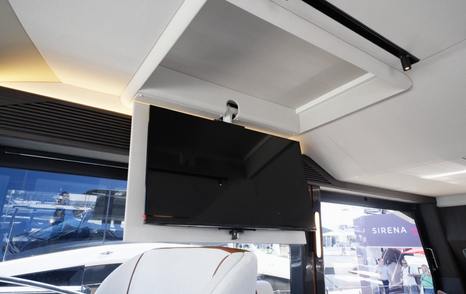
Forward, the secondary seating area works as a flexible zone. There is a table at the centre, a television drops down from above, and the surrounding seating can be adjusted to face into the saloon or overlooking the sea.
Galley
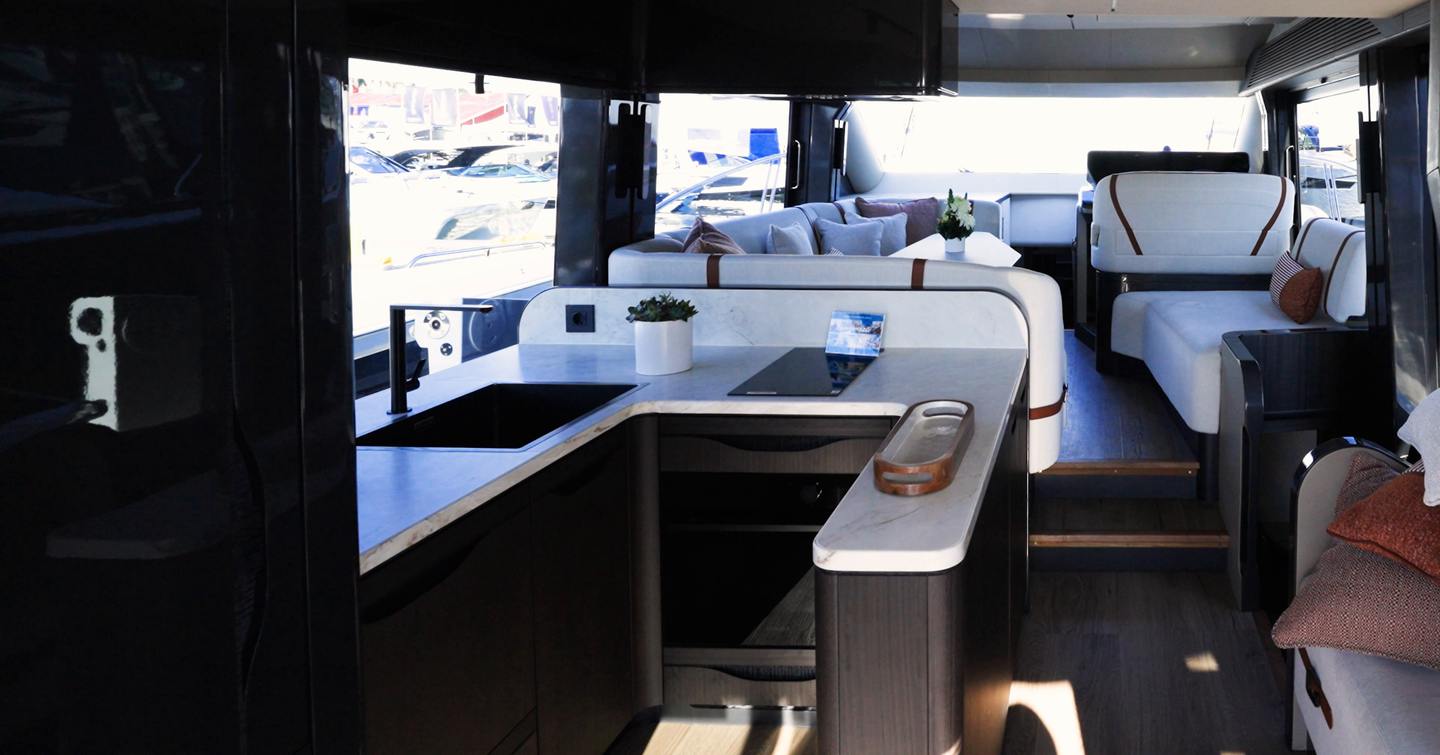
Positioned aft on the same level, the galley is very much part of the action. The side window opens wide, so you can pass food and drinks straight out to the cockpit, and it keeps whoever is cooking involved rather than tucked away. It also helps with airflow, which is useful if you're using the hob or oven.
The working area is compact but usable. Hob, sink, and storage sit within easy reach, and there is enough surface space to prepare food without blocking the passage through to the cockpit. One detail on this early boat stands out. The fridge uses a standard latch, and with heavy bottles inside, it could open if the boat rolls, so it would be a good idea for Galeon to add a locking catch going forward.
Owner's Cabin
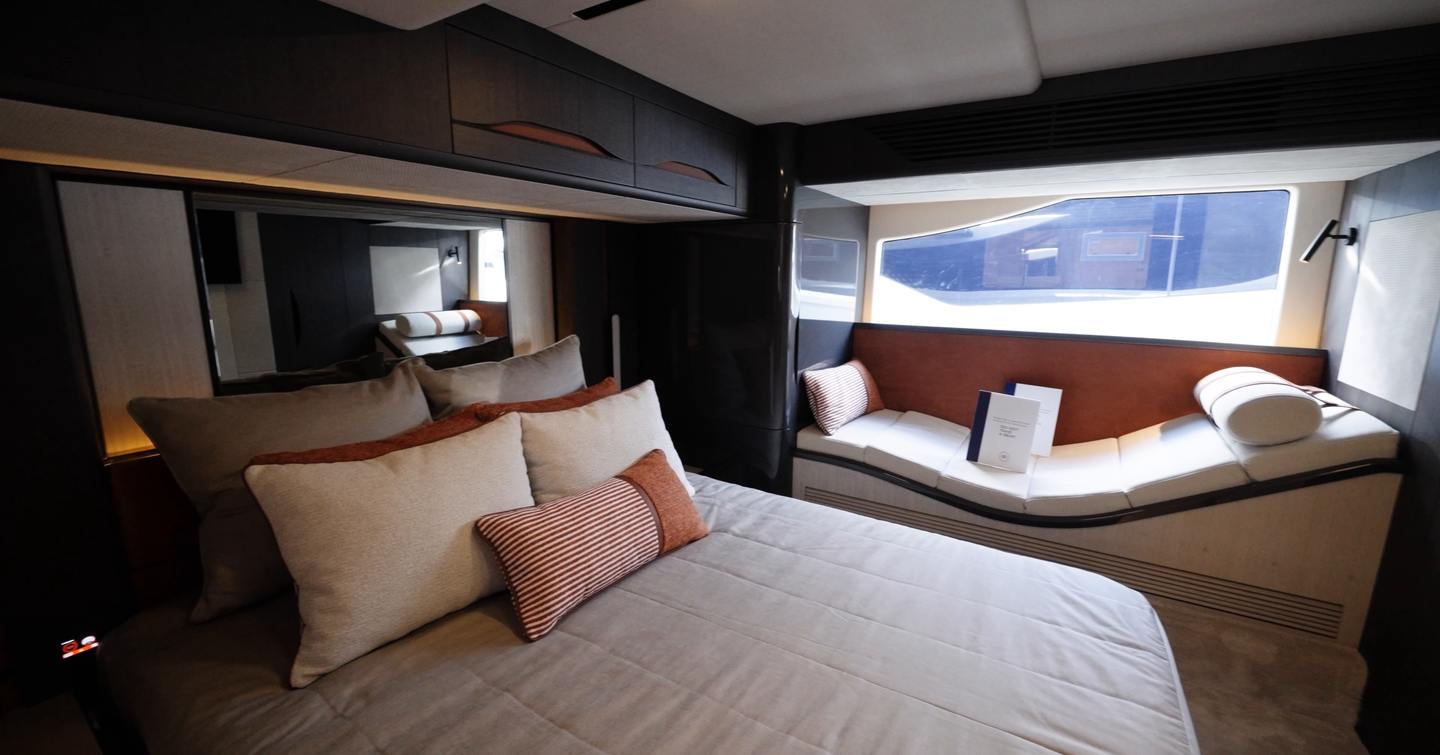
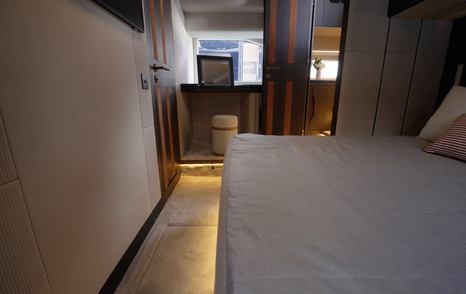
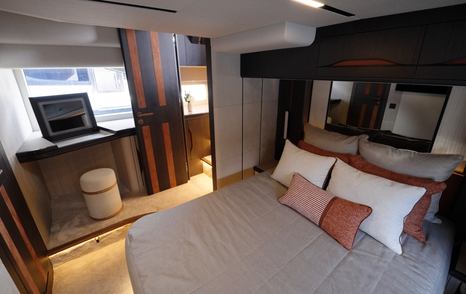
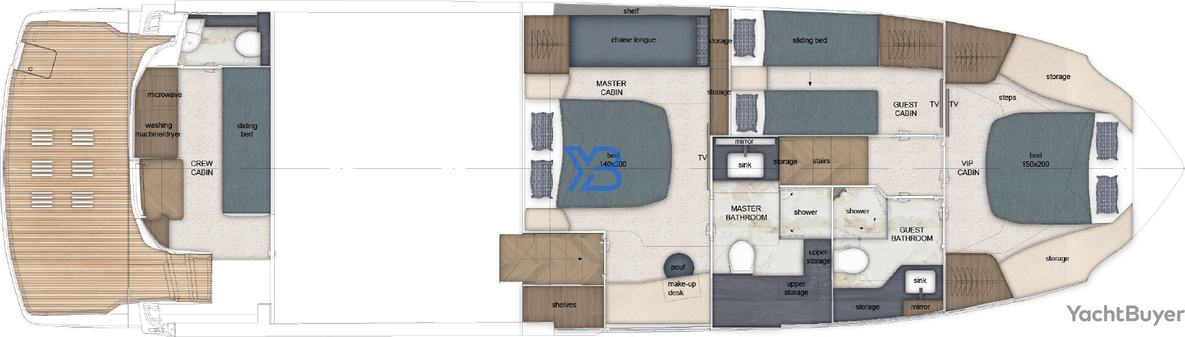
Down below, the cabin runs full beam and sits midships, and the first thing you notice is the split-level floor. You step up on either side of the bed, and there is another small level change into the bathroom, so you do need to be aware of that when moving around, especially at night.
The bed itself is a good size, set centrally with space to move around it, and there are proper bedside tables and wall-mounted lights on either side. Off to one side sits a chaise longue, and while it looks the part, it does raise a question. Storage is not lacking, but more drawer space here would likely be more useful day to day than a seat that may not see much use.
Light comes in through large hull windows, but the overall feel of the cabin is still on the darker side. The materials and colour palette are warm and quite dark, so it does feel a bit gloomy down here despite the large hull windows.
Storage is spread around the cabin, with wardrobes, cupboards, and a bureau built in. That desk folds down to create a usable workspace, and it is a practical addition if you need somewhere to sit with a laptop or organise things.
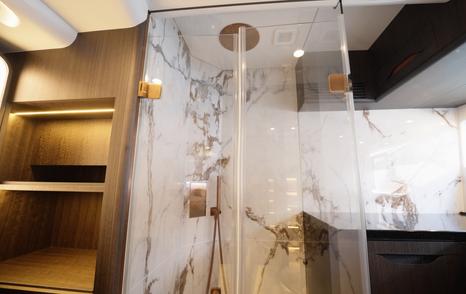
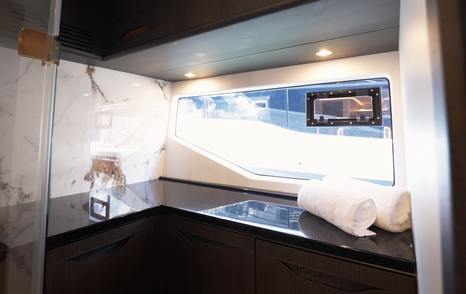
The ensuite bathroom is well-sized for the class. There is enough headroom to move comfortably, a separate shower with good height, and a decent amount of counter space around the sink. One small point here is the lack of fiddles on some of those flat surfaces, so items could move around when the boat is underway.
Guest Accommodation
Forward of the owner’s cabin, the guest area is arranged more conventionally, with two cabins sharing a bathroom, all accessed via a central companionway.
The bathroom itself stands out for its size. There is a separate shower, good headroom, and enough space to move without feeling restricted, and the finish has a bit more detail than before, with brass fittings and darker sink units adding some contrast.
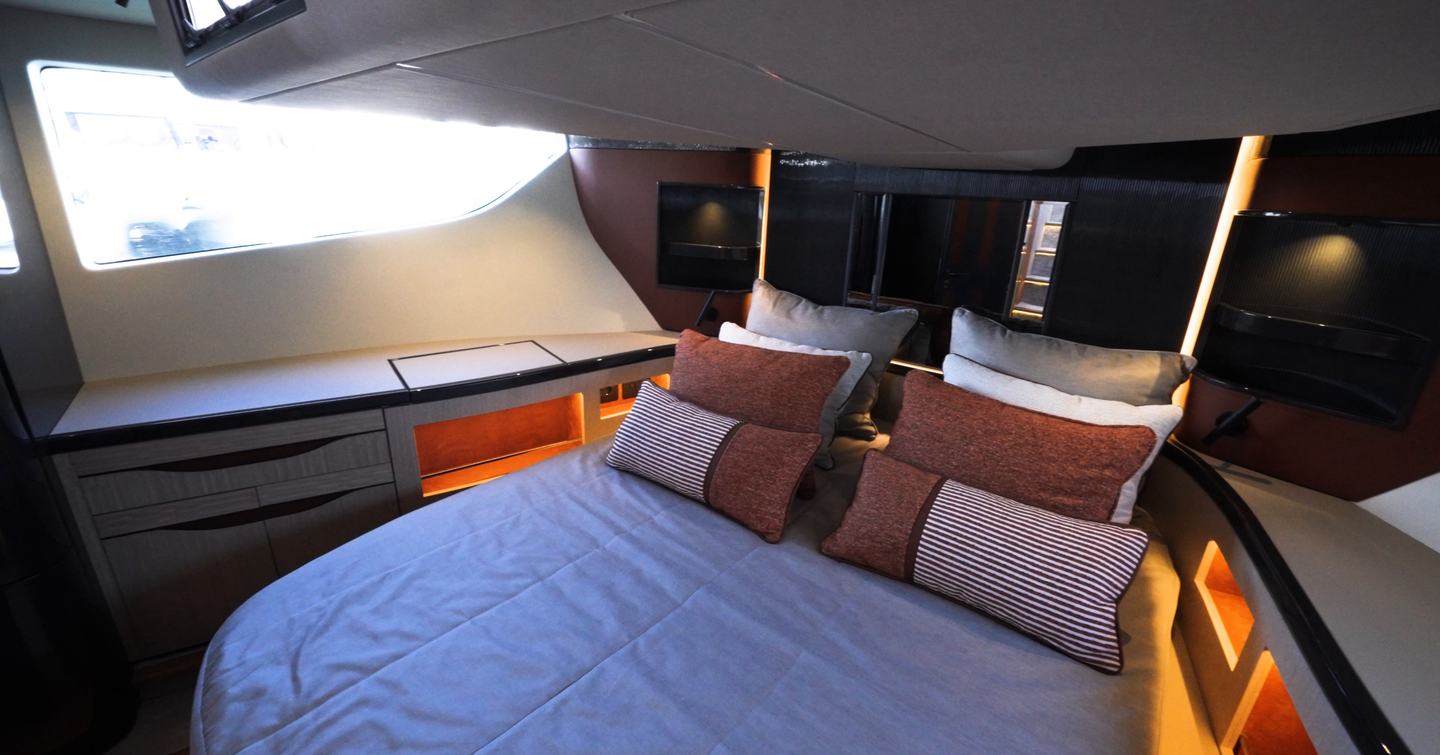
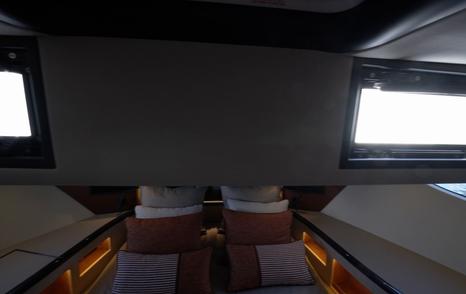
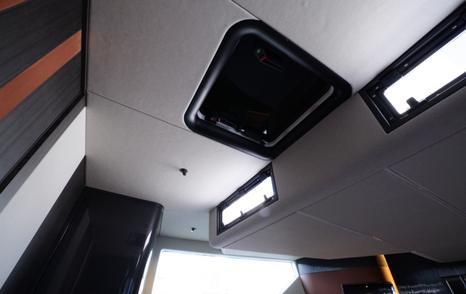
The VIP cabin sits right in the bow, and it benefits from hull windows as well as overhead glazing, so there is a good amount of natural light. The bed is well-sized, and there is enough clearance to sit up comfortably. The foredeck seating above does intrude slightly into the space, but it is softened and shaped in a way that minimises the intrusion.
Storage in here is well handled. There are drawers beneath the bed, wardrobes to either side, and small shelves and cubbies for everyday items, along with reading lights and charging points where you need them.
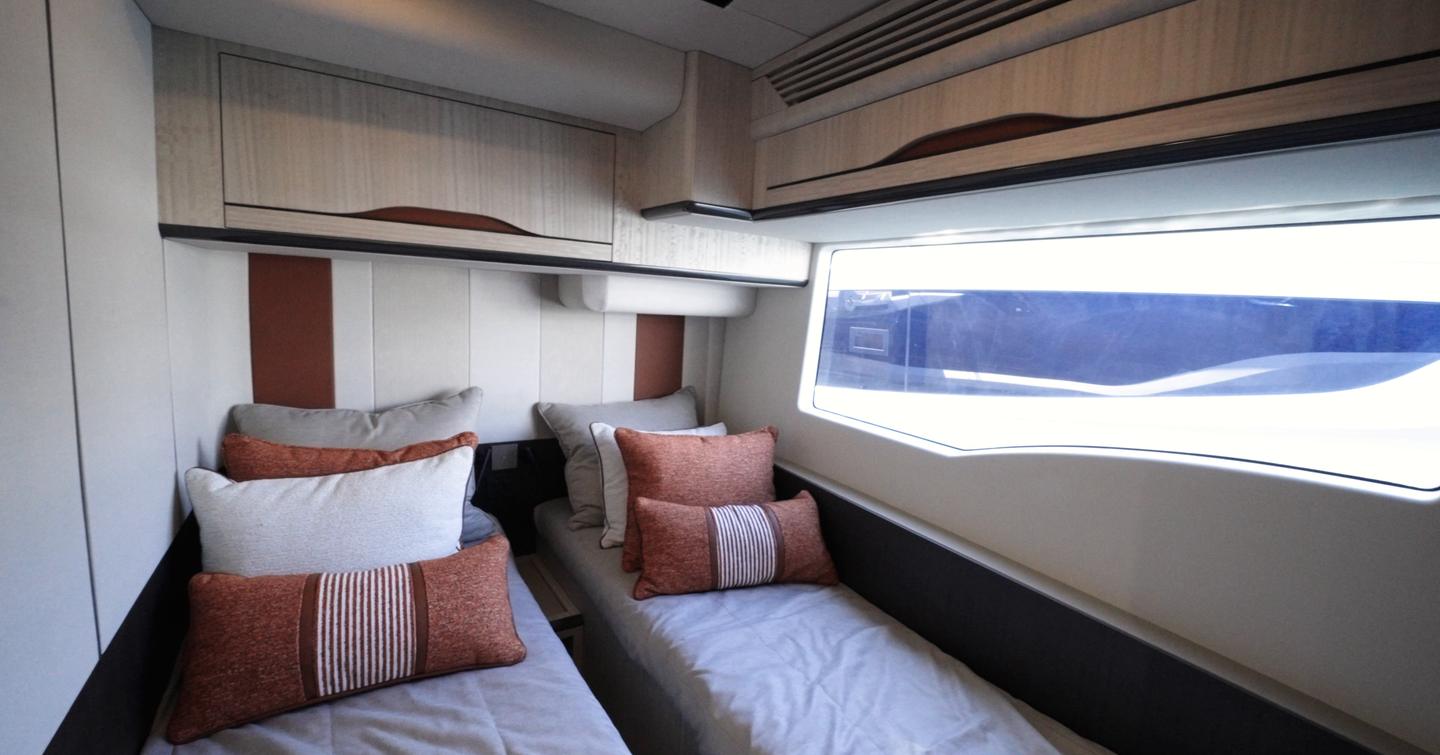
The twin cabin is on the starboard side, and the beds can slide together to form a double, so it gives you some flexibility depending on who is on board. In practice, it suits children well, while adults will be comfortable enough for shorter stays rather than extended time on board.
It is a tighter space than the VIP, but a large hull window keeps it from feeling claustrophobic, and there is still enough storage with a wardrobe, overhead lockers, and a small cubby between the beds.
Across both guest cabins, the materials follow the same direction as the rest of the boat, with warmer tones and softer finishes, and the overall feel is more restrained than earlier Galeons.
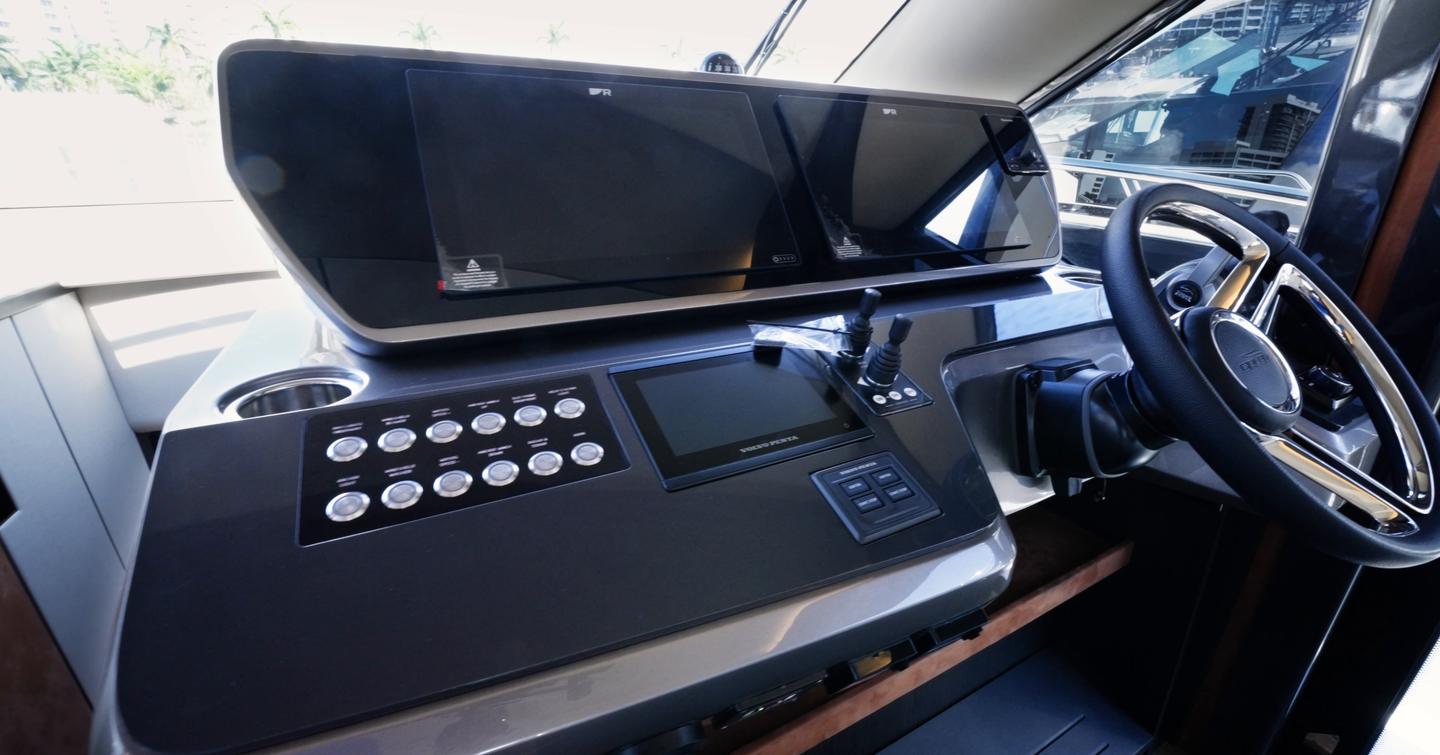
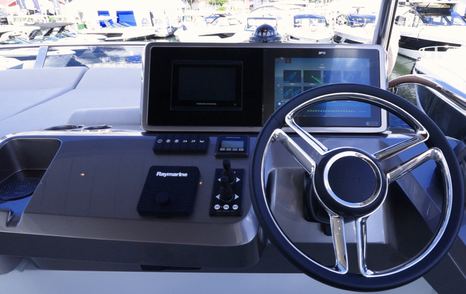
The dash is clean, with twin multifunction displays handling most of the work and only a small number of physical switches, so it is easy to read at a glance.
The seat position takes more effort to get right. It is positioned quite a long way back from the dash, so you rely on the adjustable wheel and the bolster to bring yourself into position, and while you can make it work, the seated position could be better.
From there, visibility forward is generally good, and you can see the bow clearly enough, but the windscreen is on the shallow side, so the real test will be how that view holds up once the boat is up on the plane.
The side door is where the compromise is most obvious. It is large, and that makes stepping out onto the side deck quick and easy when manoeuvring, but it is too big to use as a simple ventilation point, so you are unlikely to leave it cracked open underway. You gain access, but you lose that day-to-day easy ventilation and communication with the crew.
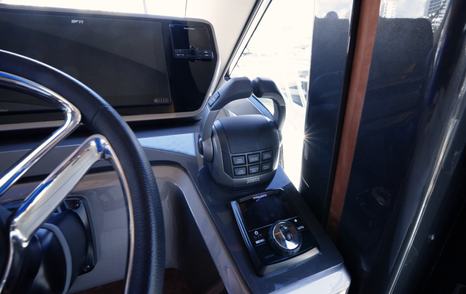
Flybridge Helm
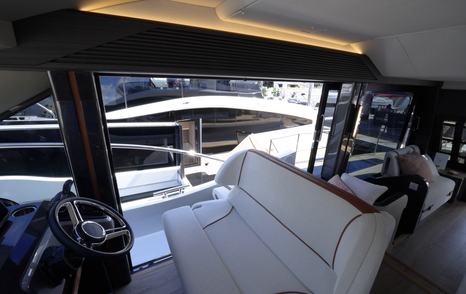
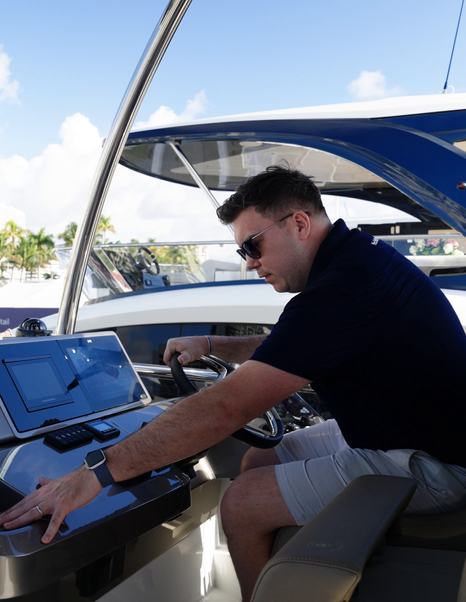
Up on the flybridge, the helm has a clear, elevated view, and this is where you will want to drive from most of the time. You get a much better sense of the boat’s position from up here, especially when manoeuvring.
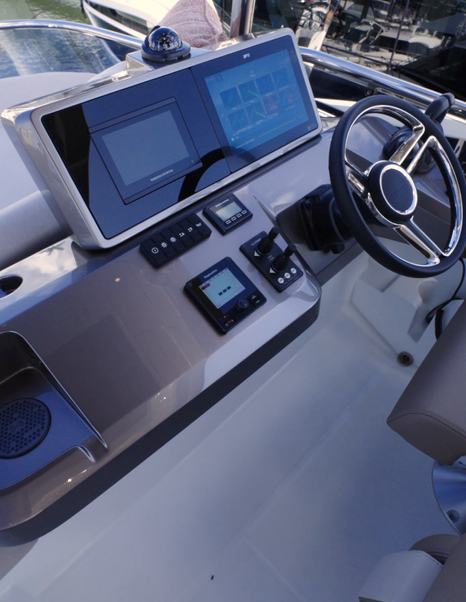
The layout mirrors the lower helm, with twin screens ahead and a simple control setup, but the screens themselves are not especially large, and it does feel like there is room to improve this. There is space to add another display, and that would make a noticeable difference, particularly if you want to split functions across multiple screens.
In fact, the current setup could be arranged better. The Volvo Penta display could be mounted on the lower dash to make space for an MFD on the upper dash.
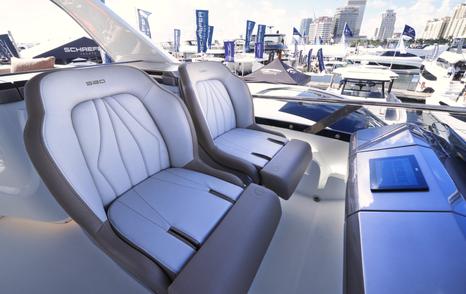
The seating works well. Twin helm seats with bolster functions let you sit or lean depending on how you prefer to drive, and the adjustable wheel helps you fine-tune your position without much effort. There are some useful details as well. The navigator gets a separate screen so that tasks can be split, and there is a glove box, wireless charging, and cupholders within reach. Having four forward-facing seats on the flybridge is a real boon.
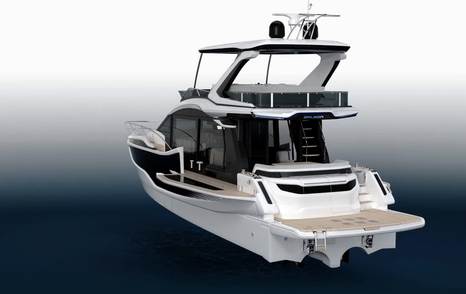
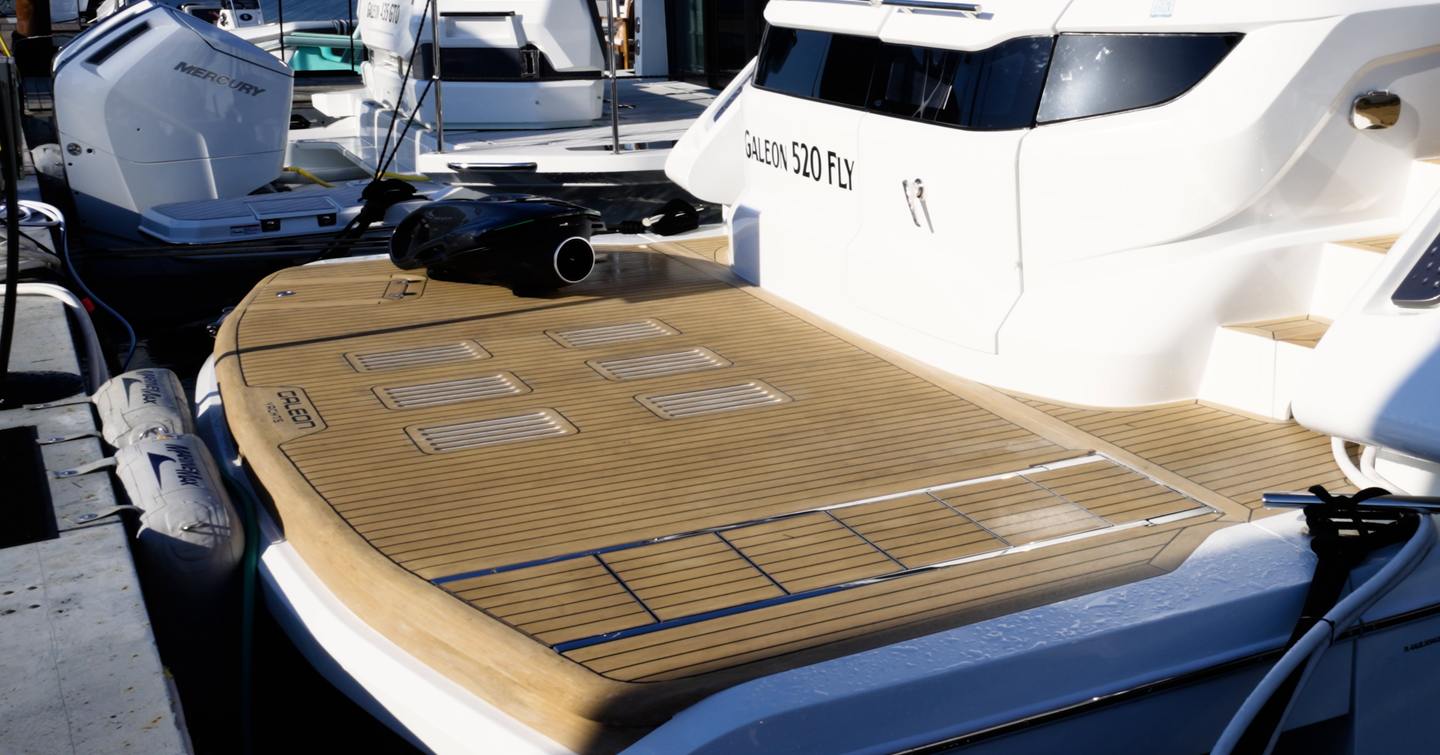
This is the area where the 520 Fly is streets ahead of its rivals. Right at the stern, the hydraulic bathing platform drops down into the water, and it works for swimming as well as launching and recovering a tender. As it lowers, built-in steps form a proper stair into the sea, and there is still a fixed ladder in place if you just want to get in and out quickly.
Behind that sits a large storage void. On paper, it can be fitted out as a crew cabin, but at this size, it is more likely to be used for water toys and gear, and having that space right at the waterline makes it practical day to day.
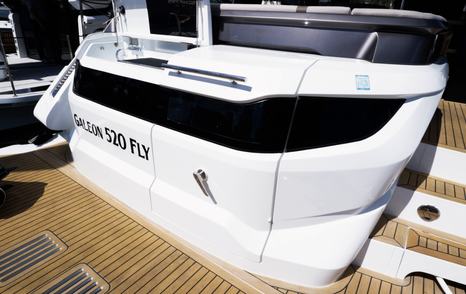
The cockpit seating is arranged around a table, and by default, it faces into the boat, which is the usual drawback with this type of layout. Galeon offers a solution in the form of a rotating sofa, which allows the whole seating area to turn aft, so you can face the water instead. It is a cost option, but it does change how this space works once you are at anchor.
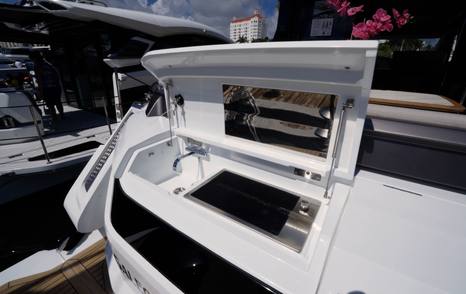
Cooking is handled by a grill built into the transom. It sits close to the water, and it hides away when not needed, which avoids taking up space with a full wet bar and leaves more room for seating.
Inside-outside connection is helped by the large sliding doors, and with no step between cockpit and saloon, movement stays easy. You can walk straight through from the platform to the interior, and back again, without interruption, which is exactly what you want in a space that handles most of the day-to-day use on board.
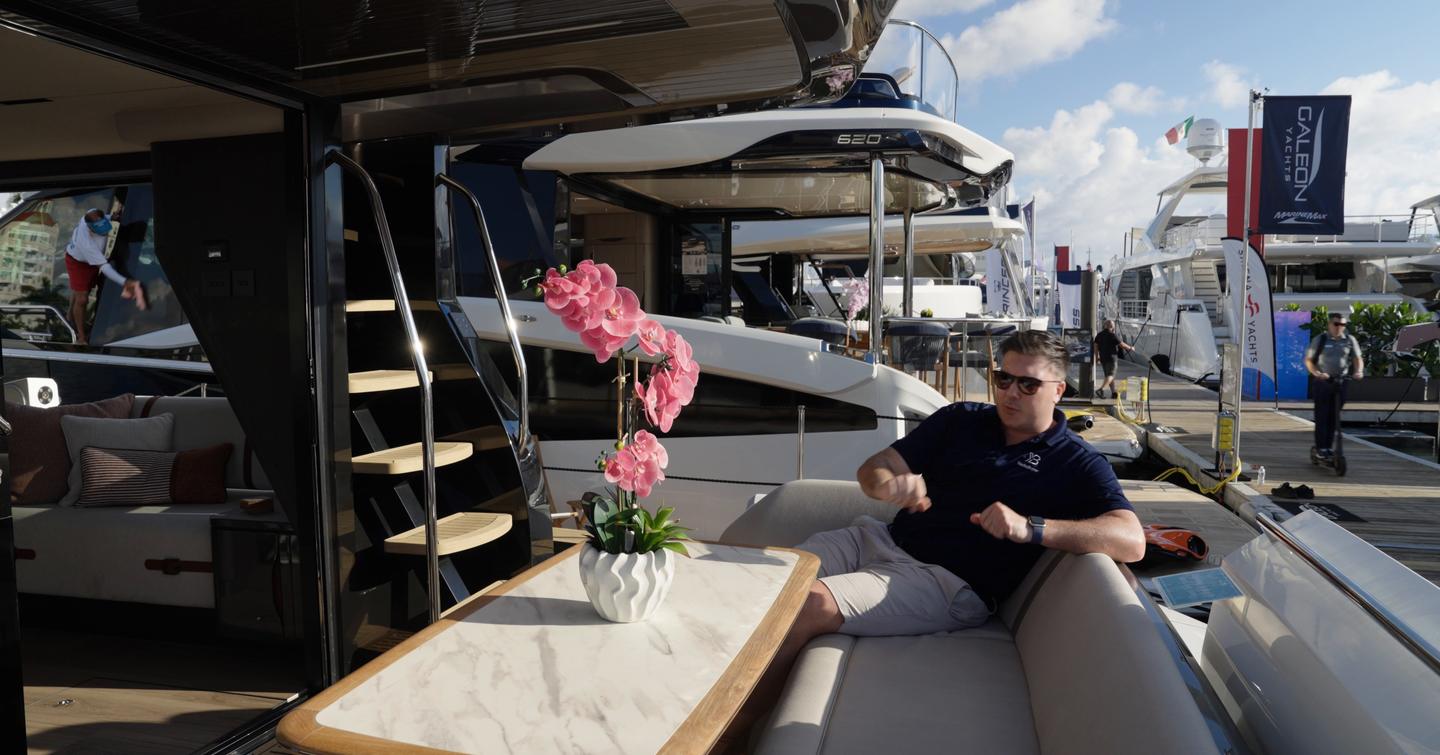
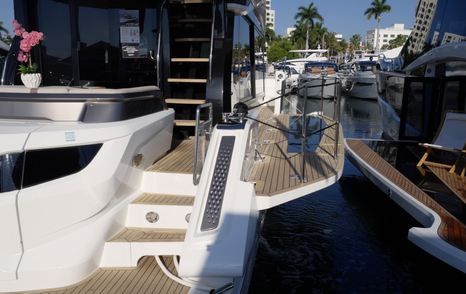
Beach Mode has its biggest impact here. The drop-down balconies extend the beam outwards, and that adds usable deck space while bringing the water closer to the edge of the seating area. It also changes how this area connects to the saloon, because once everything is open, the two connect as one and it works so well.
Foredeck
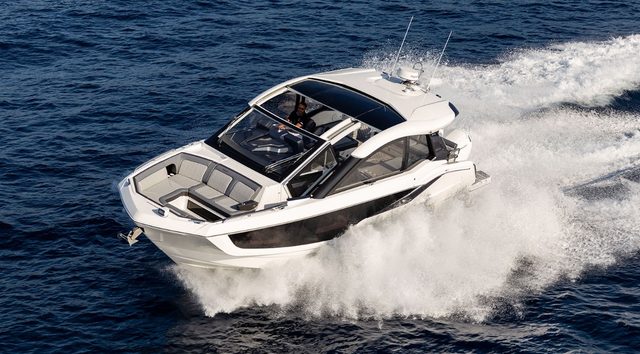
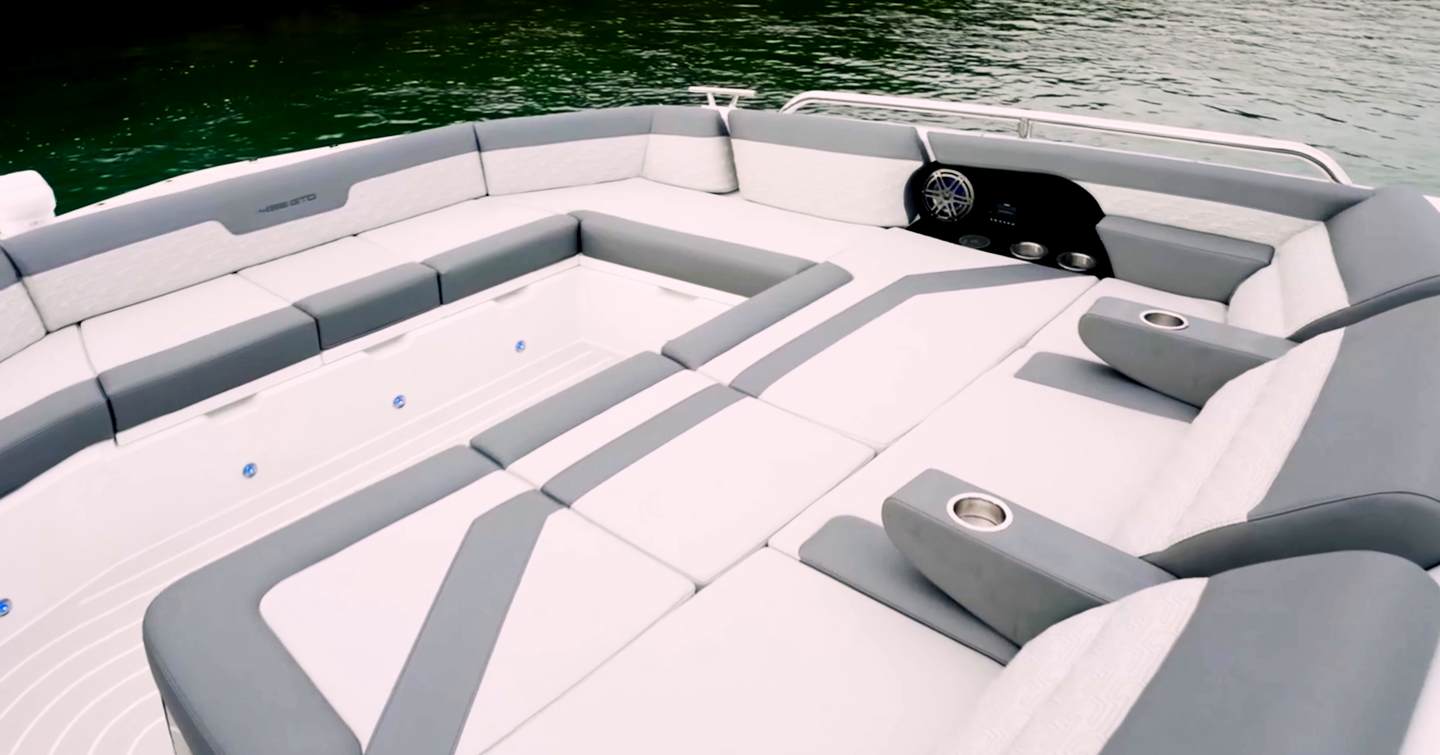
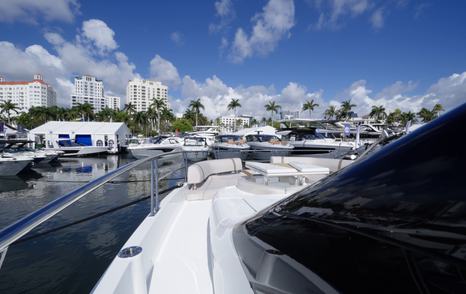
The key move in this area is the sunken seating. The whole area drops down into the deck, and that lowers your board position, so you feel more secure when using this area. It is not a big change in height, but it makes a difference, and you are more likely to stay here for longer. It feels much safer and more secure.
Seating runs around a central table, and there is enough room for a full group to sit facing each other, so it works as a proper social space.
That table does more than one job. It opens out for dining, and it lowers to create a sunpad, so the same space can switch roles quite quickly.
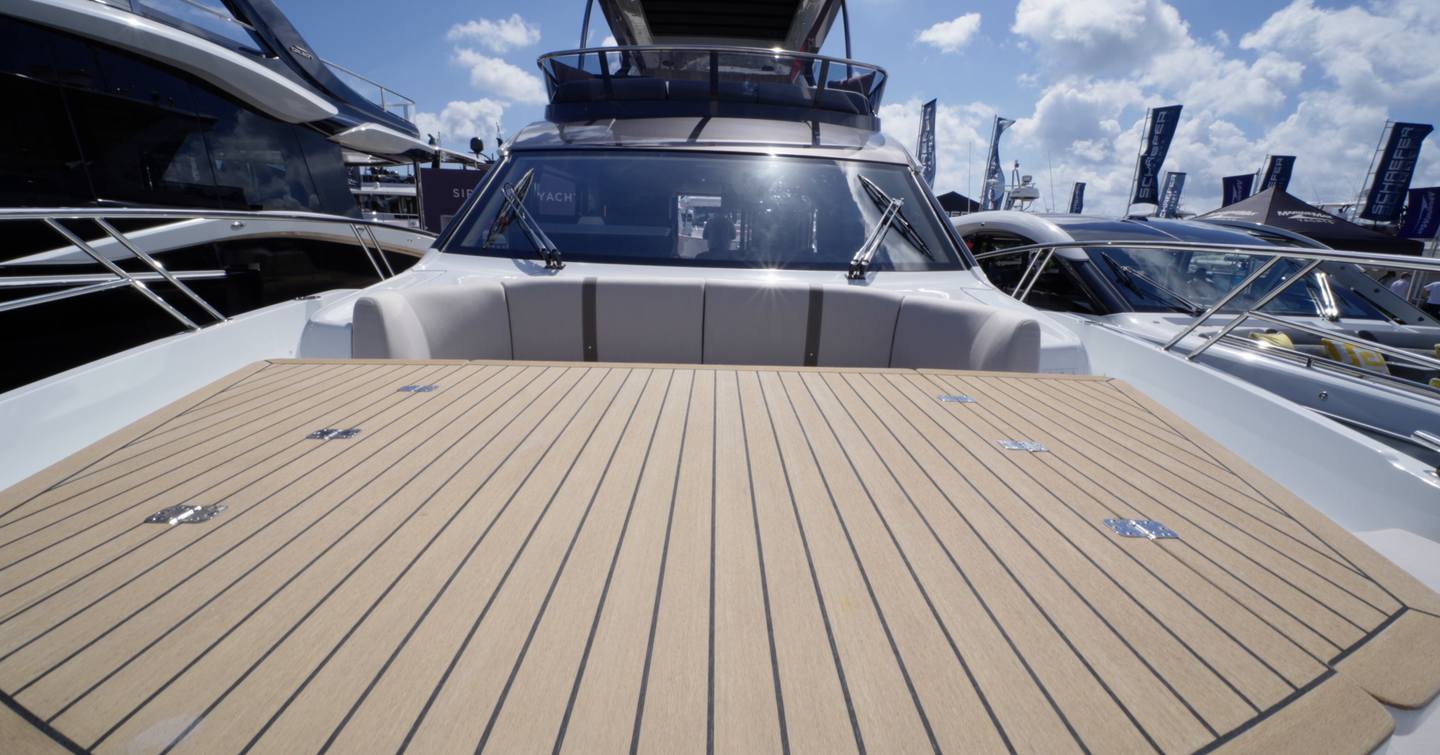
Comfort comes from the seating depth and the backrests, and you are not perched on top of the deck, which helps when the boat is underway. Shade can be added over the area, too, so it can be used in the heat of the day.
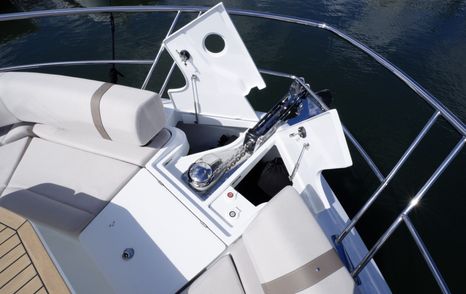
Storage sits under the seating, and it is large enough to take fenders and loose gear, so this is still a working part of the boat as well as a place to relax.
Flybridge
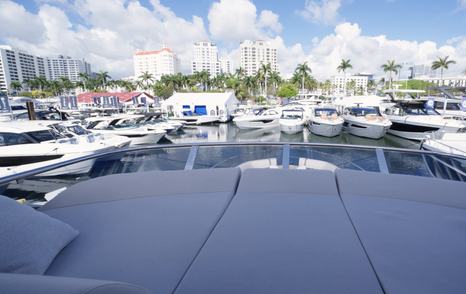
Galeon's flybridges generally punch above their weight, and the 520's is no different - it's a genuinely impressive space. There is enough space to sit, eat, and spend time up here. Once you are at anchor, this is where people tend to gather.
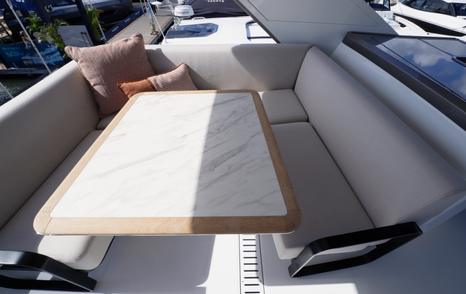
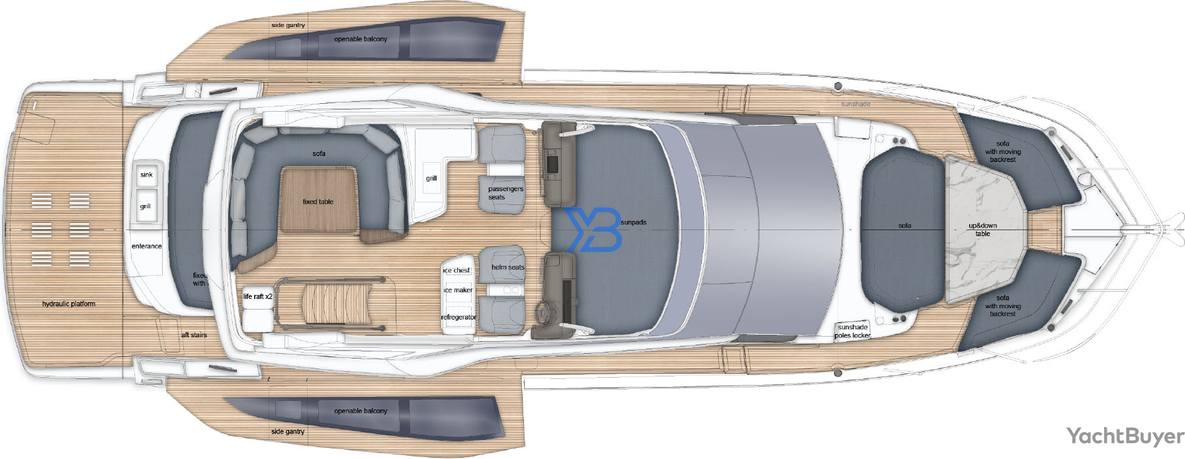
The layout centres around a large seating area aft, with a proper table and space for a full group to sit together. It works for meals as well as general lounging, and the hardtop above covers most of it, so you are not forced into the sun all the time. It's a canvas roof, which can be a bit noisy on the move, but it opens the deck up really nicely.
The furniture is a bit of a shift as well. It looks more like loose outdoor pieces than moulded GRP units, and the table has more detail to it, with a textured surface and defined timber edging. It ties in with the updated interior direction and feels fresh and modern.
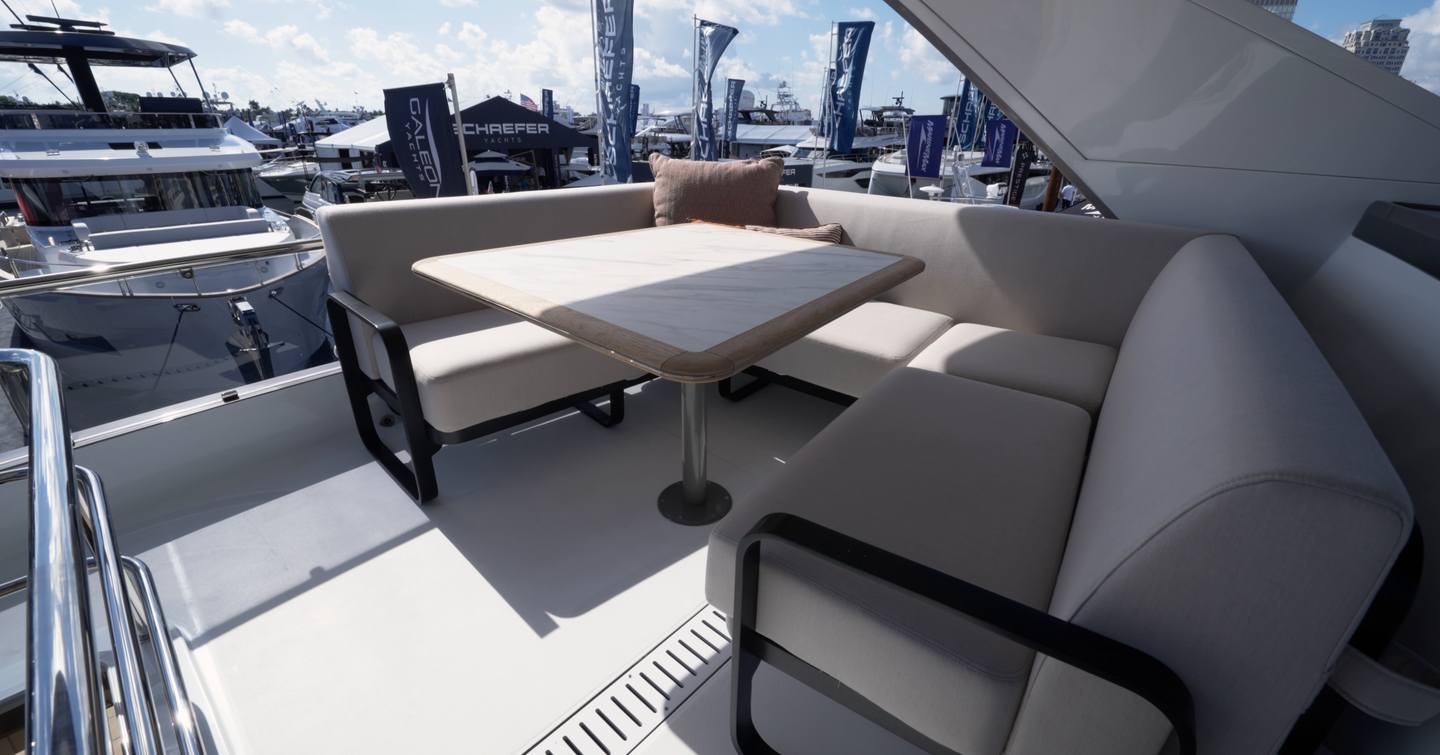
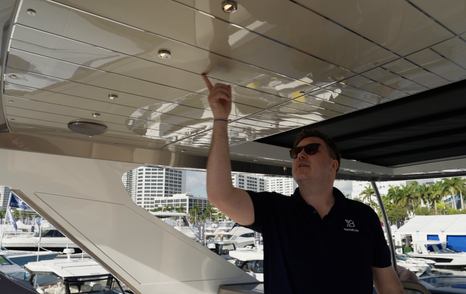
Overhead, the hardtop has been handled neatly. Lighting and speakers are set into it, and they are colour-matched with classy stainless pin stripes breaking up the GRP.
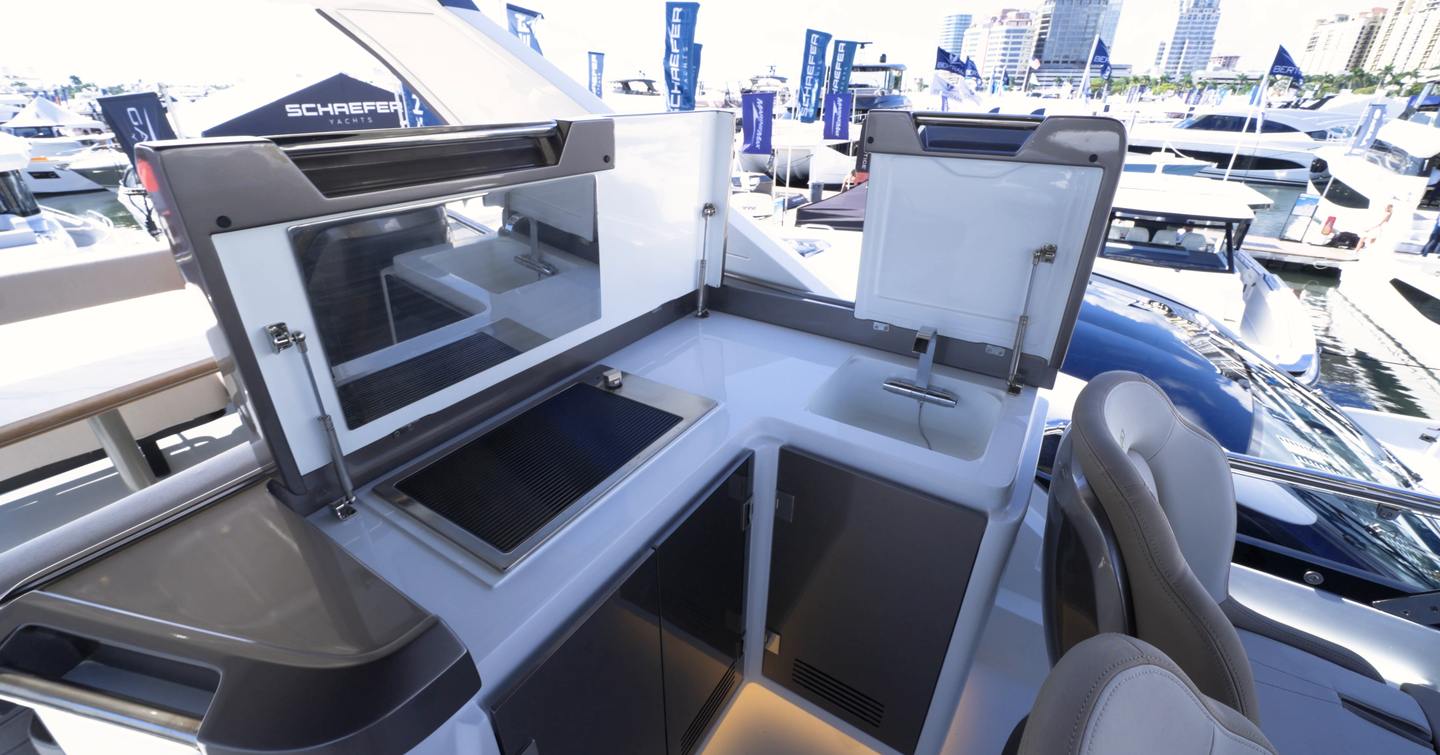
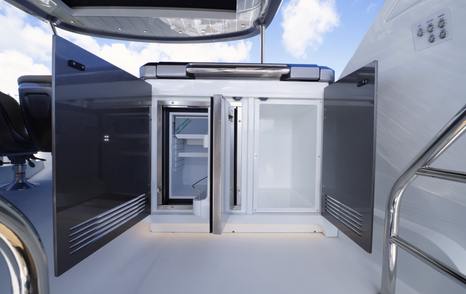
The wet bar is split across both sides. Cooking sits to port with a grill, while the sink, fridge, and storage sit opposite, and that keeps the walkway clear between them.
Forward of the main seating, there is a row of companion seats facing ahead. They give guests somewhere to sit underway, and they keep people close to the helm without getting in the way. The view forward is clear from here, and access is easy from the main seating area.
There is also a sunpad set into the forward section. It takes up some deck space, but not at the expense of the seating area, so you still get a proper social layout as well as somewhere to lie out. That balance feels about right for a boat of this type.
Engine Room
Somewhat understandably, Galeon didn't allow access to the engine room, given that the boat had been rushed to the show and needed to go back to Poland for final fixes. We plan to sea trial the 520 later in the year, where we'll be able to assess its handling, performance and machinery spaces.
This boat runs twin Volvo Penta D11 engines rated at 725hp each, and this example uses shaft drive, while an IPS option using the same platform is offered too. Galeon claims a top speed of around 30 knots and a cruising speed in the mid-20s, with a range of around 250nm.
Though Galeon didn't supply a price list, a well-specified 520 Fly will likely set you back around €2,000,000 ex VAT.
For that price, you'd expect to get options such as the gyro stabiliser, a full navigation package, a bow thruster, air-conditioning and a passerelle.
These are all options we'd go for if we were speccing the boat. We'd also stick with the entry-level shaftdrive engine option as the boat is likely to be easy to handle with twin shafts, easier to maintain, and there will no doubt be a large premium to jump to pods.
We would definitely add the carousel seating option in the cockpit, too. Even if it means removing the crew cabin, it's a sacrifice worth making for the extra deck functionality.
Our Verdict
There is no doubt that Galeon has pushed things forward here. The way the cockpit, balconies, and saloon work together gives this boat a sense of width and openness that stands out at this size, and the foredeck now feels like a place you would actually use.
At the same time, some of the details do not feel quite as resolved. The lower helm position takes effort to get right, the side door gives you access but limits ventilation, and the master cabin feels darker than it needs to despite the glazing.
The bigger question sits around how all of this holds up away from the dock. On paper, the 520 Fly builds on a strong base and adds more space and flexibility, but whether it improves on the 500 in a meaningful way is something that will only be answered properly on test.
Reasons to Buy
- Wide cockpit with Beach Mode
- Indoor-outdoor connection
- Fresh interior design
- Shafts or IPS
Things to Consider
- Lower helm seat too far back
- Flybridge screens feel small
- No proper side door
Looking to own a Galeon 520 Fly ? Use YachtBuyer’s Market Watch to compare all new and used Galeon 520 Fly Boats for sale worldwide. You can also order a new Galeon 520 Fly , customized to your exact specifications, with options for engine choice and layout configuration. Alternatively, explore our global listings of new and used boats for sale and find your perfect boat today!
Rivals to Consider
The Prestige F5.7 sits at 17.29m (56.7ft) with a 4.69m (15.4ft) beam and a 1.32m (4.3ft) draft, and it runs twin Volvo IPS800 (D8 600hp) engines with a 27-knot top speed and 23-knot cruise. It weighs 20,417kg light and 26,486kg loaded, and it uses vacuum-infused fibreglass construction. The layout is the main difference, with a semi-main-deck owner’s cabin and three en suites, so it leans towards interior volume and privacy. Against that, the Galeon focuses on outdoor space and flexibility, with its balconies and split-use deck areas changing how the boat works at anchor.
The Sunseeker Manhattan 56 comes in at 17.21m (56.5ft) with a wider 4.87m (16ft) beam and a 1.37m (4.5ft) draft, and it offers a choice of shafts or pods with twin Volvo Penta D13-800 engines. It reaches up to 32 knots and cruises around 25 knots, with a range of about 230nm at 21 knots, and displacement is around 27,000kg. The cockpit uses a modular layout that can shift towards a beach club feel, but it keeps a fixed beam. Sunseeker’s focus is clear performance and propulsion choice, while the Galeon trades that for a wider footprint at anchor.
The Absolute 56 FLY stretches to 17.64m (57.9ft) with a 4.79m (15.7ft) beam and a draft around 1.4m (4.6ft), and it runs IPS-only propulsion from D8-800 up to D11-950. Performance sits around 28 knots top speed and 22 knots cruise, with range often quoted between 200nm and 250nm depending on setup, and displacement is around 31.7 tonnes. Absolute pushes volume and light through large glazing and features such as solar panels in the hardtop, and it offers three cabins plus crew. It feels more focused on interior space and systems, while the Galeon uses mechanical features like balconies to change the deck layout.
The Princess F58 is larger at 18.2m (59.7ft) overall with a 4.9m (16.1ft) beam and a 1.53m (5ft) draft, and it carries around 32,318kg. It uses twin MAN V8 engines at 1000hp or 1200hp, delivering between 29 and 35 knots depending on spec. The layout stays conventional with three cabins and optional crew, and features include a foredeck terrace and optional cockpit BBQ. Princess builds with resin infusion and vacuum moulding, and the focus is on finish and consistency. It offers a more traditional, performance-capable package, while the Galeon stands apart with its adaptable deck design.
The Ferretti Yachts 580 is the largest here at 18.24m (59.8ft) with a 5m (16.4ft) beam and a 1.5m (4.9ft) draft, and displacement ranges from 31,000kg unladen to 37,000kg loaded. It runs twin Volvo Penta D13 engines at 900hp or 1000hp, giving 28 to 32 knots top speed and 24 to 26 knots cruise, with range often cited around 300nm. The layout includes three cabins with crew, and the design leans towards a lower profile with a strong engineering focus and Category A capability. It reads as a more traditional, system-led yacht, while the Galeon puts its emphasis on adaptable space and how the boat is used at rest.
Considering a new boat? Explore Galeon's entire current range to find the model that best suits your needs, and compare it with alternatives from competitors to ensure you make the perfect choice.
Specifications
- Builder Galeon
- Range Flybridge
- Model 520 Fly
- Length Overall 17.2m
- Beam 4.61m
- Hull GRP
- Cabins 3
- Berths 6
- Crew 1
- Cruising Speed
- Max Speed
- Fuel Capacity 1,800 Litres
- Fresh Water Capacity 650 Litres
- Engine Model 2x Volvo Penta D11-725
- Engine max range (speed type) 250 (nm)
Galeon 520 Fly Layout
-
Flybridge
-
![Flybridge Galeon 520 Fly]()
When deployed, the balconies extend the beam by 2 metres
-
Main Deck
-
![Main Deck Galeon 520 Fly]()
The separate access to the owner's cabin is on the starboard side of the saloon
-
Lower Deck
-
![Lower Deck Galeon 520 Fly]()
You can opt to have a single crew cabin at the stern of the boat
Available Stock


Interested in a 520 Fly?
NEW Build
Find your local dealer for a personalised, no-cost consultation
or just request
Brochures & Pricing
Used & In Stock
Looking for a ready-to-go 520 Fly or pre-owned options? Explore all inventory of the 520 Fly available worldwide