When it comes to life onboard there are a lot of choices to make. Below you'll find sections on domestic equipment, including heating, lighting, air conditioning, cooking, and refrigeration appliances.
There are many things that enhance the quality of life onboard. Some of them we naturally take for granted on dry land, such as unlimited hot and cold running water, mains electricity, flushing toilets, ice on demand, and other domestic systems that keep us comfortable at home. It takes a considerable amount of complex, specialist equipment to provide the same mod-cons onboard a yacht.
This article provides an overview of the core domestic systems you should expect to find onboard and also explains how they’re different from the ones we use at home. It’s worth knowing about these systems when you’re comparing models and deciding which yacht to buy, or ticking the options list after making the all-important buying decision.
Once you’ve bought your yacht, especially if you plan to carry out some of the maintenance yourself or cruise offshore, we strongly recommend keeping a copy of Nigel Calder’s Boatowner’s Mechanical and Electrical Manual onboard.
Power Onboard
Mains Electrical Power
Most modern yachts have normal plug sockets in the salon and cabins so you can plug in things like phone chargers, hairdryers, laptops, toasters, and so on.

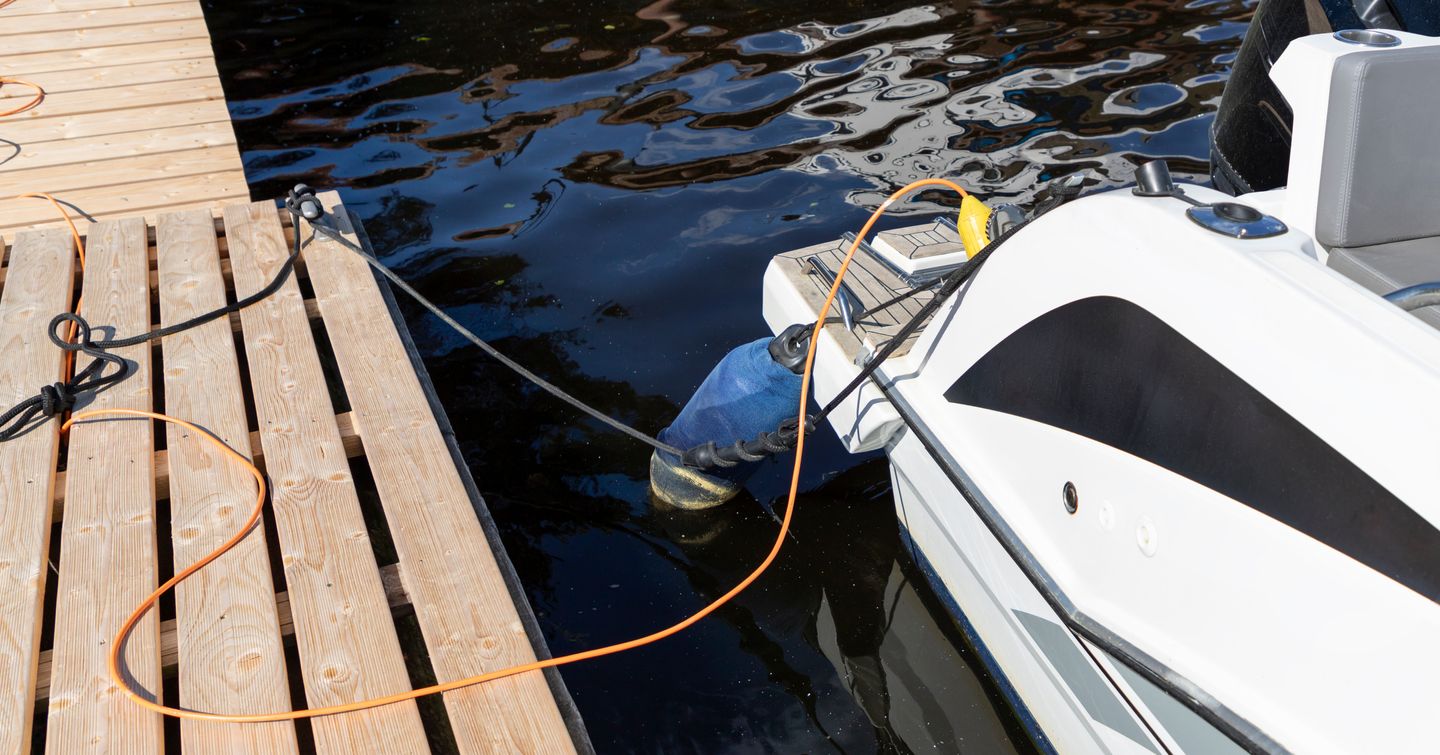
That’s no big deal when the yacht is in a marina and connected to shore power, but mains electricity won’t be available when you’re anchored in a quiet bay or moored alongside a rustic jetty so you’ll be relying on an onboard system to provide the power. Depending on the yacht, that power may come from a generator, a domestic battery bank and inverter, or a combination of several sources.
Generators
The traditional solution is an onboard diesel generator, usually installed in or close to the engine room. It supplies AC electricity for the yacht’s domestic systems and can support large loads such as air-conditioning, cooking equipment and watermakers.
Generators remain common because they can provide substantial power for long periods, but noise, vibration and fuel use are obvious drawbacks. It’s a familiar bugbear of yacht owners at anchor to be woken in the middle of the night by the drone of a generator.
Modern yachts increasingly use larger battery banks to reduce generator run time, particularly overnight or when only modest hotel loads need power.
Inverters
A DC-to-AC inverter lets AC equipment run from the yacht’s battery bank. It takes 12V, 24V or 48V DC power, depending on the installation, and converts it into the AC supply required by normal domestic appliances.
The major advantage of inverters is that they’re silent. The big drawback (especially with cheap ones) is that they can be very inefficient. A hairdryer or kettle powered by a poor-quality inverter can drain the batteries of a small or medium-sized yacht in a surprisingly short time.
Pure sine wave inverters are much more expensive but in practice, they’re the only ones suitable for use on yachts. Some builders fit top-notch inverters as standard while others don’t, so it’s worth checking.
Domestic Batteries
Most yachts have separate starting and domestic, or house, battery banks. The starting batteries are reserved for cranking the engines, while the domestic bank supplies lighting, pumps, electronics and other hotel loads.
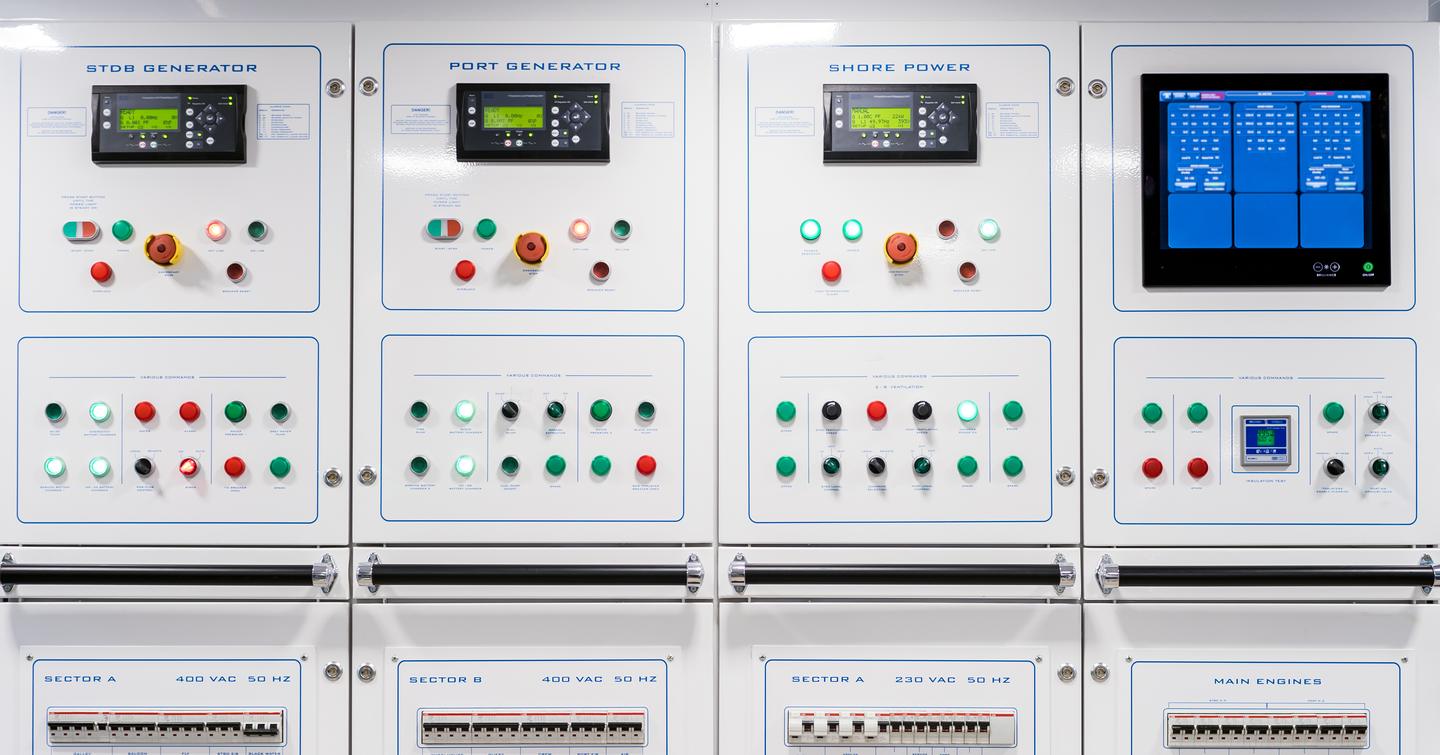
Battery monitoring systems keep track of the domestic bank and help prevent excessive discharge. On newer yachts, the system may do considerably more than display a voltage or state-of-charge figure. Power management can control how shore power, generators, batteries and other sources work together as demand changes.
Battery Capacity & Health
Battery capacity is usually quoted in kilowatt-hours (kWh), but the headline figure doesn’t tell the whole story. How much of that energy you can actually use depends on the type of battery, the limits set by its management system and the condition of the battery itself.
Two useful figures are state of charge (SoC) and state of health (SoH). State of charge tells you how full the battery is right now. State of health tells you how much of its original capacity and performance it still has as it gets older. How deeply and how often a battery is discharged, how quickly it is charged or drained and its operating temperature can all affect its life.
This matters because power-hungry kit such as kettles, hairdryers, induction hobs and air-conditioning can chew through stored energy surprisingly quickly. Even a yacht with a big battery bank may need to fire up the generator sooner than you expect if several heavy loads are in use at once.
When you compare yachts, it’s worth asking how much of the quoted battery capacity is actually usable, what the bank can comfortably power and how long it can handle the normal hotel load before the generator needs to cut in.
Power Management
On a modern yacht, the generator, batteries and shore power don’t necessarily work as completely separate systems. A power management system keeps supply and demand in balance, while more advanced energy management systems can also decide how the available power sources should share the workload.
Say you’re connected to a relatively weak shore supply and someone switches on a high-draw appliance. Rather than trip the shore connection, a system can temporarily call on the batteries to make up the shortfall. Once demand drops, the batteries can recharge again. Victron’s PowerAssist works on exactly this principle, supplementing shore or generator power from the battery bank when demand exceeds the available supply.
More sophisticated yacht systems can automate the next step too. Mastervolt and CZone installations, for example, can monitor the domestic battery bank and start the generator when charge falls to a set level, rather than relying on someone onboard to notice and do it manually.
This power juggling is important because the aim isn’t just to keep the lights on. How a yacht shares the workload between its batteries and other power sources can affect generator run time, fuel use and wear on expensive equipment. Research into modern energy management increasingly looks at those costs together rather than chasing fuel efficiency alone.
Lighting
You should expect any new yacht to be fitted with low-power LED lights that can run off the yacht’s batteries for days on end without too much fuss while also returning a good life span.
Older yachts often used halogen lights because they gave a warmer, more flattering light than the early LEDs. Modern LEDs can now do the same job with a fraction of the power draw.

If you’re buying a second-hand boat that’s ten years old or older, you may still find plenty of halogen lighting onboard. Replacing the bulbs with LEDs can be a worthwhile upgrade, although older dimmers, transformers or complete fittings may also need changing, which can push up the cost.
Lighting isn’t just about power consumption and seeing where you’re going. It also plays a big part in how a yacht feels onboard. Modern systems can combine dimmable overhead lights, indirect strips, courtesy lights and preset scenes, so the same salon can feel bright and practical by day and much softer in the evening.
Climate Control
Controlling the onboard environment has become a more sophisticated and user-friendly experience. Heating systems are now often standard fit items, particularly on North European-built yachts.

Efficient Air-Con
Air-conditioning has moved from being a moderately rare luxury to an almost standard-fit item. Despite this, you may still need to pay extra to have it onboard some production yachts.
Many yacht owners cruising in hot climates have traditionally had to choose between running a noisy generator through the night or switching off the air conditioning when they aren’t connected to shore power. Larger battery banks have changed that, but so has the air-conditioning itself.
The latest inverter-driven, variable-capacity systems can alter compressor speed to match the amount of cooling actually required, rather than repeatedly running flat out and switching off. This can cut electrical demand, smooth out the big start-up loads placed on the yacht’s power system and reduce the amount of time the generator needs to run. Dometic’s latest VARCX chillers, for example, can vary their output with demand and include load-shedding and ramp-start functions to keep the electrical load under control.
Heating
If you keep your yacht in a temperate climate with a cold season, you may want heating as well as air conditioning. Some of the latest air conditioning systems are efficient enough at heating to do both very effectively.
If you’re boating in a colder climate, you might not need air conditioning but you’ll want a heater. There are various types. The most common is a marine version of the standard modern truck or camper van heater — a blown air heater — which burns diesel to generate heat and uses electricity to drive a fan that blows the hot air out of ducts and into the cabins and salon. The two best-known brands are Eberspächer and Webasto, but cheaper, less well-known brands are also available.
Larger yachts may use a water-based heating system instead. These work rather like domestic central heating, with a diesel heater warming coolant that circulates around the yacht to radiators, fan coils or other heat exchangers. They take more plumbing than a simple blown-air heater but can heat several cabins more evenly and may also provide hot water or preheat the engines.
If you keep your yacht in a temperate climate with a cold season, you may want heating as well as air conditioning."
Premium versions are also available, such as very neat and well-engineered systems made by Wallas. You can get blown air heaters that run on paraffin rather than diesel and these may be worth considering if your yacht runs on petrol.
Blown air heaters need regular use and require servicing every few years, or they’re likely to stop working. The marine versions of these units cost a lot more than the ones designed for trucks and campers but don’t be tempted to use automotive-grade equipment. Various parts of the system will be prone to corrosion in the marine environment and most yacht surveyors regard them as a fire hazard.
Venting and Exhausts
While on the subject of fire hazards, if you’re buying a boat with a blown air heater installed, be sure to check where the exhaust is.

It’s not unusual to see a heater exhaust fitted in a yacht’s topsides, which is a very bad place to put it. When the yacht is berthed alongside another boat it’s very likely to upset the neighbors by spewing diesel fumes into their cockpit or cabin. There may also be the added risk of melting fenders.
Marine Stoves
Traditional-style cabin heaters, such as a Taylor's stove, would be out of place on a sports cruiser but are worth considering for some types of modern motor yachts. They’re attractive-looking, high-quality pieces of kit, still popular among canal boat owners and other liveaboard cruising folks because of the low maintenance and the ambiance of a fireplace.
This sort of heater includes variants that run on diesel, paraffin, or even coal. They all need to be installed against a well-insulated bulkhead with a flue going up through the deck.
Hull Color and Insulation
Whatever sort of air conditioning or heater you have (or even if you have neither) it’s worth thinking about the hull that wraps it all up.


Hull colors have become very popular, but a dark hull absorbs far more solar heat and makes the air con work harder. On a yacht designed to run its hotel systems from batteries for long periods, that extra cooling load can mean less time at anchor in silence before another power source has to cut in. If you’re cruising mainly in hot climes, a light or white hull remains the more energy efficient choice. If you have your heart set on a dark hull, ask the builder about low-solar-absorption coatings as well as the insulation behind it.
A well-insulated hull is easier to heat or cool effectively, is much less prone to condensation, particularly on metal yachts, and helps keep out the racket from other yachts’ engines, thrusters, generators and parties. The yacht next to yours may be just two feet away, so good insulation soon earns its keep. Large windows add another route for heat to get in or out, which makes good-quality double or even triple glazing a worthwhile option.
Water and Tankage
As the old adage goes, 'Water, water everywhere, but not a drop to drink’. When out at sea, it’s surprisingly easy to run out of fresh water.
At home, a shower with decent water pressure uses around 18 liters (four gallons) of water per minute. It follows that if four people onboard each have a ten-minute shower in the morning and then they each use the cockpit shower for a three-minute rinse after swimming, you’ll have used 936 liters (206 gallons) of water.

A typical 50ft yacht might only have 640 liters (170 gallons) of capacity in its freshwater tanks, so even if you’re only out for a weekend with a couple of guests, it’s nowhere near enough. This is also without considering other water requirements, such as washing dishes after meals.
To put that into perspective, the Princess F50 carries 420 liters of fresh water, while the Azimut Fly 50 carries 590 liters. Four long, high-flow showers in the morning and another rinse after a swim could therefore use more water than either yacht carries in total.
Water-Saving Tips
Many yachts use water-saving or aerated shower heads. Some low-flow versions can feel pretty feeble, but a good one cuts consumption without making every shower feel like a punishment.Using a marina’s shower facilities or simply showering as quickly as possible onboard are the two best ways to cut water use.
It is certainly worth reviewing the water (and fuel) tank capacities of the yachts you are considering. Some builders will fit small tanks to maximize interior space and save on weight. The other side of the equation is that bigger tanks will affect the yacht’s fuel economy and performance.

Watermakers
Watermakers use reverse osmosis to turn seawater into fresh water and can make a huge difference to a yacht’s autonomy. Output varies enormously, so check the liters-per-hour figure against the number of people onboard and how much water you expect to use. Power consumption matters too, particularly if you hope to run the watermaker from the domestic battery bank rather than a generator. They also need regular flushing, filter changes and membrane care.
Water Heaters
The yacht equivalent of a domestic hot-water cylinder is the calorifier. It’s an insulated tank with an electric immersion heater, but on many yachts it can also use heat from the engine coolant while you’re underway.
Greywater Waste
Grey water from showers, sinks and appliances can’t simply be assumed safe to discharge wherever you cruise. Rules vary between countries and waterways, so some yachts need enough holding capacity to retain grey water until it can legally be discharged or pumped ashore. Tank size should therefore reflect the yacht’s occupancy, water use and intended cruising grounds.

Tanks
Not long ago, high-quality yachts had water tanks made of high-grade stainless steel and cheaper yachts had fiberglass tanks. Nowadays, many yachts at a wide range of price points have flexible plastic tanks or giant bladders instead.
Steel and flexible plastic both have their pros and cons. Steel tanks are more durable and should last longer, but cost a lot more to fit and are a lot more work to replace if required.
Flexible plastic tanks are a lot cheaper and simple to replace, but are more easily punctured and thus arguably less suitable for small, fast sea-going yachts. When it comes to steel or fiberglass tanks, the thing you need to check is access. You want decent-sized inspection hatches to ensure they can easily be cleaned.
Most domestic water systems use gravity to create water pressure but yachts tend not to have large header tanks because all that weight high up would affect their stability. Instead, they have their water tank down low in the bilge where it acts as ballast, and use pumps to create water pressure.
These pumps can be noisy and it’s not unheard of for builders to put them under the floorboards of a master or guest cabin, where they’re likely to disturb a light sleeper when someone else turns a tap on. When looking around a yacht, it’s worth turning on a few taps to check the noise levels.
Sea Toilets and Holding Tanks
Sea toilets are quite different from the ones we use ashore. On smaller or older yachts, they’re often flushed manually by pumping a handle and operating a valve. Jabsco’s Twist ’n’ Lock is a familiar example and remains in production today.


Larger and more luxurious yachts generally have electric toilets, which feel much more like the ones you use at home but hide a fair bit more plumbing behind the scenes. Some use a macerator to break up waste before pumping it away, while others use a vacuum system. Dometic’s VacuFlush is one well-known example and uses less than 0.4 liters of water for a flush, while Tecma makes a wide range of electric macerating toilets for yachts.
Whichever system is fitted, it’s worth checking how easy it is to reach the pumps, valves and pipework for servicing. A posh electric toilet is less impressive when somebody has to dismantle half the yacht to clear a blockage.
Most cruising yachts will also have a black-water holding tank, where toilet waste can be stored until it can be pumped ashore or legally discharged at sea. The rules vary between countries and cruising areas, so you can’t assume that overboard discharge is allowed just because the yacht has the means to do it.

The Galley
Galleys come in all sizes and styles, offering various levels of catering sophistication. So, the most important consideration for a yacht’s galley is how it’s going to be used. Do you want to make dinner or just a quick sandwich? How much space do you need for cooking and stowage?

On a fast planing yacht, it’s unlikely to be used much when you’re underway, and especially not at high speeds. Unless you’re into fishing, you probably won’t want to use it while the yacht is rolling on an ocean swell. If you’re only going to use the galley in harbors and very sheltered anchorages, its layout is simply a matter of the cook’s personal preference.
Layout and Design
There are three basic locations for a galley, centrally or aft at deck-level, or below deck.


Having a galley at deck level creates easy access and serving but can make the galley part of the social area, while a below-deck version hides away the cooking, plates, and general leftovers. If space allows, the general move is for a deck-level layout, with aft galleys now very popular, freeing up space below for sleeping accommodation.
For a long-distance yacht, there are other considerations. If you’re likely to be cooking or using the galley in open water, it’s useful (and safer) to have an L-shaped galley where you can brace yourself against the motion of the boat.
The galley worktops should have raised edges called fiddles, which stop things from sliding or rolling off when the boat rolls.
Specialist Stowage
Stowage is another matter. Nearly all yachts have dedicated stowage for crockery, glasses, and wine, keeping these items snugly in place when underway. Be sure to check that there’s enough space in cupboards and drawers for all the pots, pans, utensils, ingredients and condiments you want onboard, and that the doors and drawers have proper catches to stop them flying open in a seaway.
Cookers
On smaller and older yachts, cookers are usually fuelled by propane or butane gas - despite the obvious potential safety hazard. Any gas leak will end up in the bilge so it’s absolutely crucial to have a reliable gas alarm onboard.
Induction hobs are now a familiar sight on modern motor yachts, particularly those with substantial generators, inverters and battery banks. Induction also avoids carrying gas onboard and is quick and easy to clean, but it comes with a hefty electrical appetite. That makes the size of the inverter, battery bank and generator just as important as the hob itself.

Microwaves, induction hobs and other power-hungry galley appliances can run from a generator or from the battery bank through a suitably rated inverter. The trick is having enough inverter output and usable battery capacity to cope with them, especially when several big loads are switched on at once.
Refrigeration
Refrigerators, freezers, and icemakers are key appliances. With most people spending a night or two onboard, the ability to store fresh food and drinks is key. Whilst for longer stays, a freezer becomes more important.


Depending on the size and style of the yacht, there could be multiple fridges, cool boxes, or icemakers to serve guests. A flybridge should have its own cold storage, as should the aft and forward cockpits on larger yachts.
Many marine fridges and freezers on small and medium-sized yachts run directly from 12V or 24V batteries, while larger yachts may use mains-powered appliances as part of their AC system.
Unlike most galley appliances, refrigeration draws power around the clock, so good insulation and ventilation around the compressor can make a noticeable difference to the domestic load.
If you’re going to spend long periods away from shore power, seawater-cooled refrigeration can also be worth considering. Instead of dumping heat into the warm air inside the yacht, systems such as Isotherm SP transfer it into the surrounding seawater, which can cut power consumption and do away with a noisy condenser fan.
Washers
Washing machines and dishwashers are rarely seen on small-to-medium-size yachts because they take up space and use a lot of fresh water and electrical power.
Most marinas have laundromats anyway, so most boaters don’t actually need a washing machine onboard their vessel.
For large yachts and superyachts, there are plenty of marine-spec options, including some from well-known premium household brands such as Miele.