-
Guests
12
-
Cabins
6
-
Crew
10
| Length | GT | Built (REFIT) |
|---|---|---|
|
49.84m
|
445 GT | 1998 (2021) |
| Beam | Draft | Top Speed |
| 8.11m | 1.49m | 30 Kts |
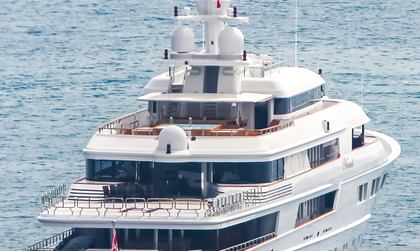
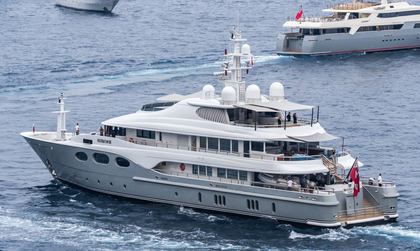
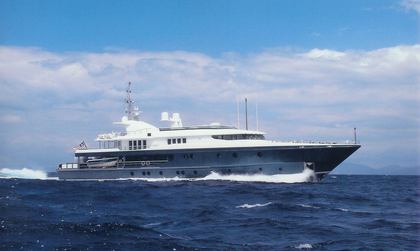
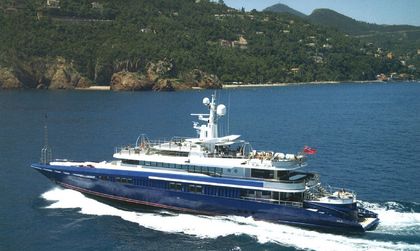
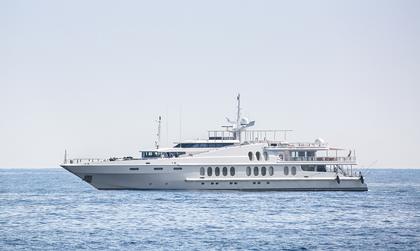
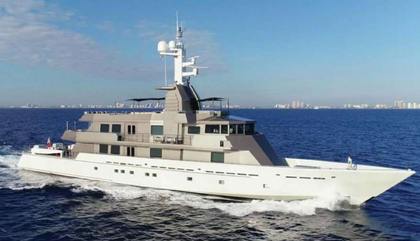
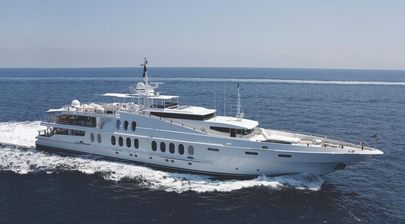
Delivered in 1998, Thunder is a multi-award winning 49.84m motor yacht built by Australian shipyard Oceanfast. Her interior design and exterior styling comes from the drawing boards of Bannenberg & Rowell, while Phil Curran Design is responsible for her naval architecture.
Key Features
- 7m counter-current pool
- Sundeck with seating and sunbeds
- 3,000nm quoted range
- Full-beam master suite
- Pool doubles as tender bay
- Military-derived ride control
Design & Construction
Designed around a planing composite hull and superstructure she features a 8.11m beam and a 1.49m draft. The yacht is built over 2 decks with an internal volume of 445 GT (Gross Tonnes).
Exterior Design
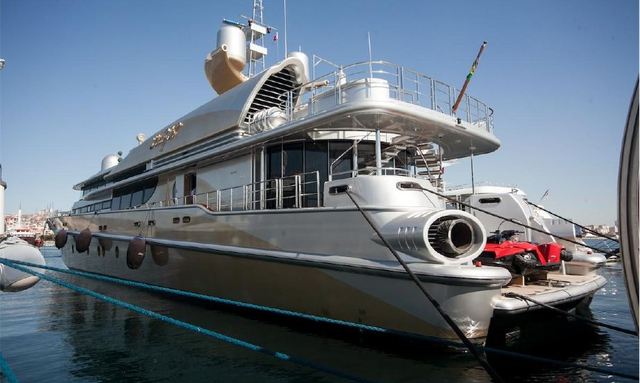
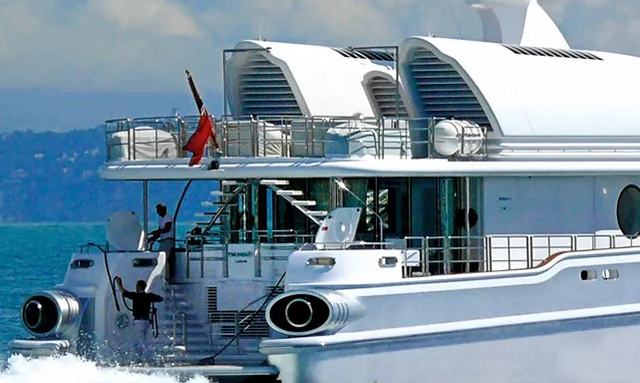
Thunder does not really fit the usual 50m (164ft) superyacht template. Jon Bannenberg kept her to two main decks, pulled the profile low and long, and then allowed the machinery to become part of the shape. The great scooped air intakes aft were there to feed the gas turbine, so instead of hiding them he turned them into some of the yacht's most recognisable features. Even now, with the turbine removed, they tell you immediately what sort of boat this was built to be.
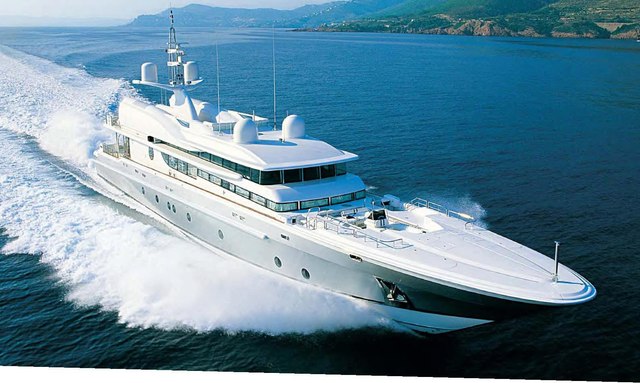
The hull itself has the lean look of a fast offshore boat rather than a heavy displacement yacht. A long raked bow runs into a remarkably clean foredeck, with the working gear hidden away in tailored lockers. Cleats, fairleads and windlasses are there, but they don't break up the deck, while the tender crane folds down to become part of the deck itself. That matters because Thunder's bow was never meant to look like a working foredeck covered in kit.
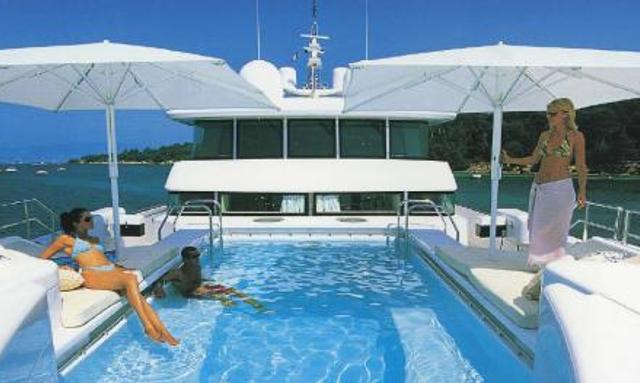
Then there is the pool. At 7m (23ft) long, it has counter-current jets so you can actually swim against the flow, but that is only half the idea. Drain it and the main tender drops into the same space, with jet skis stored nearby. The tender itself was shaped to fit the pool. It sounds faintly mad until you think about the problem it solves: Thunder gets a proper pool without losing a large chunk of deck to a tender bay.
Aft, the winter garden uses sliding glass panels so it can be enclosed when the weather turns or opened up when it doesn't. Above, the sun deck sits among those vast machinery intakes, with seating and sunpads tucked into one of the strangest upper-deck landscapes you'll find on a yacht of this size. At her original full speed, some of these areas were hardly places to wander around casually. The intake air and the yacht's own forward speed made sure of that.
The 2016 Roberto Cavalli refit added another layer to the exterior, including genuine silver and gold flake in parts of the paintwork. On another yacht that might feel like the headline. On Thunder, somehow, it is just another detail.
Interior Design
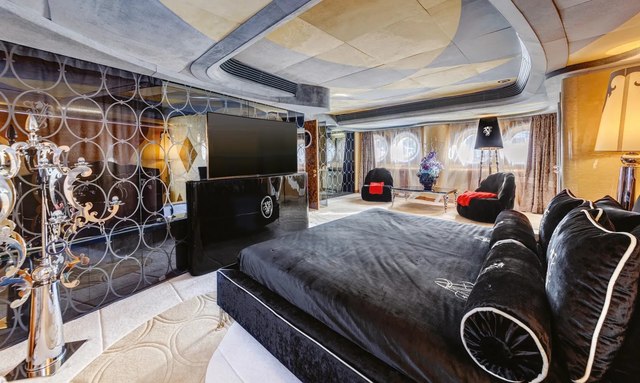
Thunder's interior has two very different authors, and you can still sense both of them. Bannenberg drew the original architecture and gave the yacht its unusual scale, while Roberto Cavalli stripped and rebuilt the interior in 2016 with a far richer and more theatrical finish.
The two-deck layout is what gives the interior its first surprise. A yacht this long would normally stack another full deck into the profile, but Thunder uses the lost deck height elsewhere. The main saloon has more than 2.7m (9ft) of headroom, and the central atrium opens up another great chunk of vertical space. You don't get the usual feeling of walking through a succession of fairly similar rooms. There is height here, curves, big changes of scale.
Bannenberg's original scheme was clever about weight as well as appearance. Much of the cabinetry was formed from honeycomb aluminium F-Board rather than solid timber, then curved and finished in metallic shades, lacquer and veneers. Dark walnut arches gave the saloon some weight visually, while the rest of the room stayed fairly clean. He disliked ceiling spotlights, so lighting came from nickel-plated reading lamps, wall lights and table lamps instead. Small thing, but it changes the mood of a room completely.
The Cavalli refit took that framework somewhere much bolder. Curved timber now rolls through the accommodation, art becomes part of the joinery, and Cavalli's emblem appears throughout the yacht. There is gold, silver, deep colour and a lot going on, but Thunder has the volume to carry it. A quieter interior might almost feel strange inside something this eccentric.
The aft dining room is another bit of old-school Bannenberg cleverness. Glass doors retract around the semicircular space so it can open onto the deck, and the circular dining table can disappear upwards into the ceiling. What is left underneath are two glass-topped coffee tables, so the dining room becomes a lounge without having to move furniture off somewhere else. It is mechanical, slightly theatrical and genuinely useful.
Accommodation
Thunder has six staterooms for up to 12 guests, although one is currently used as a gym and can be returned to guest use.
The owner's suite is full beam amidships on the lower deck. It is a big room, but the more interesting point is that it can grow further by taking in the adjoining admiral's cabin. That gives the owner the choice between keeping a sixth separate room or creating a much larger private suite.
The bathroom arrangement is unusual too. There is a main bathroom plus a separate shower room, while interior glazing and silk curtains allow light and views to move between spaces without giving up privacy when it is wanted. The Cavalli refit brought stronger timber work and art into these areas, but the underlying layout remains very much part of the original boat.
Forward, Thunder's twin cabins use end-to-end berths rather than putting the beds opposite one another across a narrow central aisle. It is such a simple idea. By running the beds along the cabin, Bannenberg freed up more usable floor space in the middle, while shelves, lockers and drawers beneath the berths deal with storage.
There are also double guest cabins and the convertible sixth room, so the layout can shift depending on how the yacht is being used. The cabin finishes carry the same curved timber and strong detailing found elsewhere rather than becoming quieter, anonymous sleeping spaces.
Thunder can carry up to 10 crew, with their accommodation kept apart from the main guest areas.
Performance & Capabilities
Thunder was built around twin MTU diesels and a centrally mounted gas turbine driving three KaMeWa waterjets. Two jets steered and the centre jet was fixed, giving a combined installation of roughly 10,500hp. The original brief called for a yacht around 50m (164ft) that could run at about 40 knots, which was a fairly outrageous request in the late 1990s and still sounds ambitious now.
The turbine came out during a 2021 refit to cut fuel use. It has been kept in storage, so in theory a future owner could put Thunder back much closer to her original mechanical form. That distinction matters. The yacht you see today no longer has the full turbine-assisted performance that created her reputation, but the hull, waterjet layout, intake architecture and light structure were all born from that brief.
And light really did matter. Oceanfast and SP Technologies used glass composite, carbon fibre and Kevlar through the structure, with foam-cored hull sides and composite longitudinal girders beneath. The aim was simple enough: save weight wherever possible without building something flimsy.
The ride-control system was equally serious kit. Thunder used a Maritime Dynamics system derived from military applications to keep the hull settled at speed, while her emergency steering could move rapidly from one side to the other. On a conventional cruising yacht that would sound excessive. On a yacht designed to charge along at speeds usually associated with much smaller boats, less so.
Her quoted fuel capacity is 70,500 litres, and the supplied figures give a range of up to 3,000 nautical miles at 18 knots. Thunder therefore combined serious passage speed with useful range, although the turbine-era figures came with the obvious price at the fuel dock. The YachtBuyer tour recorded consumption of around 2,750 litres per hour with the original high-power package running flat out.
Thunder Yacht is not For Sale
Motor yacht Thunder is not currently for sale. Explore all new & used yachts for sale globally powered by YachtBuyer’s Market Watch.
If you're the yacht owner, broker, or captain, please use the "Update Sales Info" link to report any changes to the sales information. Update Sales Info